Conservative congressmen take to the streets of D.C. to speak out against a rash of perceived injustices. A crowd listens intently before removing barricades surrounding Washington’s various monuments, carrying them to the White House gates. A group — almost all white men — carry signs that call for the impeachment of the President amidst a chaotic scene as police try to control rowdy protestors attempting to jump the gates of the White House itself.
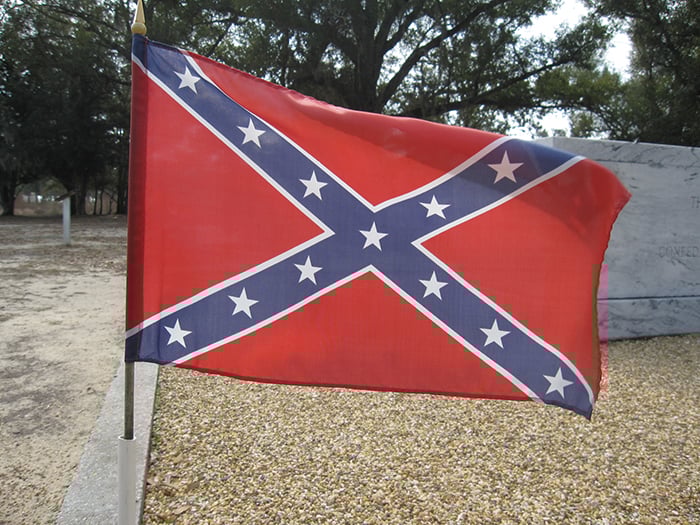
A plethora of flags are present, including the American flag, various Southern state flags, and the Gasden flag. One protestor prominently displays two flags: an average sized U.S. Marine Corps flag, and a significantly larger Confederate battle flag — the “Dixie” flag.
Can you guess the date of this scene? It didn’t take place on Sept. 4, 1957, after former President Dwight D. Eisenhower sent the National Guard to integrate Central High School in Little Rock, Ark., nor was it after former President Lyndon B. Johnson signed the Civil Rights Act of 1964 or the Voting Rights Act of 1965.
This scene occurred on Sunday, Oct. 13, 2013.
The presence of the large, unsheltered Confederate Battle flag was extremely disturbing. This flag represents violence, segregation and systems of oppression that are still deeply engrained in the minds of many. Sure, it was just one man with a flag, but nobody else associated with the protest spoke up about it. Nobody in those conservative circles do.
To be clear, I do not support legal restrictions against an individual’s right to display the Dixie flag. I highly value the First Amendment and it clearly protects the display of all symbols, no matter how offensive.
However, the right to do something and being morally right in doing something are different, and it isn’t morally right to publicly display a war symbol that embodies bigotry, hate and oppression.
The popular argument used to defend the Dixie flag is that it represents Southern culture. The problem is that it encompasses the worst parts of Southern culture. It isn’t symbolic of farm culture, two steppin’ or good ol’ Southern comfort food — things that come from the culture the Dixie flag oppressed.
The Dixie flag was first introduced as a battle flag in the bloodiest war in American history, on the side that defended one of the cruelest and most inhumane forms of slavery. While it became less prominent after the war, Mississippi incorporated it into its state flag in 1894, during the atrocious Jim Crow era.
However, it didn’t become the symbol it is today until the Supreme Court began desegregating the South in 1954. The Brown v. The Board of Education ruling decided that separate institutions were under no circumstances was equal. In reaction, Georgia incorporated the Dixie flag into its own state flag, where it remained until 2003. This led the symbol to become an icon not for mere “Southern pride,” but for the defense of segregation.
Earlier this week, two students at a Washington state high school wore the Dixie flag in reaction to a student who wore a GLBT rainbow flag to school. While it’s not a symbol that is associated with the anti-GLBT rights movement, it’s used to represent an 11 state South that fervently denies rights to GLBT people. The students said they wanted to show their “beliefs” by wearing the flag, not Southern pride.
Even if you do successfully water down the Dixie flag to mean Southern pride, it is still offensive to many. It is certainly not representative of black culture — a large minority in Southern states — nor is it representative of the many white Southerners who are ashamed of its history and connotations.
To an extent, I understand. When someone is culturally engrained in an idea or principle, it’s hard to let that go. But an upbringing or an ideology isn’t a free card to be blatantly insensitive to historically oppressed people or the rest of society. You have every right, but you aren’t morally right. So it’s time to leave a history of segregation, dehumanization and violence in the past, and leave the symbols of that past along with it.


