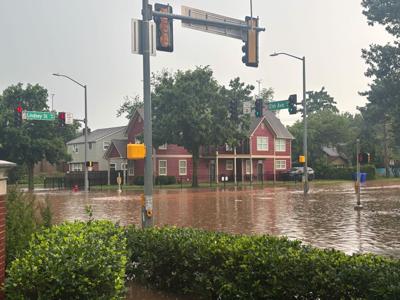

March brings the start of the storm season for Oklahoma, and being in the heart of tornado alley, the state sees more than 50 tornadoes a year on average.
Despite being located in the middle of tornado alley, Norman and surrounding areas have no public storm shelter.
Norman’s Emergency Management Coordinator David Grizzle said the city focuses on individual preparedness and awareness rather than building a public shelter.
“People need to understand that their safety is their responsibility, and they need to be aware of the situation that is coming,” Grizzle said.
According to Grizzle, it’s less safe for people to travel to a public shelter in the event of a storm than to shelter where they are.
“Then the problem is if you have a shelter, how do you determine who gets to go in or not?” Grizzle said. “There's no way to vet people that don't necessarily need to be around other people or children for various reasons in a public setting.”
Grizzles said another problem is residents bringing their pets into shelters.
“Most of the time, people will show up with every form of pet available. They'll show up with dogs, many dogs, or many cats or chickens or snakes, …” Grizzle said. “If one person has four or five dogs, the dogs can obviously take up the space of two or three people.”
Grizzle said people need to plan their shelter spaces ahead of time and know where they would go.
“If they are in a situation such as a mobile home or maybe an apartment complex and they don't feel comfortable, they need to seek other shelter whether that is through open locations, like Sooner Mall, or if they are a member of a church, many of the churches have shelters in them now,” Grizzle said. “If they absolutely have nowhere to go that they feel safe within the city limits of Norman, and I would recommend that they simply relocate out of the path of the storm.”
Zachary Lebo, an OU meteorology professor, said Norman doesn’t have shelters mostly because of the cost and the possibility that they wouldn’t be necessary.
According to Lebo, access to storm shelters should be a public service for the community.
“You can put them in, but they may never be used to actually save someone's life,” Lebo said. “If a strong tornado never crosses through — like if an EF5 never goes through Norman — then it wasn't really useful putting it in, and maybe that’s partially the thought process.”
Many Oklahoma homes lack basements due to shifting red clay and building codes not requiring homes to have their footing below the frost line — the maximum depth at which moisture in the soil freezes during winter — meaning many homeowners don’t have easily accessible shelter locations.
Meteorologist Craig Ceecee created a website called Find Your Tornado Shelter, three years ago to map shelters across tornado alley and help people locate their closest public shelter.
Ceecee has found hundreds of shelters in Oklahoma but no shelters in the Norman area. He said many factors contribute to the lack of public shelters, such as the large population.
“There's different challenges in a major metropolitan area versus in a rural area because you have traffic issues,” Ceecee said. “And you've got hundreds of thousands of people that you have to potentially manage and that requires a lot of coordination.”
Ceecee said the cost to make and maintain shelters for a large number of people also contributes to the lack of public shelters. According to Ceecee, shelters can cost up to millions of dollars in urban areas.
Finding a location with enough space for a large enough portion of the population is also a challenge, Ceecee said.
“You have to find the spaces to build them. Often they'd be in the outskirts, or wherever you can find enough land because each one would probably hold about 1,500-2,000 people,” Ceecee said. “Mind you, the entire city is not going to go to one.”
For those worried about finding shelter, Lebo said residents should identify the safest location in advance.
“Think about where that place would be if you're in a dorm or an apartment building. Those are a little bit more challenging, but your best place is to get to the lowest possible floor,” Lebo said. “I realize that's not always an option if you're on a second or third floor apartment. In that case, your best place would be an interior room, in a hallway or a closet."
For students, Lebo said there are safe spaces on campus to shelter.
“There are buildings on campus that are designated as tornado shelters, places that you students may want to seek out in advance where those are,” Lebo said. “If a tornado watch is issued, maybe that's a time to go to campus instead, and hang out in one of those buildings, do your homework there.”
Read more about OU’s on-campus severe weather refuge locations:

This story was edited by Madisson Cameron, Macey Thaxton and Natalie Armour. Ryan Little and Mary Ann Livingood copy edited this story.


