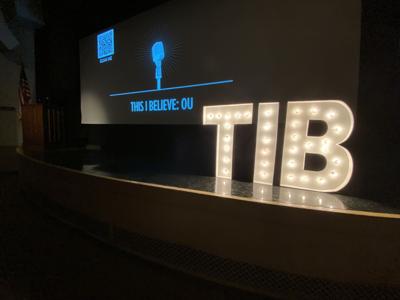

Eight OU community members presented personal essays during a speaking event Tuesday afternoon in the Oklahoma Memorial Union's Meacham Auditorium.
This I Believe: OU 2023 was hosted by First-Year Learning and Engagement in University College. It was originally created in partnership with OU's Institute for the Study of Human Flourishing and funded through a grant from the John Templeton Foundation. After the grant ended in 2018, OU continued to host the event to help first-year students understand the values of the university and develop the means for living well and thriving as college students and citizens, according to This I Believe: OU 2022.
At the event, This I Believe essays were shared by Caleb Kelly, Madison Williams, Jenny Sperling, Katie Hallum, Michael Drew, Mike Beckham, Jen Whitlock and John Banas.
Kelly, the director of Serving Our Uncommon Legacy Mission Center and Player Development and former OU football team captain, shared his essay about the power of knowing oneself and choosing how to react to situations.
"This I believe: keep a mirror on you," Kelly began.
A mirror can humble a person or help them to be confident, but it can also remind them of who they are and what they represent, he said.
The most dangerous part about life is that fear often overtakes freedom, Kelly said. Every person will have problems in their life. It's how they react and the decisions they choose that makes the difference.
"No lousy choice has to be followed up with another bad choice,” he said. “Therefore, this I believe: Excuses are a waste of breath. Fear only exists where you allow it to."
Though he said math was never his best subject, Kelly presented the audience with an equation: e + R/X = O.
"A little event plus a response divided by the amount of excuses you give to not complete that task equals your outcome," Kelly said.
When a problem arises during the day, that is an event, and a person can choose to react either negatively or positively to it, Kelly said. By holding up a mirror to oneself and the events in their life, they can see more clearly and can choose how to react, leading to their desired outcome.
"Therefore, this I believe: Keep a mirror so that you may always know who's staring at the glass, and you can make sure you're always doing right by that person,” Kelly said. “And finally, give yourself that self awareness to get rid of fear and excuses. That's earning your desired outcome until the next little event presents itself again."
Williams, a political science freshman, presented her essay: "Life's Luxury or Systemic Excellence."
Williams’s essay focused on the excitement of learning something new when she was a child, and how, as she has grown older, that excitement has been replaced by the desire to obtain a certain test score.
This shift, Williams said, is not only because of the complexity of the content learned, but also the emphasis on grades and scores.
"The desire to acquire an A on an assignment undermines our ability to learn something that should stay with us for years," she said.
Williams said she once had a teacher who told her, "Knowledge is the only thing a person can't take away," but she has realized as she's gotten older that a point system can.
Williams said she realized education isn't just a class over textbooks, but it is experiences, learning, storytelling and communication. She said she never wants to lose sight of why she volunteers to learn.
"I believe knowledge is one of life's luxuries, not the result of systemic excellence," Williams said.
Sperling, an assistant professor of critical studies in education in the OU department of educational leadership and policy studies, spoke about the limitless possibilities of queer friendships.
Sperling said she experiences others' emotions like water flowing through her, sometimes raging and other times a calm ripple. She said queer friendships are similar.
"The fluidity and infinite possibilities of water-like feelings is how I've come to recognize what I believe to be queer friendships or queer relationships," Sperling said. "Like water structures form, queer friendships are often the magical, intimate moments shared over laughter, grief, joy, sadness and fear."
Sperling said she often struggles to cope with all the feelings around her and that her mother once told her to stop carrying the world's emotions.
Sperling disagreed.
"I carry them because so many before me have carried them to battle with them, laughed and smiled with them,” she said. “So many before me have laid the foundations for queer relationships and friendships to exist and to grow."
Sperling said she believes queer friendships have transformed the world.
"(They) allow us to stay dreaming, remind us to be creative and imagine intimacies yet to be explored, felt and inspired by," Sperling said.
Hallum, a journalism and international studies junior and former OU Daily news reporter, presented her essay: "The Silver Lining."
When Hallum was 19, she was diagnosed with a terminal illness and told she would need a kidney transplant. Hallum said she had always been independent, but everything changed in that moment.
"I couldn't walk, bathe, eat, sleep or do anything without assistance. I lost my hair, my weight, and I started to cognitively decline,” Hallum said. “I lost my independence, and more importantly, I lost my will to live."
One day, she said her doctor grabbed her shoulders and told her she would never get better because she wasn't allowing herself to. After that, Hallum's perspective changed. She said any time she would feel despair because of her situation, she would remind herself of how far she'd come.
"The silver lining to all of this is that I'd gone through the worst things to happen to a person,” Hallum said. “My dreams and my mind was ripped away from me. But since, I've experienced the unimaginable and survived. I am unstoppable. If I lived through a death sentence. I am untouchable. We cannot change what's happened to us. That is a tragedy, but we can change how we relate to it."
This story was edited by Alexia Aston, Jazz Wolfe and Karoline Leonard. Francisco Gutierrez copy edited this story.


