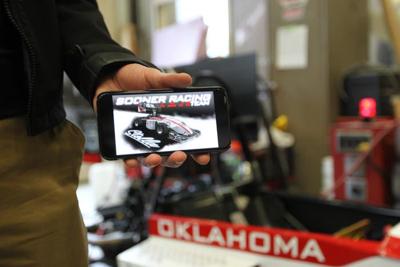
The Sooner Racing Team is gearing up for its annual international competition where they race a car the team members coded, designed, tested and built.
The team, made up of about 20 OU undergraduate students, plans to travel to Lincoln, Nebraska, on June 18 to compete in the Formula SAE competition with other teams from around the world, team member Jack Sartin said.
Sartin, a mechanical engineering fifth-year, said Formula SAE is a student organization run by the Society of Automotive Engineers consisting of 550 teams worldwide with 14 competitions on five continents.
“Formula SAE is sort of a weird class because they’re bigger and faster than any go-kart you’re ever going to get; it’s very small, very agile,” Sartin said. “It’s like driving a go-kart if the go-kart went twice as fast, drove twice as hard, you know just throwing you around corners."
The Sooner Racing Team begins working on the car about two weeks after the previous competition and works for a full year designing the car to perfection before the next competition. The members learn from their previous car's mistakes. said Sean McLain, an electrical engineering sophomore.
“We want a reliable car; we suffered a little bit with that last year, so we really worked out the kinks of the last year’s car,” McLain said. “Once we get everything slapped on the car and do a lot of testing on it, I think it’ll be significantly faster than our old one.”
In the 2018 competition, the team placed 21st, but is hoping for better this year, said team captain Ryan Cowdrey, a mechanical engineering senior.
“Historically we were at one point No. 1 in the U.S., in like 2011, and we were like No. 4 in the world,” Cowdrey said. “So this year, top 10 is definitely achievable, hopefully top five, would be big for us, that’s kind of our goal.”
The competition consists of two halves; dynamic events and static events. The dynamic events consist of five driving events. The static half consists of three events: a cost event in which they have to cost out every single component on the car, a design event in which they have to validate the car in front of a panel of judges and lastly a business presentation, Sartin said.
“With racing you never want to make guarantees because it’s one of those things where you sort of have to be perfect for four days,” Sartin said. “Sometimes you just get unlucky, but I think she’s going to be a really strong, really fast car.”
Every year, the team names its car. Last year’s was Stella, this year’s is April.
“We’ve taken a lot of the lessons we’ve learned from her and applied them to April,” Sartin said. “We really have only improved across the board, the engine’s gotten faster, the suspensions have gotten faster, the aerodynamics have gotten a little bit more streamlined.”
Although Cowdrey said the last few years have been rough, they are feeling confident in April and are hoping for a comeback.
“We are competing against teams from Stuttgart, Germany ... they get to go test their car in Porsche’s wind tunnel,” Sartin said. “They get engine building help from Mercedes, and we are a team from Oklahoma who has a little bit of oil money every once in a while … and so we have always really had to punch above our weight.”
Sartin estimates that each car has 2,550 individually-designed components, which are divided between about 15 to 20 team members.
McLain says he spent two months just working on the steering wheel for the car, making 20 different prototypes before finding the right fit and model for the steering wheel.
The team welcomes students from all backgrounds and majors, as there are many different skills that go into making and presenting the car, Cowdrey said.
“We would like to have other people who are good at business and that kind of thing, that’s a big part of what we do,” Cowdrey said. “Pretty much no one comes in knowing anything about building cars or engineering at all; a lot of people join as freshmen, and we teach them everything they need to know.”
Sartin, Cowdrey and McLain all joined the team during their freshman year and are working on the car “more often than they’re not,” Sartin said. Sartin said his dedication and extensive time spent working on the cars has hindered his education, and is the reason he is taking a fifth year.
“This team is very demanding, we expect you to come in and work well beyond your years,” Sartin said. “We’re doing some of the most advanced machining at the university, we’re laying up the largest composites of anyone at the university, we’re doing some of the most advanced analysis of anyone at the university, and we’re undergrads.”
The Sooner Racing Team has produced a number of successful alumni, with former members at Google, SpaceX, Tesla, Honda R&D Americas, Microsoft and Red Bull Formula One, Sartin said.
“We really pride ourselves on being sort of a small group of people but really an elite group of engineers,” Sartin said.


