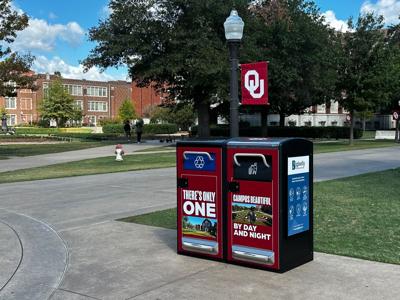

OU installed three new solar-powered waste stations on campus this month as part of a pilot program funded by a one-time grant from the Oklahoma Department of Environmental Quality's Solid Waste Management Act grant program.
The grant to OU’s Facilities Management department totaled $23,227 and the overall cost of the three stations was $16,440, according to an OU spokesperson.
The Bigbelly Smart Max waste and recycling stations hold five times more waste than traditional bins, with a total capacity of 150 gallons, according to a statement from the university. The stations include a waste bin and a recycling bin as well as a compactor and sensors that report fullness level, collection activity, bin status and GPS location.
The waste stations are located across campus with one on the southeast corner of Asp Avenue and Felgar Street, the South Oval outside of Richards Hall and the South Oval outside Dale Hall.
Sarah Ballew, OU Energy and Sustainability director, wrote in the statement the primary goal of any recycling program is to stop more waste from reaching a landfill.
“These new stations immediately increase the visibility of our program due to their size and customized wrap design,” Ballew wrote. “We are optimistic that this will lead to higher collection volumes and lower rates of contamination.”
The stations are entirely solar-powered and send automated, real-time collection notifications to the university’s recycling team. According to the statement, this means more labor hours can be pivoted to sorting collected materials or other recycling tasks.
Ballew wrote in the statement these stations are only one aspect of a larger project to review the locations and number of OU’s exterior waste and recycling bins.
“By strategically reducing total bins on campus to where only necessary, the department will reduce the number of plastic liners used, reduce fuel consumption to service the bins and reduce daily labor hours,” Ballew wrote.
This story was edited by Alexia Aston and Karoline Leonard. Mary Ann Livingood copy edited this story.


