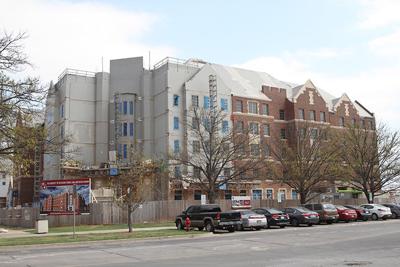

While OU's Dunham and Headington Residential Colleges — scheduled to open fall 2017 — must abide by some rules required of all university-owned housing, students will use a system of self-governance to decide their own policies — including those surrounding alcohol.
The two colleges will serve as upperclassmen housing modeled after similar residences at Yale University. Its policies will allow students of legal drinking age to decide if they want to have alcohol in their rooms, said Keith Gaddie, Senior Fellow of Headington College.
“This is a space that’s made for people to be adults,” Gaddie said. “And that doesn’t mean stuffy or conservative, that means we are trusting in people to use judgment and govern themselves.”
The residential colleges will incorporate faculty mentorship, classes, social events and self-governance into the living experience, Gaddie said.
“Far from being just a place where you sleep and leave your stuff, it is a place where you dine together, where you learn together, you socialize together,” Gaddie said. “It has cultural, academic and social programming built-in.”
Each residential college has 12 faculty fellows who will teach one-hour seminars every semester for residents and act as mentors by engaging with students in the informal environment of the living spaces. Some faculty will have offices on the first floor of the colleges, Gaddie said.
“Their job is to create relationships and do the kind of soft teaching in the hallway that’s really at the heart of the good liberal arts education,” Gaddie said.
Gaddie said the colleges will each have four "resident mentors," or student leaders living in each hall whose role is similar to that of the resident advisers in the other on-campus residential halls. In addition, each college will have four graduate tutors living in the halls who will play a similar leadership role and offer tutoring services.
Holly Crawford, international business and entrepreneurship junior, will serve as a resident mentor in Dunham College and said she will help act as a support system for the residents by planning activities and promoting community building.
Crawford said she wanted to apply for the position because of her positive experience living on campus as a freshman.
“Living in the dorms was the best experience I could have asked for, where I met my closest friends, and something I know I’ll always look back on and just have really, really fond memories from,” Crawford said. “So the chance to get to move back to campus and having the chance to set up community, hopefully kind of like what I had freshman year but for upperclassmen, is just an incredible opportunity that I couldn’t pass up.”
Applications to live in the residential colleges are currently open. Gaddie said there are no special requirements, but he hopes the colleges will attract a diverse group of students who want to build a new culture.
“This is a place for the kind of student who wants to be engaged in campus life,” Gaddie said. “So if you’re the kind of person who engages with programming on campus, engages with life on campus, and you don’t want to have to drive all the time, this is exactly where you ought to be.”
Each college has the capacity to house 311 students, but Gaddie said he expects it will take several years for the space to be completely filled.
“It takes three to four years to fully stand something like this up and have demand to exceed capacity, because it takes that long to establish the culture,” Gaddie said. “If we’re at 65 percent, that’s a win, because we’ve hit a critical mass, we’ve got good numbers, and the revenue model looks good.”
Mark Morvant, Senior Fellow of Dunham College, said the concept of a residential college is difficult to explain and understand because it is rare and new to OU, so there is a general lack of prior experience.
“After we go through one year, everybody will go, ‘Oh, that’s what a residential college is,’” Morvant said.
The social programming will be largely left up to the student residents after they move in, which also makes it difficult to predict exactly what it will look like, Morvant said.
“We can’t show you what’s going to be there because we’re waiting for the students to develop it,” Morvant said. “What we’re trying to get is to get students who are kind of visionary and want to be part of building something to jump on board.”
Gaddie said the residential college model offers the basic framework for growth, but the residents will give it life.
“We’ve got a basic framework here ... and we have people,” Gaddie said. “And they’re going to make something — we don’t know what it’s going to be, but I tell you what, if this sticks, and I think it will, I think it’ll be special. I really do.”
Gaddie said the university is considering using the residential college model in future housing developments.
“Moving forward into the future, hopefully we can find additional donors, additional support, and construct additional residential colleges,” Gaddie said. “We can imagine a future where the freshman experience is based more upon a commons model, with a new freshman campus that looks more like this and feels more like this.”
For more information about the residential colleges, visit their website.


