


Updated story: Tulsa couple ties knot after decade of waiting
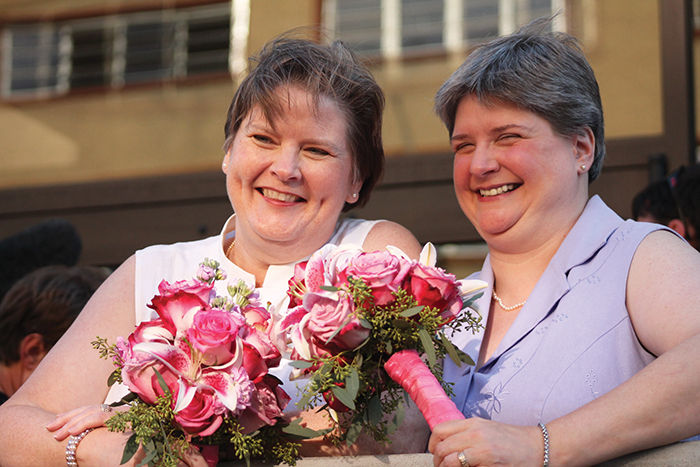
Thirty minutes after noon on Monday, Sharon Baldwin and Mary Bishop were preparing to visit the Tulsa County Courthouse and leave with a marriage license — something they’d been fighting to do for over a decade.
The 10th U.S. Circuit of Appeals lifted its stay on same-sex marriage a little before noon Monday, shortly after the U.S. Supreme Court denied appeals from five states — including Oklahoma — that would prohibit same-sex marriages. Since the federal appeals court lifted the stay, Oklahoma same-sex couples, like Baldwin and Bishop, should be able to get marriage licenses today.
Baldwin, a class of 1992 OU alumna, and Bishop, alongside Gay Phillips and Susan Barton, began their lawsuit against Oklahoma in November 2004. In January, federal district Judge Terence Kern ruled Oklahoma’s ban on same-sex marriage unconstitutional, but the ruling had been stayed — meaning Oklahoma couples couldn’t get married — pending ruling from a higher court.
Baldwin said although she knew the U.S. Supreme Court would deny cases today, she had no idea her case would be among those denied.
Baldwin’s tentative schedule for today looks something like this:
• Get a marriage license from the courthouse
• Attend a press conference at Tulsa’s Equality Center
• Get married soon after that.
“We’re still not positive about that part yet,” Baldwin said.
Although Baldwin said she may have “uttered an expletive” when she heard the U.S. Supreme Court had denied her case, and she is excited to receive her marriage license, Baldwin said she thinks the U.S. Supreme Court made the wrong decision in not hearing her case.
“It’s not what we expected. You have to keep in mind that our joy about being married is mixed in with a little bit of concern because we don’t think the Supreme Court did the right thing.”
Baldwin said her main concern on the court's decision to not rule on her case is that there isn't a cohesive ruling on same-sex marriage throughout the country, meaning other states won't be required to honor her Oklahoma marriage once's she married.
"So, we cross the border into Missouri, we’re suddenly not married, and that’s just not good," Baldwin said. "That’s not good for anybody."
Of the six states currently border Oklahoma — Colorado, New Mexico, Kansas, Arkansas, Missouri and Texas — only three recognize same-sex marriage. Those states are Colorado, New Mexico and Kansas.
The U.S. Supreme Court didn’t comment on why they won’t hear the cases, the Associated Press reports. The decision to not hear the cases means same-sex marriage is now legal in 30 states, the Associated Press reports.
Baldwin, Bishop, Phillips, Barton and members of their legal team visited OU Friday to discuss their case.
Baldwin said the event had a good turnout and students’ questions and responses were indicative of society’s changing attitudes toward same-sex marriage.
“You know, the attitude from 2004 has really shifted. Public sentiment is just so far ahead of where it was a decade ago, and we see that in everything from comments on news stories, to just people’s reactions to us,” Baldwin said. “It’s light years different.”


