

WASHINGTON — When Congress is in recess, many may assume reporters focused on Congress have time to relax.
That is not true.
In fact, I’ve come to find it is the opposite.
When Congress works on Capitol Hill, a reporter’s job — from my short time in Washington — is significantly easier than when members of Congress are back in their districts.
When they’re in town, there is a constant flow of new stories. There are gatekeepers, but it’s easier to get around them. Sources — in this case, members of Congress — are easily accessible if you know where and when to find them.
However, when Congress is in recess, you have to get creative. You have to hunt down new and obscure sources and find unique stories.
Of course, there are times when stories more or less fall into your lap. That is what happened to me in early October. I thought the stories would be relatively easy, but I was mistaken.
I covered the oral arguments for two different cases: Garland v. VanDerStok and Glossip v. Oklahoma. This resulted in writing two “advances” and two recaps.
Garland v. VanDerStok deals with a dispute about the regulation of weapon parts kits, or ghost guns. Glossip v. Oklahoma deals with Richard Glossip’s petition for a new trial after reports of errors during his original trial.
When writing the advances, I spent hours reading court documents, amicus curiae briefs — meaning friend-of-the-court briefs — and articles written by court reporters with far more experience and expertise than I. While I have a deep love for and interest in such research, it was the least exciting part of my reporting. Shocking, I know. Who wouldn’t consider reading legalese for hours on end the most exciting part of a project?

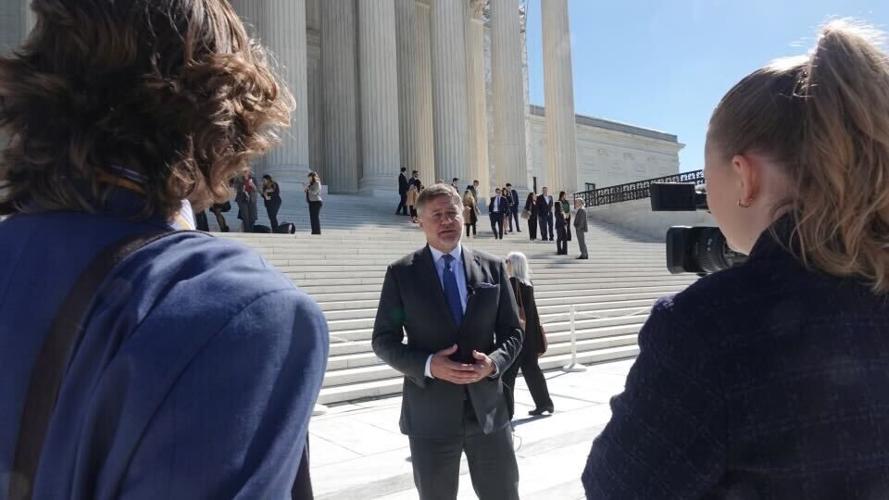
Kevin Eagleson and Victoria Anderson interviewing Oklahoma Attorney General Gentner Drummond.
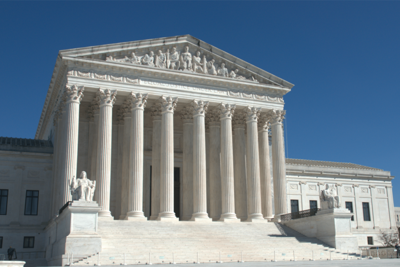
Despite the excitement of the research, it was not on par with the exhilaration of sitting in the U.S. Supreme Court, the halls where history has been made.
I had more or less gotten past my imposter syndrome from the beginning of my time on Capitol Hill, but I was indescribably nervous upon arriving at the Supreme Court on Oct. 8.
I knew I was going into the courtroom where complete silence was not a request but a demand, and where arguments I did not comprehend would be hashed out.
As I made my way to the public information office to pick up my day pass and prepare, I broke my glass water bottle. I had shoddily secured it into my backpack. In my haste, it fell from the bag and shattered. The sound was out of place as it echoed in the quiet courthouse.
It was a great way to start a day already filled with nerves.
The first case, Garland v. VanDerStok — in which the court heard arguments on ghost gun regulations — was far less consequential than the second case I covered: Glossip v. Oklahoma.
In Glossip v. Oklahoma, the arguments made will inevitably affect whether or not Oklahoma executes a man that Oklahoma Attorney General Gentner Drummond himself does not think deserves to die at the hands of the state.
Due to the nature of Glossip v. Oklahoma, the media coverage was much more in-depth and voluminous. During the first case I covered, I managed to secure a seat in the press area of the courtroom where Supreme Court Justice Ketanji Brown Jackson was directly in my sight.
During Glossip v. Oklahoma, I was relegated to the back bench where my visibility was limited to the spectators in the courtroom.
After the arguments in the Glossip case, multiple people hosted press conferences outside the court. This did not happen after the arguments in Garland v. VanDerStok. There was an implied significance surrounding the Glossip case that was not present before.
Aside from the pressure caused by the increased media presence, making sure I understood the arguments as much as possible was the only thing on my mind.
Other than having to do an hour or two of research afterward to understand the procedural arguments in the case, I believe I did an all right job.
Now that October is coming to a close with a historic election — in which the nation will decide between the nation’s first woman president or the nation’s first convicted felon president — less than a week away, with the remainder of the 118th Congress riding on the coattails of the election, I’ll be returning to Capitol Hill where I’ll trade legalese for obscure policy verbiage.
I don’t expect November to be any easier than the past two months, but perhaps the foothold and experience I’ve gained will come in handy.
Kevin Eagleson is reporting from Gaylord News’ Washington bureau this fall as part of an OU Daily scholarship.
Gaylord News is a reporting project of the University of Oklahoma Gaylord College of Journalism and Mass Communication. For more stories by Gaylord News go to GaylordNews.net
This story was edited by Anusha Fathepure, Ana Barboza and Ismael Lele. Grace Rhodes and Mary Ann Livingood copy edited this story.


