

In the past two years, the COVID-19 pandemic devastated the U.S. with a death toll of about 1 million, leaving behind mothers, fathers, children and friends. Despite the rapid approval of vaccinations, these individuals who were exposed or even contracted the virus were left wondering “why me?” as they navigated loss and recovery.
Russell Rooms, a nurse practitioner, said this survivor’s guilt isn’t new or specific to COVID-19 as he enters his fourth year treating individuals who are living with or have newly contracted HIV. While the COVID-19 pandemic raged on, so did the HIV epidemic — a virus that took the lives of millions of people seven years before the first drug was approved by the FDA.
Forty years after the virus was recognized by the CDC, Rooms said the survivor’s guilt is still present among older HIV-positive people he treats in Oklahoma.
“We have the drugs that we have today standing on the graves of millions of people, a lot of which were gay men,” Rooms said. “When younger people today say ‘Oh I can just take a pill, and I'll be fine,’ there's a resentment to that by people who had to live through four-pill regimens that made them sick, and through the deaths of their friends around them and going to funerals every week to people that were a part of their community part of their culture.”

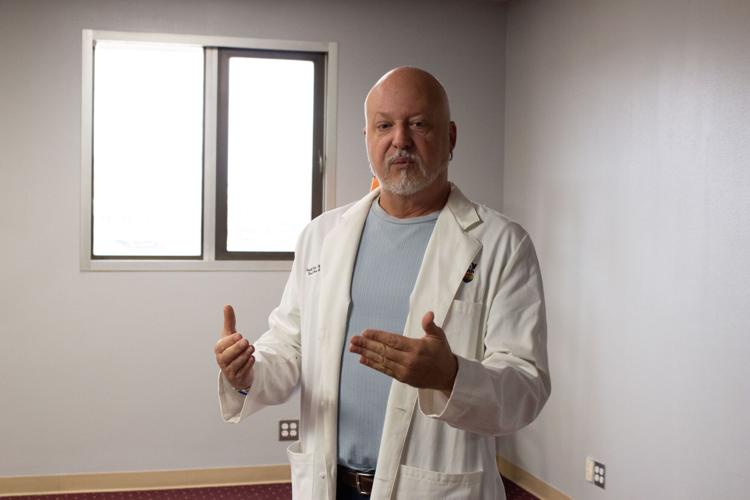
Nurse practitioner Russell Rooms during an interview at the Diversity Family Health Clinic.
Such local pushes have built concerted national efforts to address the ongoing epidemic, as former President Donald Trump took the House speaker’s rostrum during his State of the Union address three years ago and pledged to end the HIV epidemic by 2030, despite raised eyebrows from researchers and expressions of distrust from advocates. The plan sought to target populations with high infection rates to reduce transmissions, as the HIV epidemic persisted with case numbers leveling off in 2013 at an average of 39,000 per year.
President Joseph Biden renewed his commitment to confront the HIV/AIDS epidemic “at home and around the world” on World AIDS Day 2021, noting that the COVID-19 pandemic impacted every aspect of the HIV response. It likely increased HIV transmission rates and negatively impacted treatment, as limited testing services for HIV during the suspension of non-emergent clinical services will result in a backlog of undiagnosed cases.
It also encouraged mRNA vaccination research to combat COVID-19, which, as of early March, is being applied to prevent and end HIV through clinical trials for three mRNA HIV vaccines.
Despite the advancement of treatment for HIV, Oklahomans like Rooms said at-risk and HIV-positive individuals still exist and require services. To meet this crisis, Oklahomans are using education, affirming care and destigmatization to help the — as of 2019, the most recent year for which data is available — 6,351 people living with HIV in the state as they meet the unique challenges of a high rural burden and uncomprehensive, abstinence-based sex education.
No longer a death sentence
Michelle Lewis has known some of her HIV-positive patients for 20 years.
Lewis, now a clinical associate professor with the OU College of Medicine, was once a College of Pharmacy student who spent time in the OUHSC Infectious Diseases Institute. The campus began caring for individuals living with HIV in October 1996 through Ryan White HIV/AIDS Program funding, which helps low-income people with HIV.
The clinic’s inception began with fewer than 400 patients and came around the time medical professionals were treating HIV-positive people with a three-drug regimen of saquinavir, zalcitabine and zidovudine, Lewis said. The regimen resulted in complicated, hour-long consultations, where Lewis and her patients would map out their days to ensure they took the right medicine at the right time. Patients would take medications anywhere from three to six times per day.
Now, Lewis said the institute serves about 2,000 people living with HIV and has pared the consultation process down to just 10 minutes with single-tablet, once-a-day treatment regimens that can be maintained during a set time of the day with little to no side effects. By decreasing a patient’s viral load — the amount of virus that circulates the bloodstream — to 200 copies per milliliter of blood, HIV becomes undetectable and unlikely to be transmissible by a patient.
What was once a death sentence is now a manageable chronic infection that is easier to treat than conditions like diabetes and hypertension, Lewis said.
“There's really not much about having HIV that should limit what you do with your life,” Lewis said. “We have women with HIV that have babies all the time and safely have babies who are not infected with HIV. We have men with HIV who continue to have families with their non-HIV partners. From a work standpoint, there's really not much that you can't do.”
Prevention services extend to the OU Norman campus, which offers primary care through HIV testing and filling pre-exposure prophylaxis (PrEP) and post-exposure prophylaxis (PEP) prescriptions in the Goddard Pharmacy. If an HIV-negative individual is exposed, PrEP can reduce their risk of getting HIV from sex by over 90 percent, according to the Oklahoma City County Health Department. PEP is an effective treatment used to prevent HIV within 72 hours of possible exposure to the virus.
Health Education Coordinator Katie Qualls Fay wrote in an email that OU Health Services provides care for HIV-positive patients as it would for other patients with chronic diseases. This sometimes involves monitoring statuses, refilling prescriptions and ordering routine testing.
Patients with an HIV diagnosis are referred to a specialist for care and treatment, Fay wrote. Newly diagnosed HIV patients are referred to an infectious disease specialist.
OU Health Services has also partnered with the HIV Prevention and Education Co-Op — a cooperative made of community-based organizations in the Oklahoma City metro that can provide testing, counseling, referrals, prescription information and support — since 2019 to provide free HIV testing on campus the week before Valentine’s Day, Fay wrote. This year, they tested 55 people and invited the Gender + Equality Center to partner to promote healthy relationships.
Fay hesitates to estimate the need at the university level, as not all people in the campus community with HIV may seek care and treatment through OU Health Services. She wrote that the number of patients they see does not accurately represent the number of patients on campus with an HIV diagnosis.
In terms of prevention, testing and counseling, Fay wrote that their staff is capable and well-resourced. Currently, she wrote that OU Health Services doesn’t envision using students for peer-to-peer HIV testing or counseling because they have a comprehensive medical staff and laboratory that can test and prescribe.
“We believe that our peer health educators are best utilized to educate, refer, promote testing and work to eliminate stigma regarding HIV,” Fay wrote.
In Oklahoma, about 220 people from 13- to 24-years-old are living with HIV, and the age group makes up one-fourth of the 320 documented new HIV diagnoses in 2019, according to AIDSVu, a public resource visualizing HIV surveillance data and other population-based information. Lewis said she has newly diagnosed 18-year-olds in her clinic and newly diagnosed 15-year-olds in her adolescent clinics.
Although the virus is becoming increasingly easier to treat, Lewis said the biggest barrier to HIV eradication is found in social stigma and lacking health equity.

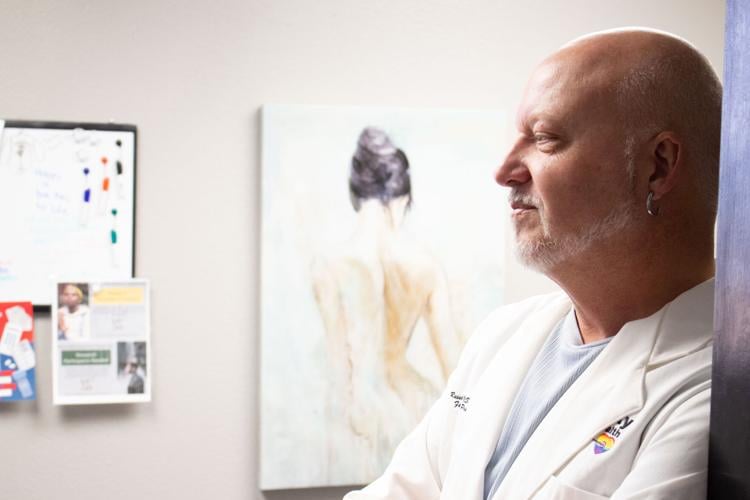
Nurse practitioner Russell Rooms during an interview at the Diversity Family Health Clinic.
Breaking stigma and providing
personalized care
Just off North Shartel Avenue sits the tallest building in Midtown Oklahoma City, and Rooms is settled in Suite 606. The entrance to his office is labeled with a “bat cave” door sign, and his walls are covered with Batman decor, pictures of Disney princes and a calendar of “dragtivists,” or drag queens whose activism goes hand in hand with their performance art.
It’s not your typical nurse practitioner office, but Rooms has called it and the surrounding Diversity Family Health Clinic home for two and a half years.
The clinic began four years ago in a single room when Rooms was working full time at OU as an advanced practice nurse. He recognized a need in the 2SLGBTQ+ community for healthcare, as individuals, especially those who are trans, experience difficulties accessing providers who are knowledgeable about and accepting of their needs.
Rooms spent evenings and weekends when he wasn’t caring for his two sons growing the clinic and covered all its services, including labs, exams and filling prescriptions. He said appointments were full three weeks after the clinic opened. He ultimately transitioned from taking paid time off to working part-time to leaving OU for a full-time position at Diversity Family Health Clinic when it moved to Suite 606.
Rooms is now accompanied by three nurse practitioners, and the clinic is open from 9 a.m. to 5 p.m., Monday through Friday. Although the clinic doesn’t do much advertising beyond supporting events like Pride or working through the HIV Prevention and Education Co-Op, he said the clinic typically serves 32 patients a day.
“It was just patients who needed the care, and so it just kind of organically grew. … You tell one gay person, and they tell the rest of their friends,” Rooms said.
The clinic also began providing PrEP and PEP as nonprofits like Guiding Right Oklahoma and RAIN Oklahoma would get positive tests and experience three-month wait times to get people appointments with the Infectious Disease Institute. Rooms said HIV treatments are so good now that organizations don’t always need a fellowship in infectious disease to care for patients, but they still partner with the institute and other specialists.
Although some no longer view HIV as a medical emergency, Rooms said it is a psychological emergency, which is why the clinic works to see people as quickly as possible. As patients enter with concerns about who they have to tell and how the virus will affect them, Rooms said he and his other employees work to educate them.
“I tell my patients and tell everybody else I'd rather have sex with a guy who's positive and undetectable than I would with somebody who doesn't know their status because that person could possibly give me HIV. The person who's undetectable cannot when they know their status, and they're on treatment and they're doing good. So, that's the way we reduce the stigma,” Rooms said.
Oklahoma is a difficult environment for stigma, Lewis said. The CDC notes in one of its issue briefs that Southern states bear the highest burden of HIV, accounting for 52 percent of new HIV diagnoses. Cultural factors may play a key role in driving the southern HIV epidemic.
The stigmatization of HIV is pervasive in the South, according to the CDC, and often focuses on sexual orientation, substance abuse, poverty and sex work. Stigmas have also been associated with limiting an individual’s willingness to disclose their HIV status and seek care.
While HIV infection rates are disproportionately higher among members of the 2SLGBTQ+ community, it is not confined to the 2SLGBTQ+ individuals, according to the Human Rights Campaign. From 2015 to 2019, new infections among young gay and bisexual men dropped 33 percent in the U.S., while Black and Hispanic communities continue to be disproportionately affected.

The CDC recommends that everyone between the ages of 13 and 64 gets tested for HIV at least once as part of routine healthcare. Yet, stigmas that characterize the virus as affecting only certain populations and judgmental peers cause some individuals to avoid testing and treatment.
“We have patients who don't want to come to our clinic for care because our clinic is known as being an HIV clinic. So just coming in the building labels you in some way, and that's not completely true, as my clinic is actually an infectious diseases clinic, as we see all kinds of infectious diseases. … But the majority of my patients are HIV positive, and people among the community know that,” Lewis said. “So people don't want to come get care because of that. They don't want to come and get care because they're afraid they'll see somebody that they know in the waiting room.”
Stigma has also been associated with lower or delayed access to care due to perceived discrimination from healthcare providers, according to the CDC. The Diversity Family Health Clinic works to make the 2SLGBTQ+ community feel safe and heard as they seek out services by leaving discrimination and bias at the door.
“A person can walk in and they know the receptionist is going to be affirming and is going to be accepting and the medical assistants and everybody they encounter as opposed to … a waiting room full of people that may, when they walk in and they look transgender, are going to give them the stink eye or they're gonna feel it regardless of what anybody does in that waiting room,” Rooms said.
As the case management supervisor for RAIN Oklahoma, Kathy Ackerman said the key to personal care is a coordination of services.
Case managers work to build relationships with people living with HIV and focus on linking them to healthcare, psychosocial and other services. As a management supervisor, Ackerman assigns HIV-positive individuals to case managers, handles referrals for dental and transportation services, ensures billing is working and connects individuals to fresh groceries, all while handling a small personal caseload.
RAIN Oklahoma is funded by part B of the Ryan White HIV/AIDS Program, which covers core medical and support services for lower-income individuals as the payer of last resort. This means funding can be accessed once all other available public and private funding sources have been exhausted. The nonprofit currently has a caseload of about 80 HIV-positive individuals, Ackerman said.
Often, Ackerman said case managers are making contact with clients to ensure they maintain connections to services. She said, however, that her job title often becomes muddled in relationships with clients, as they seek mental support in the relationship.
Client retention is maintained by a “personal touch,” Ackerman said.
“There was a gentleman that moved in from another country … that said ‘Wow, this is such a personal touch. For the last 20 years, I got my medicine, no problem, but there's a personal touch here, and he said this is gonna take me a second to get used to.’ … There's a lot of people that need to access mental health resources (and) substance abuse services, but it's just sometimes the turnover rate,” Ackerman said. “It's the 'you're in and out in and out. I have X amount of time with you, you got to go, I have X amount of time with you, and you got to go.' I think that (if) the clients feel there's not a personal connection, then they drop out.”
Individuals can shed self-stigma once they see themselves beyond their diagnosis, and Ackerman said organizations like RAIN Oklahoma are there to help HIV-positive people keep their chins up.

A sign inside the Diversity Family Health Clinic.
‘Knowledge is power’
Although vaccine trials for mRNA HIV vaccines are underway, Lewis said her enthusiasm is reserved, as it has taken about 25 years to make the strides researchers are taking. In the meantime, Lewis said the best way to combat the crisis is through education.
Jill Coleman, the Instructional Coordinator and Prevention Educator at the OUHSC, works through the South Central AIDS Education and Training Center, which is a regional branch of a national grant-funded program that works to improve the quality of life of people with or at risk of HIV through the provision of professional education and training.
Coleman said there is a specific need among rural providers, as Oklahoma was recently ranked among seven states with the highest rural HIV burden. She said providers have been more open-minded about education, as they recognize the need and expressed wanting to focus on stigma-related training.
The real work lies in schools, Coleman said, as, according to the Oklahoma State Department of Health, school districts are not required to teach sex education but are required to teach about HIV and AIDS by highlighting that “engaging in homosexual activity, promiscuous sexual activity, intravenous drug use, or contact with contaminated blood products is now known to be primarily responsible for contact with the AIDS virus.”
Oklahoma sex education finds a foundation in abstinence, Coleman said, as when she served as a health educator, school districts would reach out to her for trainings and request she talk about sex only from that perspective.
“As far as our state goes, especially rural areas, they think that by giving the information that that's giving permission to do risky things which, of course, we know, it's not the case,” Coleman said. “Knowledge is power. We want to give all the information. Make informed decisions.”
Rooms said the effects of abstinence-based education in high school carry into college, as students may be exposed to sex, alcohol and drugs. Being educated on how at-risk you are in college is important, Rooms said, as it allows students to make informed decisions and feel comfortable asking their healthcare providers questions.
At OU, Fay wrote that the OU Health Promotion team focuses on providing education on topics of sexual health, including HIV and prevention. Sexual education presenters never assume that a student has or hasn’t had previous sex education, and they don’t ask students about the amount or type of sex-ed they received before college.
The majority of students who attend the presentations or visit their events come away with something new and engage positively, she wrote.
Rooms, Coleman and Lewis said they hope to grow partnerships at the OU Norman campus in expanding education and services on HIV.
The Diversity Family Health Clinic currently partners with the University of Central Oklahoma’s BGLTQ+ Student Center to train its sexual health ambassadors and Rooms said he is interested in training people at OU. And, although there is some separation between the OUHSC and OU Norman campuses, Lewis and Coleman expressed they hope to coordinate with Goddard and its health services to provide further training and education.
Ultimately, Lewis said she feels lucky to be in a part of her career where patients have hope in their diagnosis, as the virus is no longer the death sentence it was 40 years ago. Now, she has an opportunity to tell her younger patients that, although it might not be in her lifetime, there will be a day when there is a cure or a way to prevent HIV.
“We've made substantial advancements in both treatment and prevention in the last 20 years,” Lewis said, “and we will continue to do that.”


