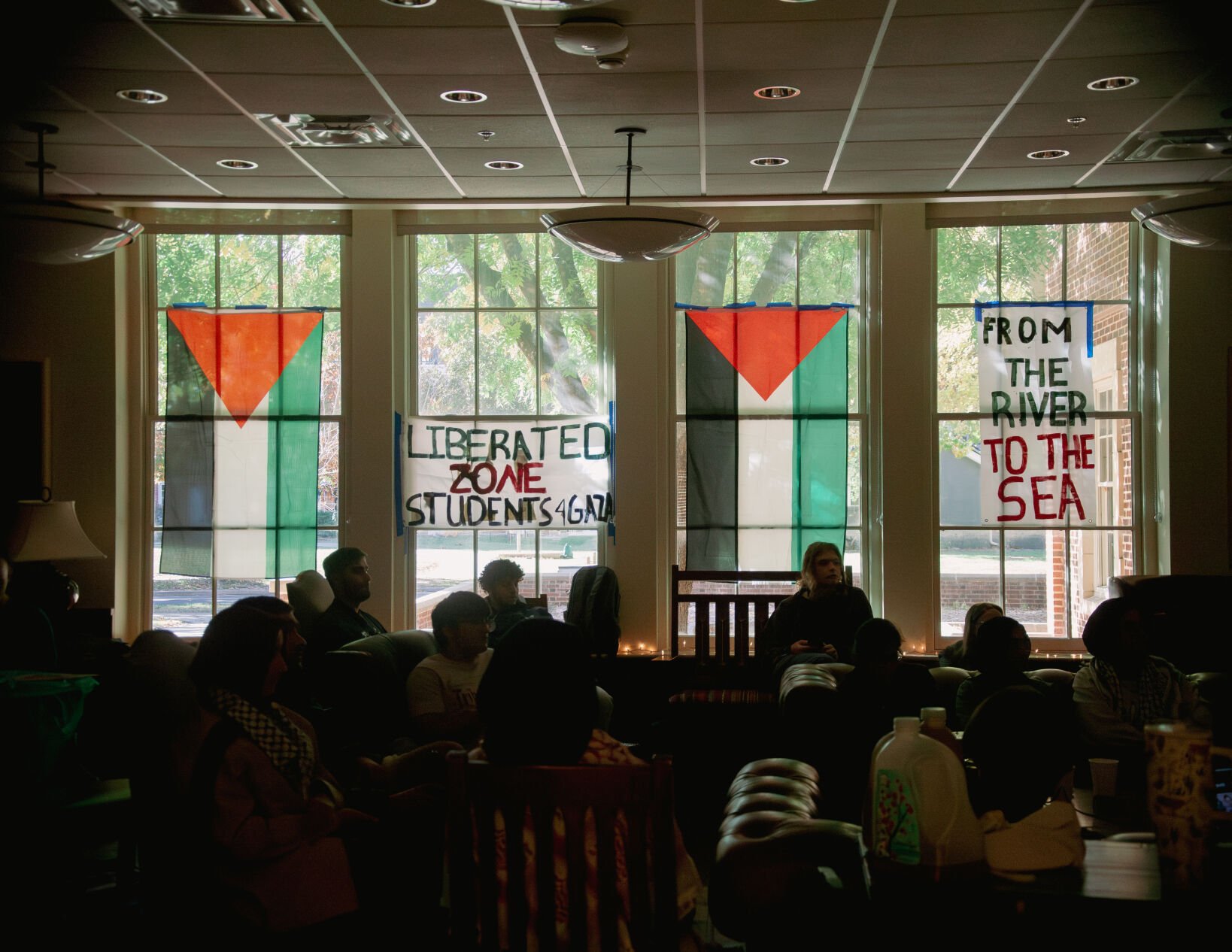


OU Students for Justice in Palestine and OU Student Socialist League held an educational strike Thursday, featuring a series of lectures and activities centered around the current war in Gaza, Palestine, imperialism and anti-Muslim and anti-Arab rhetoric.
Around 30 students attended the 7-hour series in Farzaneh Hall’s David L. Boren lounge. Five Palestinian flags hung throughout the room, while signs referencing SJP’s goals of divestment from OU’s corporate partnerships affiliated with Israel were tied to windows and bookshelves.
Abraar Hassany, SJP media liaison, said the strike was intended to be a “more mellow” event, yet still a protest. The event was in solidarity with a global strike, serving as alternative education for those boycotting classes.
“The idea behind doing something more mellow or light was to reconnect with all of our people on campus, to have a space for all these anti-colonial students that come out to talk with each other, to engage in nice, productive activities,” Hassany said. “SJP is (interested) in a sustained, organized movement that can and will defeat and destroy colonial structures on our campus.”
The event began with a lecture on land defense in “Turtle Island,” a name in Indigenous mythology to describe North and Central America. Based on mythology, a giant turtle on a flooded Earth produced the North and Central American land mass from soil on its back. While the story varies depending on the culture, it represents a connection between the natural world and Indigenous people.
Waleed Mahdi, associate professor of U.S.-Arab cultural politics, was among the lecturers. At noon, Mahdi spoke about anti-Arab and anti-Muslim rhetoric, specifically depictions in film, literature and media.
“Islam in Hollywood was not embraced, was not endorsed, was not accepted,” Mahdi said. “Hollywood, in some way, was not even in touch with reality.”
Mahdi documented a century-long history of Muslim and Arab people in media, citing key events from the mid to 20th century that reinforced stereotypical and reductive ideas.
He said Sirhan Sirhan’s assassination of Robert Kennedy in 1968, the attack by Palestinian militant group Black September on the 1972 Munich Olympic games that left 11 Israeli athletes dead and the 1973 Arab-Israeli War were among the events that formed the idea of Palestinian, Arab and Muslim people as “terrorists.”
“There was a birth of a narrative that has been sticky until now, and we still live really with that narrative,” Mahdi said. “This narrative did Americans a big disservice because it didn't allow Americans to fully understand who the Arabs are, who the Muslims are, (to) never fully appreciate how Arabs and Muslims have been building this country from the very beginning.”
Mahdi said post-9/11 films like “American Sniper” promote reductive images of Arab and Muslim Americans, depicting them as “national security threats” or “foreign policy concerns.” Despite this, Mahdi said holistic media characterization of Arab and Muslim plights could lead to greater understanding.
“If you don't have representation, then you don't exist,” Mahdi said. “Representation is key. It's one of the important ways through which we can endear an alienated public to the Palestinian people.”
Following Mahdi’s presentation, two members of the OU Muslim Student Association read verses from the Quran in Arabic and shared Islamic principles with the context of the war in Gaza. Co-Dawah Chair Muhammed Mian and Secretary Safia Mesiya said social action and faith are intertwined for Muslims, making protesting the war obligatory.
“Social activism and justice, especially regarding this issue, is not only recommended for people, Muslims and others, but it's actually required upon us,” Mian said. “We have to be there, speaking out against any injustice, especially when it goes against people in Palestine that we consider as Muslims, our brothers and sisters.”
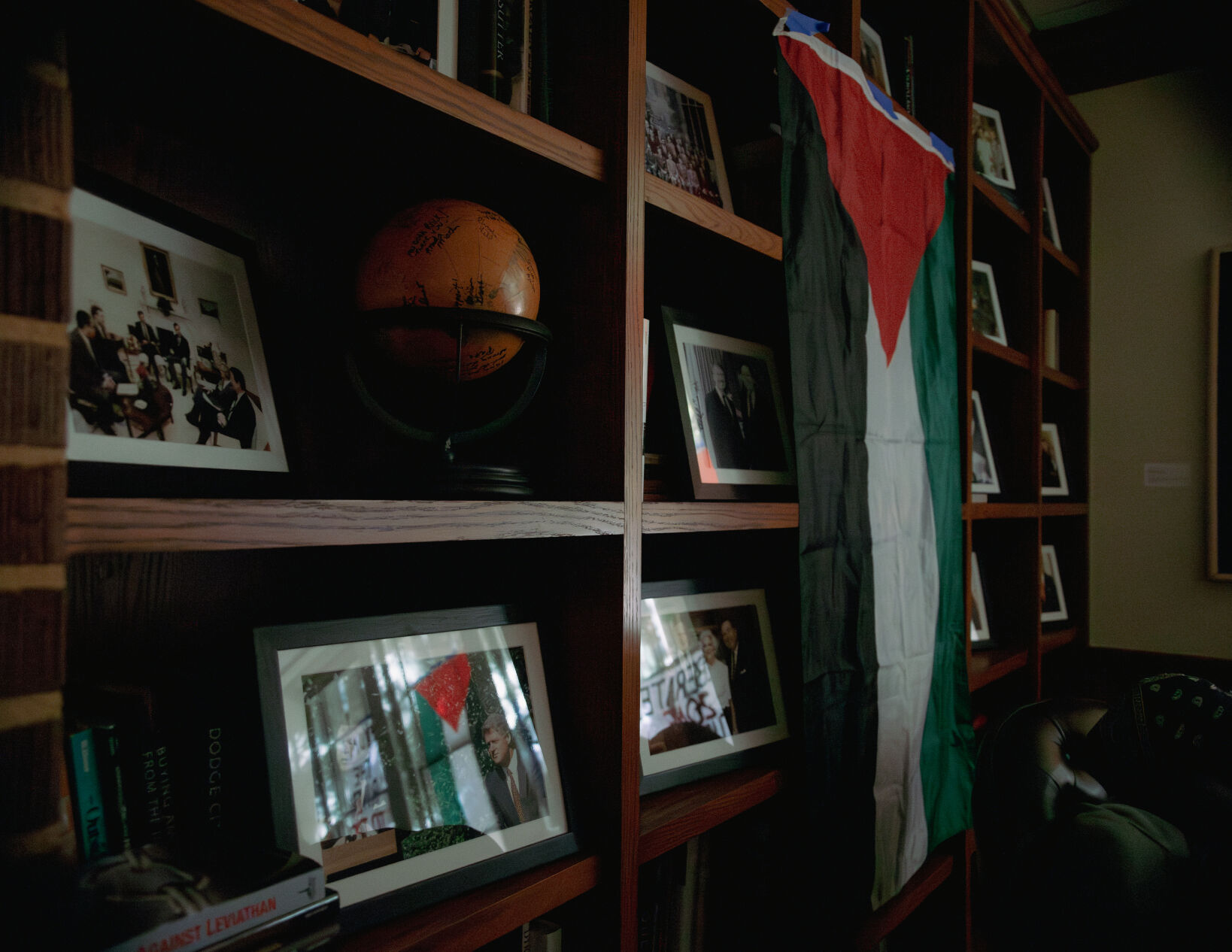
Palestine flag during SJP Popular University for Palestine on Nov. 21.
Mesiya said injustice must be spoken out against, through either actions or words.
“If you see evil in society anywhere, you should first try to change it with your hands, so by your actions, and if you're unable to do that, at least with your voice,” Mesiya said. “We should always strive to take action.”
In the afternoon, the event’s focus shifted to “Health in Gaza.” Two members of OU Medical Students for Justice in Palestine, Sidra Jawaid and Khaled Shihabi, spoke about the impact of the war on Palestinian healthcare workers, facilities and patients.
They listed multiple hospitals damaged or destroyed during the war, including the Beit Hanoun, Nasser and Al-Shifa hospitals. Shihabi said Israel destroyed hospitals to emphasize their importance to everyday life, citing the war as the largest issue to Gazan healthcare.
“Hospitals are sites where life and death takes place, where we see the best news of births to something like the worst news, like the death of loved ones or people suffering from diseases and illnesses,” Shihabi said. “Hospitals are like little parts of society, and attacking them is like hurting the entire body, and this body is the Palestinian people.”
The war in Gaza has killed 44,000 Palestinians, the Associated Press notes.
Shihabi added that healthcare is deeply political. Shihabi said addressing threats to healthcare in Gaza requires confronting topics like Zionism.
“Zionism is a deeply political, racist ideology that is the foundation of the violence and the genocide that we're seeing in,” Shihabi said. “We need to use politics in healthcare, in whatever field that we're in, to confront Zionism as a racist political ideology.”
Graham Cifelli, a Gaylord College graduate student, said Israeli expansionist policies mimic the United States’ Manifest Destiny plans from the 19th century, which sought to expand U.S. territory into Indigenous land. He added protestors should resist global imperialism in addition to the Israeli government.
“Manifest Destiny is the guiding light of American politics always and American politics today,” Cifelli said. “We must understand that the modern state of Israel is not purely the enemy. It is the imperial powers of the United States and the global Zionist movement which supports it.”
Thursday’s strike is the latest in a series of protests organized by SJP over the past year.
In October, SJP held a protest one year after the initial Israeli invasion into Palestine. Over 60 students marched across the South Oval and through the Bizzell Memorial Library and Evans Hall, calling for divestment and disclosure from OU’s corporate partners affiliated with Israel.
In September, around 60 students held a rally in the Oklahoma Memorial Union, calling for divestment from OU’s corporate partners.
At a May Day rally in May, SJP and the Student Socialist League organized over 100 students to protest Gov. Kevin Stitt’s executive order calling for a review of diversity, equity and inclusion programs; the closure of OU’s Gender + Equality Center; and OU’s corporate partnerships, including those with Boeing and Lockheed Martin.
In March, over 150 students congregated in the Oklahoma Memorial Union. Pro-Palestinian protesters and pro-Israeli counter-protesters gathered in the food court to advocate for their stances.
Last fall, around 150 students staged a walkout across the South Oval, where they chanted and held signs calling for OU to divest from weapons manufacturers.

This story was edited by Anusha Fathepure, Ismael Lele and Ana Barboza. Riley McDaniel and Avery Avery copy edited this story.


