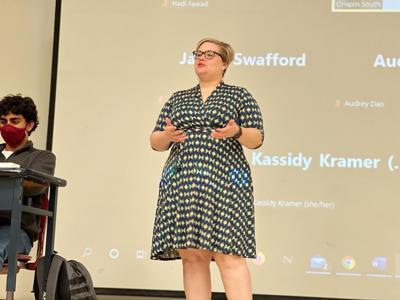

The OU Undergraduate Student Congress voted to retain its three executive officers and invited a guest speaker from the Oklahoma House of Representatives in its last meeting of the semester on Tuesday evening.
House Minority Leader Emily Virgin (D-Norman) spoke on her position as minority leader, campaigning and how the political landscape in Oklahoma has changed over her decade-long tenure.
Virgin went to OU as an undergraduate, majoring in criminology and political science, and attended the OU School of Law before deciding to run for office at 24 years old.
To aspiring politicians, she said they shouldn’t “wait until it’s their time” because youth will be seen as an asset rather than a liability.
“I have candidates all the time, who are like, ‘Well, can I just run ads on social media,' or 'Can I use this texting program?’ or things like that,” Virgin said. “Those are important tools, but nothing beats getting out there and knocking the doors.”
Communicating with constituents is vital, Virgin said, and current congress members need to get their practice in now. The same goes for bipartisanship, as Virgin said she found conversations and opinions can change with just a cup of coffee.
She said the state and federal legislation are different in many ways, but a key difference is the communication between the majority and minority.
“We’re not on CNN talking shit about each other,” Virgin said. “I know that I’m gonna see (House Speaker) McCall (and) we’re going to … talk about each other’s families. I love that about the state legislature because you do still have a lot of collegiality, and you don’t have nearly as much vitriol as you do at the federal level. While I love to read about (that), I think it's pretty clear that it’s not good for policymaking.”
Hyperpolarization has emerged strongly in the past decade, Virgin said, due to an increased focus on social issues — like 2SLGBTQ+ rights and critical race theory — particularly from the Republicans.
Regarding the current lawsuit against HB 1775, which restricts gender- and race-based instruction, Virgin said the suit is an unprecedented piece of law because First Amendment case law usually deals with student self expression.
“You go back to Vietnam (with) students wearing armbands (or) saying a student can’t wear a shirt that says something, that’s where most of the … First Amendment in schools (case laws are), not a lot in terms of curriculum,” Virgin said. “I think they have a pretty strong case for getting it overturned, but I don't think there’s a whole lot of precedent out there. I think it’s important that they’re challenging it.”
In a tweet after the meeting, Virgin wrote she was excited to be back at the university and have an engaged discussion with passionate student leaders.
Congress also conducted routine congressional votes of no confidence, voting on the three executive positions of chair, vice chair and secretary.
Parliamentarian and Congressional Administration Chair Abby Halsey-Kraus said 10 minutes are allotted for questioning before going into Execution Session, when only sitting representatives, associates and student affairs employees are allowed to be in attendance.
She said then there would be debate and a roll call vote for whether the given officer be removed from office. Congress Chair Crispin South, Vice Chair Sidney May and Secretary Hadi Fawad were all voted to retain office.


