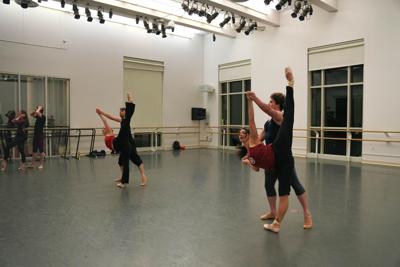


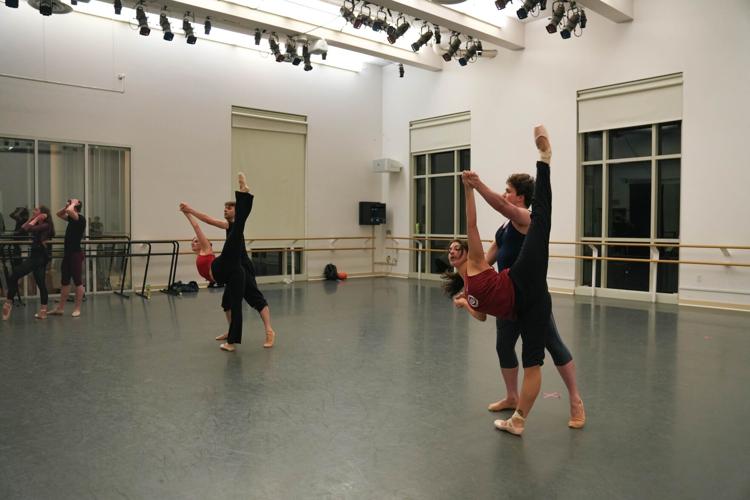
An OU School of Dance senior will re-debut her 57-minute ballet in collaboration with Oklahoma City’s Windsong Chamber Choir, “The Sacred Veil,” Saturday at Inspiration Point Center for the Arts in Eureka Springs, Arkansas.
“The Sacred Veil” is a 12-movement music piece, written by Eric Whitacre in collaboration with poet and lyricist Charles Anthony Silvestri, in memory of his wife Julie. The music tells the story of the couple: how they fell in love, struggles with infertility, starting a family, Julie's ovarian cancer diagnosis and her passing.
Sophia Smith, dance senior and choreographer, first listened to the last section of the work, “Child of Wonder,” in 2020.
“I was immediately overwhelmed by the breath of life in the music and the power of the story,” Smith said. “By the time I listened to the full thing, a couple of months later, I went from thinking, ‘Wow, someone really has to choreograph that one day,’ to ‘Oh, I'm gonna choreograph this one day.’”
According to Smith, she did not have the life experience she believed she needed to choreograph the “The Sacred Veil” when she first heard it. While learning more about its creators in the following years, Smith said she couldn’t help but start choreographing.
Smith said she pitched her idea for “The Sacred Veil” to Michael Bearden, OU School of Dance director, before she was accepted to OU in 2022, and he was all in.
“I came together with this work that almost feels unexplainable, the kinds of things that might only happen by divine intervention or the way that things align perfectly to make something happen,” Smith said. “It's one of the reasons I feel like this had to happen. It wasn't even necessarily something I created; it was something I was simply a vessel for.”
After researching local choirs, Smith emailed the director of Oklahoma City's Windsong Chamber Choir Jeanise Rene Wynn, who responded in 20 minutes.
“The way she described her vision of it, her passion for it, I really thought I was talking to somebody in their 30s,” Wynn said. “I really had no idea that she was a junior. It was so professional and so mature and so deep and so composed, and the passion just really came through, and I knew immediately that I wanted to be a part of it.”
The production’s debut featured nine OU dancers and 21 Windsong members at Donald W. Reynolds Performing Arts Center. According to Smith, around 350 people attended both shows.
“The reaction on opening night was unlike anything I've ever experienced,” Smith wrote to the Daily. “In most performances I've been to, the audience is moving or softly speaking on occasion, but the theater was incredibly silent except for the sniffles and occasional crinkle of a tissue packet. When the last notes played, Jeanise dropped her hands and there was about 15 seconds of complete silence before anyone clapped.”
The show's lighting designer, Kellen Sapp, spent the summer after the debut working for Inspiration Point Center for the Arts in Arkansas. The center saw photos of the show in Sapp's portfolio and reached out to Smith.
Smith and Wynn were eager to jump at the opportunity to reach audiences beyond Norman.
“It's been over 20 years since anything like that happened, and especially with working professionals, with adults who have children and lives, it's hard to leave town for several days, …” Wynn said. “But to a person, every single person in the choir was like, ‘I'll do whatever it takes. I want to do it. I want to be part of it.’”
Smith described “The Sacred Veil” as a layer of life.
“Whenever there is birth or death, ‘The Sacred Veil’ between the worlds grows thin and opens slightly up, just long enough for love to slip, silent, either in or out of this, our fragile, fleeting world. And it just gets better from there,” Smith said. “It's a beautiful overview of grief, and this idea of the veil. It presents this idea that there is so little space between where we are now and where those who are yet to come, and those who have left this earth are residing.”
In her early choreographic process, Smith decided that The Veil must be portrayed by an actual person dancing.
“I realized that this veil needed a dancer to represent it. It needed a human form to become inhuman in order to make it feel real to an audience,” Smith said.
The Veil was originally portrayed by Cheyenne Lok, but Ava Kabelo will dance as The Veil in the 2026 performance. By adding a new dancer to the role, Smith said they have explored deeper into what different emotions The Veil feels.
“I see The Veil as something that isn't just fragile, and that people pass through as a ghost would pass through a wall — almost as though there's stretch and substance to The Veil,” Smith said. “If Julie is passing through The Veil after her death, what does that feel like for The Veil?”
According to Smith, the music is deeply emotional, and Kate Busselle, who specializes in intimacy and violence choreography at the School of Drama, helped the team process it.
“She has really helped us understand what working with such emotional depth in our choreography does to our brains, and how handling grief from an artistic standpoint can be emotionally taxing,” Smith said. “(She) helped us find strategies to get around that.”
Similarly, Wynn’s choir has practiced separating themselves from their art during rehearsals due to the music addressing heavy topics including death, miscarriage and cancer.
“There's something about performing where you have a piece of you that's able to kind of disconnect your personal thoughts and brain movements and just be completely present in the art, …” Wynn said. “It's definitely something that you learn over time, but it's the only way you can be fully present in your performance.”
After the debut of “The Sacred Veil,” Smith said she realized how many people had been affected by cancer.
“When you ask those in a rehearsal room, even if we've got the entire team together, ‘Who here has been impacted or known a loved one that's been impacted by cancer?’ Almost every single hand goes up, and that’s true for all of us,” Smith said. “So when I pitched this story to someone because I needed their help, or I needed resources — even if they were skeptical of the scale of it or of the ability of a college junior to make it happen — they often believed in the story and could see the value in it, and the beauty in it, and were willing to help, in whatever way they could.”
Smith hopes that a second performance of “The Sacred Veil” will bring more cancer awareness.
“We talk about cancer, it's whispered, it's kept behind closed doors,” Smith said. “We don't want anyone to see us struggle or see our family members struggle. … There's something in this that everyone relates to in some way, shape or form, whether it's you've been through it, or you've watched a loved one go through it.”
This story was edited by Madisson Cameron. Kylie Caldwell, Andrew Higgins and Gretchen Schultz copy edited this story.


