

Seventy-four years after 75,000 Filipino and American soldiers marched 65 miles to prison camps in the Philippines during World War II, veterans still honor them with an arduous march of their own.
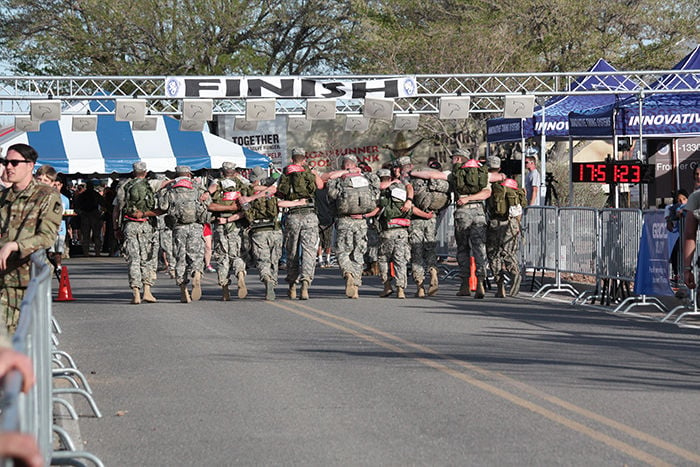
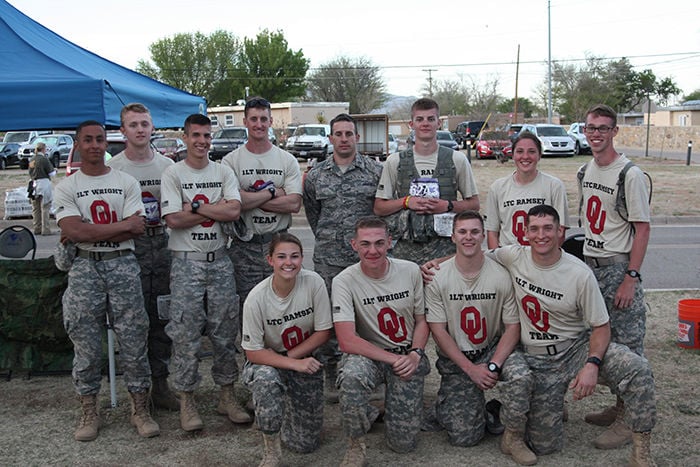
OU Army and Air Force ROTC cadets honored those soldiers and all others by competing in the Bataan Memorial Death March in White Sands, New Mexico, over spring break.
The memorial march is a grind — a 26.2 mile marathon run on sandy ground with some participants carrying packs weighing 35 or more pounds.
Marchers included men, women, children, former and current veterans as well as wounded veterans with prosthetic limbs. Some of the veterans with prosthetic limbs even carried the rucksacks, said Connor Foy, a health and exercise science and pre-physical therapy freshman of the 1st Lt. Wright Team. The team was named after David Wright, an OU alum and veteran who was killed in action by an improvised explosive device in Afghanistan.
The marathon was initially held at White Sands Missile Range in 1992, and it continues to recognize the sacrifices made by those thousands of American and Filipino soldiers who were seized by Japanese forces defending the Bataan region during World War II. Many of them died as they were forced to march through the Philippine jungles in extreme heat. Soldiers dealt with a lack of food and medicine while also suffering from other life-threatening circumstances as prisoners of war.
In a small way, the Bataan Memorial Death March gives participants a taste of some of the hardships these soldiers and other U.S. military veterans have gone through in times of war, economics junior Dawson Frazer said. Frazer was the team captain for the 1st Lt. Wright Team.
This marks the third year the OU Army ROTC has participated in the Bataan Memorial Death March. Frazer said he and his teammates were honored to have the opportunity to show their support for soldiers in current and past wars by being able to test their mettle in the marathon.
“It started out as a physical challenge with me wanting to push myself to see if I could actually do that marathon with a rucksack on my back," Frazer said. "Now, it’s grown to this need and desire to want people to remember what happened at Bataan and what’s happened in the history of our military. It was an emotional connection to the soldiers who came before me and the guys who were actually there at the Bataan Death March.”
Frazer said two Army cadet teams and one team of Air Force cadets from OU, some of whom carried rucksacks on their backs, made the 26.2 mile march across harsh, desert terrain with approximately 7,000 other participants. Frazer added that a 98-year-old veteran and survivor of the actual Bataan Death March of 1942 completed half of the marathon, too.
Marissa Bailey said there was a heavy Army team and light Army team. Bailey is an OU industrial and systems engineering junior and captain of a team named after Lt. Col. Edwin Ramsey, another OU alum who served in Bataan during World War II. She said both teams' members wore full Army combat uniforms, but the heavy team also carried 35-pound rucksacks. For training, the prospective marchers ran trails around Lake Thunderbird, working their way up from eight miles to 12 or 14, she said.
Foy said the course was still difficult even with all the training and preparation.
“I really felt like I learned a lot about myself and my teammates, and it really brought us closer together, but it was a lot tougher than I anticipated," Foy said.
"Seeing myself struggling and knowing what the actual survivors of the Bataan Death March went through, it really puts it into perspective and helps you understand the struggles they went through and the struggles that soldiers go through today," he said.


