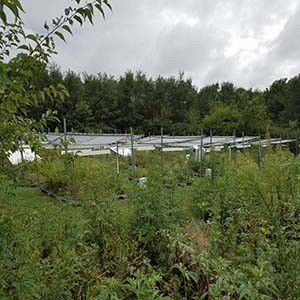

OU researchers are studying the ecological consequences of climate change in Oklahoma tallgrass prairies.
The study, led by OU Institute for Environmental Genomics director Jizhong Zhou, is the first demonstration illustrating that climate warming accelerates tallgrass prairie biodiversity in soil microbes or bacteria, and that warming plays a predominant role in how quickly these organisms change, an OU Research press release said.
“The climate change and temperature increases might increase (carbon dioxide) in the atmosphere or change in precipitation patterns, but it varies in how ecosystems respond to temperature changes,” Zhou said. “We don’t know much. So we’re just studying how they change with time. The response rate is very important in ecosystems.”
In collaboration with researchers from Central South University, Tsinghua University, China and Michigan State University, Zhou and OU researchers also found that tallgrass prairie ecosystem functions and services may become more vulnerable in a warmer world.
Further research will help Zhou and OU researchers understand and predict the ecological consequences of climate warming and ecosystem management strategies, the release said.
“Microbial biodiversity depends on both the size of the area sampled and the time span of the observation,” Zhou said in the release. “Reliable comparison of biodiversity across ecosystems must consider both area and time. This presents challenges for determining appropriate time scale for biodiversity assessment and conservation in ecosystem management.”


