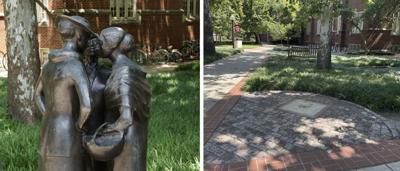

OU’s Provost’s Advisory Committee on Women’s Issues played a key role in the relocation of “The Gossips” — a popular statue that stood outside the Oklahoma Memorial Union until late June.
The bronze-colored statue was created in 1996 by Harry Marinsky, a 20th-century European artist. Former OU President David Boren and his wife, Molly Boren, gifted the statue to the university in 2007.
While the advisory committee’s current board has not made a statement as to why the statue was removed from its regular location, a university spokesperson wrote in an email that they removed the statue based on requests from OU community members, alumni and at the appeal of the advisory’s committee.
The statue was moved from the student union to the Fred Jones Jr. Museum of Art. The spokesperson wrote that the university plans to replace the art with a piece that “celebrates women.”
Keri Kornelson, the advisory committee’s 2018-2019 chair and mathematics professor, wrote in an email, although she isn’t currently a member of the advisory committee, she does understand the community’s concern surrounding “The Gossips.”
“It depicts adult women having a conversation and labels it ‘gossip’,” Kornelson wrote. “That seems inappropriate on a university campus, particularly one where women are underrepresented in many disciplines.”
Kornelson wrote that she’d be content with the statue if it were called “The Collaborators”, “The Friends”, “Mentoring”, or even “The Lunch Break.”
Kornelson also wrote that she understands community concern surrounding other art installations on campus, including the “Covered Wagon” statue outside of Gaylord Hall.
Tom Otterness — the New York sculptor and artist who made the “Covered Wagon”— adopted a dog from an animal shelter in 1977, tied the dog to a fence and shot it, all while recording the incident. Otterness apologized for the incident in 2007, saying it was “an indefensible act,” and asked the public for forgiveness.
“There are certainly other pieces of art on our campus that might cause concern, and I hope the administration is as responsive to discussions about those pieces as they were about ‘The Gossips,’” Kornelson said. “Let’s choose artwork that celebrates the creative activities and collaborations of our community.”


