
Editor's note: This story was updated at 9:X a.m. on April 16 to correct three instances of misspellings and incorrect information, including a misspelling of the word revenue as reserves, an incorrect listing of $50 million toward faculty excellence corrected to $300 million and a clarification that there was a committed $185 million invested to build Stephenson Cancer Center in Tulsa.
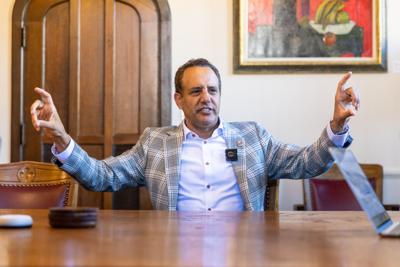
OU President Joseph Harroz Jr. detailed revisions to the university’s “Lead On, University” strategic plan at a launch event Tuesday.
In 2020, OU launched “Lead On, University,” originally an eight-year strategic plan centered around five pillars to represent significant goals set by the university.
• Lead as a Top-Tier Public Research University.
• Empower students for a life of success, meaning and impact.
• Ascend as one OU – unified by our purpose, values and strategic plan.
• Lift the health of Oklahoma.
• Shape the future through discovery, creativity and innovation.
Harroz announced a refresh of the strategic plan in an email to the OU community in Spring 2024, marking the halfway point of the eight-year plan. The revised plan incorporates OU Health Sciences Center and OU’s Tulsa campus.
“Our Strategic Plan was never meant to be static. It must evolve to meet the challenges of our ever-changing world while continuing to serve the distinct needs of our community,” Harroz wrote in an email to the OU community in April 2024.
At the launch event Tuesday, Harroz said the university has cut $140 million in costs, increased cash reserves by $200 million on Norman’s campus and reduced the average costs for in-state students by 28% in the past five years.
“Affordability is critical. We restructured how we do fundraising. We thought we were good at it before,” Harroz said. “We’re now raising 330 to 350 million (dollars) a year, we’ve got half a billion targeted to go towards helping students attend OU too, $300 million towards faculty excellence.”
Harroz spoke of the university’s finances, noting it is in “really good” financial standing, however, low state funding and federal grant cuts pose an added challenge. He said Oklahoma universities do not receive sufficient support from the state, and maintaining the strategic plan budget is vital with federal funding at risk.
“Federal actions related to universities right now, if you look at anything in the last 24 hours, you’ve seen more activity around that,” Harroz said. “I know there’s lots of anxiety on overhead rates for federal research and a lot of other issues.”
Last week, three OU faculty facilitating major research projects received notice their federal grants would be terminated by the National Endowment for the Humanities at the direction of the Department of Government Efficiency. The projects lost a total of $767,536 in federal funding.
After the event, Harroz told OU Daily federal actions have only impacted grants from the National Institute of Health so far. He said he believes the university can plan for consequences of rising overhead rates, but he continues to watch for changes.
“Where there is a concern is around the overhead rate,” Harroz said, “you may have seen that they’ve talked about 15% versus the traditional rate. That will be an impact to us. So far, it’s only been NIH grants, but if it expands beyond there, that obviously would have a greater impact.”
According to Harroz, enrollment across all OU campuses has drastically increased over the last five years starting at 2% growth in 2021 and up to 20% in the last two years – a major step toward university enrollment goals.
During his 2023 state of the state address , Gov. Kevin Stitt challenged OU and Oklahoma State University to grow up to 40,000 students by 2030. Harroz said the university accepted the challenge, doubling its goal for online students and increasing first-year enrollment at all OU campuses.
“Everything we do has to be focused on excellence,” Harroz said. “Value, as we define it, is excellence and affordability. One without the other completely destroys our strategic plan.”
Harroz said one of the primary goals in the next five years is to become a member university with the Association of American Universities. Of the approximately 4,000 degree-granting universities in the U.S., there are currently 69 AAU institutions with just over half being public institutions.
The Association of American Universities is an invitation-only organization of America’s leading research universities credited for life changing education, research and innovation. Member universities earn the majority of federal funding for research that improves public health, seeks to address national challenges and contributes to the education and training of younger generations.
“As we look at our strategic plans … hopefully you’ll see inside of this clear objective measures to get to be one of the public AAUs,” Harroz said. “You got to be invited in, but we’re going to meet the standards. That’s our goal in (the) next five years, this refresh of the strategic plan.”
Harroz said the university must make 300 additional faculty hires, work to raise $500 million for student support and receive additional funding from the state to meet the AAU criteria. He said OU requested $75 million annually for the Norman campus, but there is often pushback from legislators.
“I told them, we’re 58% down, we need 75 million on a continuing basis, just for (the) Norman campus,” Harroz said. “Interestingly enough, our ask to the state legislature this year is $75 million.”
As a result of underfunding from the state, Harroz said students have faced tuition increases for three consecutive years, and while the university has made efforts to mitigate the financial burden of tuition increases, it is not sustainable. Harroz said state funding and additional funding from donors is necessary to maintain excellence.
“We’ve gotta have the state’s participation, and we have to have our donors kicking in funding. This is critical,” Harroz said. “We cannot waste dollars. They’ve got to be efficient.”
Harroz said when the original plan was developed, OU hadn’t distinguished itself as an academic health system, but now it serves as the only academic healthcare system in the state. According to Harroz, the Health Sciences Center educates 80% of Oklahoma’s healthcare workforce, serving the state while also educating and researching.
Harroz said the difference between a community and academic healthcare system is that an academic system can continue its research, clinical trials and education and integrate its developments in its patient care.
“We’re the ones you go to when they’re out of answers, because we don’t stop searching for answers,” Harroz said.
After seeing the significant impact Stephenson Cancer Center has made in cancer research and treatment, Harroz said the university committed $185 million to bringing the center to Tulsa.
The Stephenson Cancer Center is Oklahoma’s only National Cancer Institute-Designated Cancer Center, providing expert treatment, performing clinical trials and incorporating scientific breakthroughs in treatments.
“During this refresh of the strategic plan, we have already committed $185 million investment to build Stephenson (Cancer Center) in Tulsa,” Harroz said. “It’s going to save thousands of lives.”
Harroz said by expanding the university’s healthcare system, he hopes to decrease the number of cancer deaths by 10% and decrease deaths from complications related to diabetes by 30% in Oklahoma. He said the Health Sciences Center will focus primarily on research, treatments and trials related to cancer, diabetes and neurosciences.
“We have three areas that are critical to us in the health space. It’s cancer, it’s diabetes and it’s neurosciences,” Harroz said. “Those will be our focal points for the next five to ten years, and we’re focused on it with incredible precision."
Harroz said the strategic plan isn’t only focused on academic excellence, but the goal is to invest in each student in every area, ensuring each student has every resource necessary to their success at OU. He said the goal of the “Lead On” plan is more than just preparing students for a job after college, but also shaping each individual to thrive in a rapidly changing society.
“The key to all of this is that our primary job is to make sure our students are not just minted for a job, they’re minted for a career that will change, and to give them those skills that will allow them to flourish in a rapidly changing society,” Harroz said.
This story was edited by Ismael Lele, Ana Barboza and Anusha Fathepure.


