



Editor's note: This story was updated at 6:22 p.m. March 27 to reflect that RAVE alerts are limited to 160 characters per alert, not 360.
Over the past three spring semesters, OU has seen incidents on its Norman campus that have caused students to be concerned for their safety.
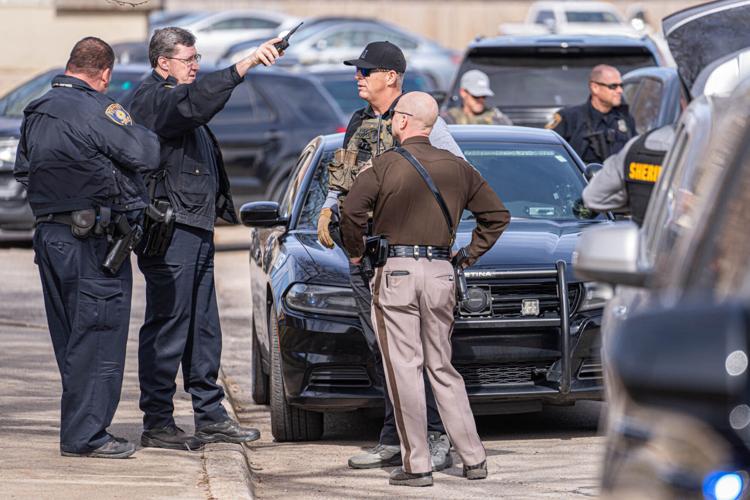
On Jan. 28, a suspect initially believed to be armed and wanted in connection with a car theft escaped Noble police and traveled to Norman. This triggered OU RAVE alerts telling students to avoid the south end of OU’s campus by the Jimmie Austin OU Golf Club. The suspect was arrested in the late afternoon after a day of searching.
In February 2024, protest art was mistaken for a bomb outside Gaylord College, prompting faculty and student evacuations from nearby buildings and parking garages. In April 2023, an international swatting incident drew a large police presence to the OU campus, triggering lockdowns in residence halls and buildings.

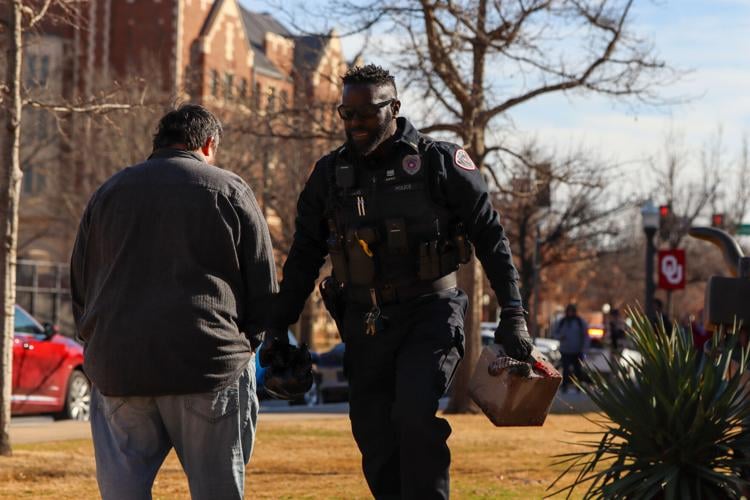
Norman Police Officer with suspicious package during the suspicious package alert on Feb. 16.
Each event brought the same feelings: stress, anxiety and worry. Each spring, there was something new. Some students began to wonder if their safety was in jeopardy.
‘I didn’t know what to do’
Mia Chrisco, advertising junior, is a tenant of The Flats at Norman, an apartment complex within a mile of where the Jan. 28 suspect search concluded. Toward the south end of the complex where the search concluded, the area is separated only by shrubbery and a chain link fence.
Chrisco was in her apartment when the OU RAVE alert went out.
“I was really worried,” Chrisco said. “The police were not letting anyone through to their houses, the front office had no idea what was going on and neither did I. I didn’t know how long it was going to take or how severe the situation was.”
Chrisco said she was unfamiliar with safety protocol during crisis events and didn’t know about the incident until she received the OU RAVE alert.
“That email made me realize it was pretty serious,” Chrisco said. “Police were flying down the street. My professors told us to stay away from campus, and my friend could not come through the complex. I didn’t know what to do.”

With OU being no stranger to threatening conditions, some students — especially upperclassmen — are noticing a trend.
Taylor Morris, marketing junior and tenant at The Flats, said the university needs to play a bigger hand in keeping students safe.
“The issue is a lack of communication. Just saying every 30 minutes, ‘Hey, by the way, he’s still in this area,’ not closing down campus. I’m not a big fan of how the university handled that,” Morris said. “I feel like the complex handled it better than (the university) did, and I don’t feel like they had as much information as the school did.”
Duncan Rumbaugh, creative media production junior and tenant at The Flats, said an initial lack of effective communication between the university and students almost put him in danger.
“I was on the North Oval in class when all of a sudden five helicopters passed by,” Rumbaugh said. “I had known something was going on, but I did not know it was so near to my complex. The alert said to stay away from a golf course. Well, which course? The unit I live in, you cannot get closer to the course than this.”
Rumbaugh said the suspect search caused him and his roommates intense stress.
“They were like, ‘Holy crap, this is crazy,’” Rumbaugh said. “There are police officers with (assault rifles) that were not letting people in the complex. It feels strange, which is an understatement.”
Rumbaugh believes that The Flats should have done more to protect tenants during the suspect search.
“The way that this complex is built, there is only one entrance. People couldn’t come or go during the lockdown because of that,” Rumbaugh said. “What if we couldn’t get in and that guy was still out? If there was a fire and there was only one way out, what do we do? I just don’t think that this complex is built with our safety in mind.
“How am I supposed to feel safe during things like this when I don’t even feel safe living here at all?”
How RAVE alerts work
In an email to OU Daily from Nate Tarver, associate vice president and chief of police for the OU Police Department, and with contributions from OU Marketing and Communications, Tarver wrote that RAVE alerts are sent out in regular intervals to keep OU students safe and informed.
“OU takes the safety and well-being of our students, faculty, and staff very seriously,” Tarver wrote. “OU relies on the RAVE alert system to share accurate and timely updates during an emergency. … The university follows best practices, which recommend providing updates every 20 minutes during an ongoing emergency.”
According to Tarver, RAVE alerts are limited to 160 characters per alert, which can inhibit the amount of information conveyed through RAVE alerts. The alerts are also divided into three different categories: emergency, urgent and critical.
In the past, events like the Gaylord College bomb threat have been listed as an emergency, suggesting to “Take Immediate Action”; severe weather conditions have been listed as urgent, meaning to “Be Aware/Prepared”; and miscellaneous crimes, such as e-scooter thefts, burglaries and sex offenses, have been listed as critical, which “Indicates a Timely Warning.”
Tarver wrote that the RAVE system is constantly reviewed to enhance efficiency.
“We continuously review and assess our procedures to ensure that the information provided is both timely and relevant,” Tarver wrote. “While we are always evaluating how to best tailor alerts to address a variety of dangerous events, including weather and crime, our commitment is to maintain a balance between adapting to new threats and adhering to the legal frameworks that guide our processes.”
OU RAVE alerts adhere to the Clery Act for reporting and announcing certain crimes or threats to college campuses.
Morris said OU should be more decisive about protecting students when danger befalls the university.
“Expecting us to come to class when we did not know what the threat was and how big it was was my biggest issue,” Morris said. “Most people here couldn’t even leave their apartments, and if there is an exam or an absence, no one wants to miss those.”
Morris said the university's actions on Jan. 28 follow a trend she has noticed during her time at OU.
“Risking danger just for campus to not close down, I feel like that has been an issue a lot recently with (OU) not willing to close unless they absolutely have to,” Morris said.
In an interview with OU Daily, Tarver said that OUPD’s main focus was maintaining order on campus during the suspect search.
“We had a few officers that were involved with that, but we try to keep officers on campus,” Tarver said. “We have a shift change that occurs (at) about 4 p.m. This incident was right at about 1 or 2 p.m. We contacted officers that we were coming in at 4 p.m. and said to come in early so we would have enough coverage on campus.”
Tarver wants to reassure the OU community that OUPD is well equipped to combat any threat to student safety on campus.
“Our officers are just as well trained as any other police department,” Tarver said. “We have state mandatory training that every other officer does. Our officers are trained to respond to active shooters, so we can respond to various types of calls. The fortunate thing about the university environment is that we really don't have a lot of violent crimes.”
Tarver wants students to know that OU is safe and OUPD is there for them.
“I want students on our campus to feel safe,” Tarver said. “It's a safe zone for you to be who you are, and we're here for everybody. The university would not exist without students here feeling comfortable on campus being who they are. Our campus is safe.”
Student resources
In an email to OU Daily, Kesha Keith, director of strategic initiatives, wrote that the Division of Student Affairs — which oversees Student Life and several other student programs — “promotes student success in all areas of life, including physical, mental, and emotional well-being.” Keith wrote that during the suspect search, OU deployed various resources outside of the OU Police Department to secure students’ safety.
“Housing and Residence Life secured residential buildings by implementing card-only access,” Keith wrote. “The Division of Student Affairs ensured that students had access to crisis counseling during and after the event.”
Keith wrote the Division of Student Affairs focuses on the recovery of students’ mental and emotional health both during and after threatening events on campus. According to the email, available resources include the University Counseling Center and TELUS Health for crisis counseling.
Keith wrote the best way to stay informed during crises that threaten student safety is to stay connected to OU and city safety resources.
“Ensure your contact information is current in OU’s Emergency Communication System. … Add secondary numbers for loved ones to receive alerts,” Keith wrote. “Follow official OU communication channels, including email and social media, for updates during emergencies.”
Madison Koppes is a public relations sophomore and social media manager of OU Wellness Society, a new organization that aims to promote student mental and physical health and wellness. The Wellness Society has chapters at universities across the U.S.
Koppes said she had to choose between her safety and her academics on Jan. 28.
“When that guy was on campus, I had four different classes that day, and I saw (the RAVE alert) right before I was supposed to go to class,” Koppes said. “I was like, ‘I don't feel safe walking to class right now,’ so I stayed at home and missed all of my classes, even though none of them actually got canceled.”

Reagan Gist, advertising junior and president and founder of OU Wellness Society, said the lifestyle the organization promotes can help mitigate the negative effects of threatening events on campus and in Norman.
“Breathing, connecting with your mind with your body and taking a step back to realize that you're OK, you're in control, that's really important,” Gist said. “Things are gonna happen, but this is how you can grow from it, learn from it and take it into your daily life.”
As OU Wellness Society president, Gist said she takes several safety precautions to protect organization members and herself, and it has been effective.
“If we are going on a walk, I do not post where we are meeting up and when. All group chats have member approval on them, so an admin needs to approve your request to join before you can,” Gist said. “Have an emergency number listed and be aware of your surroundings.”
Koppes said the organization has resources available for students who are experiencing anxiety about their safety on campus and in Norman.
“We want to offer a welcoming community for those people who are experiencing traumatic events,” Koppes said. “That's what we're all about, being very open and welcoming and offering little things, even if it's just a speaker who comes and talks about wellness and how to take care of yourself. I think little things like that help, even if it's just a few people.”
This story was edited by Ana Barboza, Anusha Fathepure and Ismael Lele. Kylie Caldwell, Sophie Hemker and Grace Rhodes copy edited this story.


