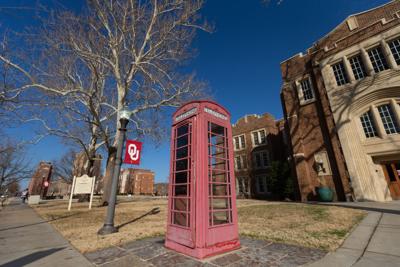

A community engagement program created a proposal to bring new life and purpose to the red phone booths across campus.
The Institute for Quality Communities, also known as the IQC, is a community engagement program in the Christopher C. Gibbs College of Architecture that collaborates with Oklahoma communities to address local issues through planning and design solutions.
“Small Oklahoma communities sometimes don’t have the resources for their own (projects) and need our expertise (and) our community engagement skills to help them (get) going,” Natalie Young, a graduate assistant in the IQC, said.
In the 1990s, former OU President David L. Boren installed phone booths on campus from the United Kingdom as part of a campus beautification project. The booths were donated by Southwestern Bell Telephone Company and private donors after John Major, then-prime minister of Great Britain, decommissioned them throughout the country.
The phone booths were roughly 70 years at the time of purchase and are now estimated to be around 100 years old, making them historically significant edifices “of a bygone era,” according to the IQC.
For a short period of time, Earth Rebirth, a nonprofit organization that promotes sustainability, transformed one of the Campus Corner phone booths at Buchanan Avenue into Norman’s first Borrow-a-Book micro-library.
The project operated successfully for four years, but the Campus Corner Association decided to shut down the project in 2017, Andrew Sartain, Earth Rebirth founder, said. Earth Rebirth’s Borrow-a-Book micro-library was revived briefly before being shut down again in 2019 with shelves being ripped from their frames and the door locked.
For the next three years, the phone booths across OU’s campus and Campus Corner have remained mostly dormant, sustaining more damage and graffiti over the years, but the IQC decided to change this.
Every year, the IQC accepts proposals from different communities across the state to address local concerns, Shane Hampton, director of the IQC, said. The institute takes these proposals and matches them with a class or team of students in the College of Architecture who can provide advice and assistance.
Jeremy Lambeth, director of Risk Management at the OU College of International Studies, submitted a proposal to learn more about the history of the phone booths and develop a plan to maintain and revitalize them, Jacob Lange, a graduate assistant in the IQC, said.
The IQC team first began with surveying community members. Through these surveys, the team found that the community wanted to repair and renew the booths.
“Through those surveys, we actually found a lot of support for them. … We found a lot of international students value them because they remind them of home. … Other students said it reminded them of their own previous travel abroad opportunities,” Young said. “Others just saw them as, like, this cool bit of nostalgia like this. … They have become just this icon on campus. Losing the booths would mean losing all of the stories and emotions that are tied up in them.”
The IQC first took inventory of the location and conditions of the nine booths across campus while identifying key stakeholders in the future of the booths. Nearly all of the booths were reported to have some amount of damage from broken window panes and chipping paint to graffiti in and outside the booth.
In their report, the IQC suggested recommendations based on each phone booth’s location to optimize usage. For example, due to the Farzaneh Hall phone booth’s location near the College of International Studies, the IQC recommends turning the booth into an advertising outpost for the university’s education abroad opportunities. Another example was remodeling the Fred Jones Jr. Museum of Art phone booth into an interactive art exhibit.
The report also detailed the necessary repairs and maintenance that would need to be performed on each individual phone booth.
While the IQC’s work ended with creating the report, Young and Lange both hope Lambeth and his team will start having conversations with the stakeholders involved, such as facilities management and business owners to develop a long-term approach on maintaining the phone booths.
For Young, Lange and the rest of the IQC team involved with the booths, they believe that, while not a large-scale project, revitalizing the phone booths means caring for a part of OU’s history.
“It's not a huge thing. It's not like they're installing giant gardens or some crazy new facility on campus,” Young said. “It's just a new view of something old that we've always had.”
This article was edited by Alexia Aston and Karoline Leonard. Grace Rhodes and Nikkie Aisha copy edited this story.


