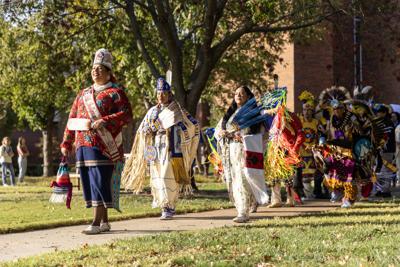


Gigi Sieke, Nivy Yarholar, and Julia Guerrero during Indigenous Peoples Day on Oct. 14.
The jingle of Native American ankle bells, pounding of drums and singing filled the South Oval Monday morning in celebration of Indigenous Peoples Day.
About 60 people joined in a Tribal Celebration Walk, starting from Copeland Hall, which houses OU’s Native American Studies Department and the Five Moons Student Lounge, to the middle of the South Oval, in front of the Bizzell Statue.
The group surrounded the stage as Hozshona Post, OU American Indian Student Association president and member of the Kiowa tribe, began the ceremony by welcoming the crowd.
Christine Armer, OU language instructor and member of the Cherokee tribe, recited the opening prayer in the Cherokee language.
Post took the stage again to give an opening speech. She said that Indigenous Peoples Day is a celebration that acknowledges the past, present and future of Native American people across the United States.
“It acknowledges the legacy of colonialism, which has devastated our Indigenous communities and continues to impact us to this day,” Post said. “Indigenous Peoples Day tells the real story of the first people, not on this land but of and from this land.”
Mel Fillmore, an OU Native American studies professor and member of the Lakota tribe, encouraged the crowd to shake the hands of the people around them, explaining that in the Lakota ways, they center their lives with “Mitakuye Oyasin” which means “we are all related.”
“Mitakuye Oyasin means we create opportunities for us to be called relatives,” Fillmore said. “To be good relatives means we understand that the original Indigenous peoples did not always see their futurity when they were removed from their lands and communities.”
The ceremony acknowledged some of the Indigenous student leaders at OU, who were asked what Indigenous Peoples Day means to them.
Taylor Pearce, president of Gamma Delta Pi — OU’s first and only Native American interest sorority — and member of the Cherokee tribe, said the festivity made her reflect on her ancestors’ journey.
“To me, Indigenous Peoples Day is a space for us to remind everyone around us that we are still here,” Pearce said. “We are still celebrating our culture, we are still singing our songs and speaking our languages because generations of people have had to fight for our ability to do so.”
Duncan South, president of Iota Gamma — a Native American fraternity at OU — and member of the Choctaw tribe, said Iota Gamma exists because of events like these.
Heather Lee, president of the American Indian Sciences and Engineering Society, said that although she is not from an Oklahoma tribe, she likes spending time with other tribes and expressing her culture.
“(Indigenous Peoples Day) is also a reminder how far we have come as Native people, that we are able to express our cultures and traditions without any consequences,” Lee said.
Graycianne Bennett, president and founder of Indigenous Art Forms — a group that practices honoring diverse cultures by learning, teaching and preserving art forms — said it is an honor to share the community that came to the ceremony.
Cole Burris, treasurer of the OU Osage Club; secretary of Iota Gamma; and a drumkeeper of the Osage Nation, said even though assimilation and colonization has affected Native people, Indigenous Peoples Day shows Native American traditions and people are strong.
“(The Osage Club) provides community for Osage people, or Native people alike to flock to whenever they come to OU or they don’t have anywhere else to go,” Burris said.
Lily Painter, secretary and co-founder of OU Kiowa Club, said there’s more context on why Indigenous Peoples Day exists.
“I urge you all today to on Indigenous Peoples Day, think of the context in which it exists, and for us, that means constantly having to defend our presence here at OU, not just to some people at OU, to our governor, to those around the state who still try to silence Native students,” Painter said.
Following speeches, the opening prayer concluded with dances, group and individual. Leaders of the group dances pulled people passing by into the dance. As the dances ended, the cedaring ceremony began.
The cedaring ceremony occurred in the tipi set up in the South Oval, with burning cedar waved over the receiver as the holder of the cedar prays.
“(Cedaring) is just something that kind of purifies and starts the day off on a good note,” Post said. “I definitely recommend it if you haven’t ever tried.”
Following the morning events, OU’s Indigenous Peoples Day agenda included workshops and demonstrations, dinner and a screening of the movie “Smoke Signals” at 8 p.m. in the Gaylord Hall auditorium.
This story was edited by Anusha Fathepure, Ismael Lele and Ana Barboza. Grace Rhodes and Mary Ann Livingood copy edited this story.


