
OU Faculty Senate aims to vote on a resolution to affirm the senate did not endorse the university’s termination of graduate teaching instructor Mel Curth in a virtual ballot.
The proposed resolution, which was brought forth during the February senate meeting’s new business portion, states that the senate was neither involved in the discussion nor endorsed the decision to terminate graduate teaching instructor Mel Curth for being “arbitrary in the grading” of a psychology paper that cited the Bible.
According to a Dec. 22 statement from OU, the Faculty Senate Executive Committee was consulted throughout OU’s investigation and determination regarding Curth.
A statement from the University of Oklahoma: pic.twitter.com/FzcjByOjpp
— University of Oklahoma (@UofOklahoma) December 22, 2025
“Because this matter involves both student and faculty rights, the University has engaged in repeated and detailed conversations with the Faculty Senate Executive Committee to ensure there is an understanding of the facts, the process, and the actions being taken,” the statement reads.
Faculty Senate’s resolution insists “OU Faculty Senate Executive Committee and Faculty Senate were neither solicited for input nor endorsed the decision of the administration on this matter.”
According to the resolution, the Faculty Senate fully supports the OU American Association of University Professors petition titled “Defend OU Instructors and Academic Freedom,” delivered Jan. 2, as well as the Graduate Student Senate resolution titled “Call for Accountability, Transparency, and Academic Integrity,” passed Dec. 4.
While the resolution did not appear on Faculty Senate’s agenda, it was distributed among the body Feb. 6 over email by Sen. Dean Hougen, who sponsored the resolution.
“A few senators engaged in discussion and drafted the attached resolution. This will be brought up for a vote during new business on Monday,” Hougen wrote. “We invite you to read it, and if you would like to co-sponsor it, please let me know.”
While most university legislative bodies adhere to the Open Meetings Act, which would require the posting of all agenda items 24 hours before meetings, Faculty Senate Chair Sarah Robbins confirmed senate is not subject to Open Meetings Act regulations because members do not have final authority on the budget.
“However, we try to be open as much as we can regardless,” Robbins wrote.
While Faculty Senate resolved at the end of Monday’s meeting to hold a virtual vote on the resolution, in a Tuesday email to Faculty Senate members, Robbins wrote that while she intended to send out the virtual ballot that morning, she realized, per senate bylaws, senate needs the executive committee to vote and approve sending the resolution to the senate in a two-third vote rather than a simple majority.
“The vote will be delayed by at least a day while we conduct the vote with (Faculty Senate Executive Committee),” Robbins wrote.
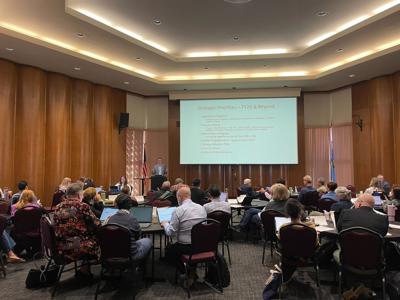
Faculty Senate reached the new business portion of the meeting around 5 p.m. Monday — when senate meetings usually conclude. Many senators had already left earlier in the meeting, so as the remaining members moved to vote on the new resolution, they found the senate no longer met quorum, the required number of senators present to vote.
OU Daily observed senators leave the meeting room to make calls to encourage other members to come to the meeting so quorum could be met. Senators quickly realized they would not be able to gather enough senators and decided to move to a virtual vote over the course of the next two days.
Hougen said he has reason to believe not all of the Faculty Senate rules were followed during OU’s investigation of Curth.
“There was a lot of pressure that was applied that would be inappropriate, …” Hougen said. “We have rules, the rules are fair, the rules are always implemented regardless of external factors. What we need to really think about is sticking behind our faculty, sticking behind our teaching assistants, our instructors.”
Before the resolution’s introduction, Stewart Berkinshaw, senior vice president for strategy and finance and chief financial officer, gave a 45-minute finance presentation that showed the university has seen a roughly $26.1 million increase in state appropriations over the past three years.
“I appreciate the things that Stewart was telling us about the money and the good relationship with the state government, and so forth. But we’re not just a business, it’s not just about the money, right?” Hougen said. “It’s got to be about academic integrity, and how we protect ourselves, and academic freedom. And that involves actually following the rules.”
Curth’s grading of psychology student Samantha Fulnecky’s paper received state and national attention, with Oklahoma Gov. Kevin Stitt posting on the social platform X that the situation was “deeply concerning” and called on the OU Board of Regents to review the results of the investigation.
“The OU decision on this matter has had, and will continue to have, significant repercussions that negatively impact trust within the OU academic community,” the original resolution reads.
Mashhad Fahes, associate professor of petroleum and geological engineering, said including the word “negatively” was necessary.
“It is the negative impact that we’re addressing and we’re talking about here. That’s the whole point,” Fahes said.
The amended resolution ultimately kept much of the same language with the exception of the first paragraph being changed from “OU issued a statement on Dec 22nd that identifies the OU Faculty Senate Executive Committee as a partner in the OU decision regarding terminating instructional duties for a graduate teaching assistant” to “OU issued a statement on Dec 22nd that identifies the University as having engaged in ‘repeated and detailed conversations with the Faculty Senate Executive Committee to ensure there is an understanding of the facts, the process, and the actions being taken’ regarding terminating instructional duties for a graduate teaching assistant,” according to a Tuesday morning email from Robbins.
During the meeting, Fahes asked Robbins to clarify if executive committee members did speak with administration during the investigation.
“I have a concern with (the language in the proposed amendments). It’s just legitimizing something that we as a faculty don’t really know. But you know that this happened. Me, as a senator, the whole point of … doing this is because the university dragged us into this,” Fahes said.
Fahes said the university falsely implying the Faculty Senate’s support caused members to receive criticism for a decision they were not involved in.
“A lot of senators received emails, basically accusing them of betrayal,” Fahes said.
Robbins and Hougen discussed the extent to which the executive committee spoke to the administration during the investigation.
“The administration talked to the executive, but the executive was not involved in the decision making process … you guys didn’t say, ‘Yes, we should do this,’” Hougen said.
“No. Nor should we have. I don’t think that would be appropriate,” Robbins responded.
Following the discussion, present senators decided to move the decision to a virtual ballot, which needs a two-thirds vote in favor to pass instead of senate’s usual quorum majority, according to a Tuesday morning email from Robbins. Robbins wrote that there is not a specific timeline for the vote, but senators during the meeting wanted 48 hours so they will use that timeframe.
“The statement and results of the vote will be made public – if the statement passes, it will be distributed across campus and available on the senate website,” Robbins wrote. “If it does not pass, it’ll be a part of the journal record for the February meeting that gets distributed in March.”
Fahes wrote in a paper statement to OU Daily that faculty and the whole OU community are looking to the senate to be their voice on the issue.
“Saying nothing is saying a lot, and that is not an option. That’s why we need this resolution voted on ASAP even though the threshold for virtual ballots is higher. Those of us who drafted this resolution wanted to amplify the voices of the other groups on campus,” Fahes wrote.
Sen. Fabio de Sa e Silva, who co-sponsored the resolution, addressed the senate during debate.
“There is a lesson that we learned through this process, …” Silva said. “There has been an attempt by the administration to instrumentalize the faculty to not take responsibility for the decisions that they are making.”
After the meeting concluded, Silva told OU Daily that it is important to clarify what actually happened and convey what the real interest of faculty and graduate students is.
“The statement that the university issued in December doesn’t reflect the truth. It implies that the faculty have been consulted and that were part of, and supported, the decision that was made to remove Mel Curth from her teaching duties.”
Background
In November, junior psychology student Samantha Fulnecky contested a failed grade on an essay assignment in an OU psychology course, stating she believed she received the grade because of her religious beliefs. Fulnecky reportedly received zero out of 25 points for the Bible-based essay and filed an illegal discrimination claim. Curth, the course’s graduate instructor, was placed on leave later that month.
Curth stated the grade was based on the essay’s lack of empirical evidence and said parts of the essay were offensive, according to reporting by The Oklahoman. Fulnecky reportedly asked Curth to reconsider the grade, stating she met the requirements of the essay, but Curth denied the request.
The other instructor for the course, according to Canvas comments published by The Oklahoman, wrote that they concurred with Curth’s grading and the paper should not be considered as a completion of the assignment.
On Dec. 5, around 250 protesters gathered on campus in support of Curth. Protesters also called on OU to protect professors from political attacks.
On Dec. 22, OU announced that following an investigation, it was determined Curth engaged in arbitrary grading and would no longer have instructional duties at OU. Curth submitted an appeal to the Institutional Equity Office on Dec. 30, according to her attorney.
Anusha Fathepure contributed to the reporting of this story.
This story was edited by Anusha Fathepure and Audrey McClour. Sophie Hemker copy edited this story.


