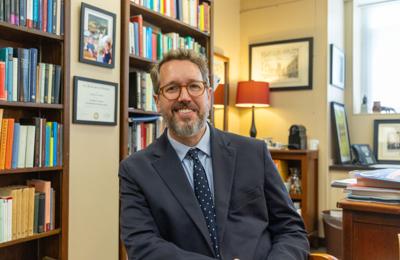

Charles (Ben) Watson, associate professor and chair of the OU Department of Classics and Letters, visited Washington, D.C. in March to advocate for federal funding for humanities programs in higher education.
Watson told OU Daily he and Rusty Jones, associate professor and chair of the philosophy department, were representing the OU Arts and Humanities Forum.
“Each year, the Arts and Humanities Forum, which … sponsors humanities and arts-related projects, sends usually someone from their office and another faculty member to Washington, D.C. during a particular set of days in which advocacy is sort of the main thing on the bill,” Watson said.
Before this year's visit, Kimberly Marshall, associate professor of anthropology and faculty director of the OU Arts & Humanities Forum, had been OU’s representative to Capitol Hill for the past five years.
“Essentially what we’re doing is we’re trying to explain to lawmakers how those federal dollars benefit local Oklahomans. It’s always that message, right? Like, these are federal dollars, but because they come into Oklahoma in these ways, they are this federal funding that’s benefiting local Oklahomans,” Marshall said.
OU is a member of the National Humanities Alliance, a nationwide coalition advocating for the humanities on campuses, in communities and at the Capitol, according to its website.
“It’s like the nonprofit, lobbying sort of organization for the humanities, …” Marshall said. “They provide a lot of professional development and training for humanities leaders throughout the year.”
Watson said the National Humanities Alliance organizes meetings between legislators and representatives from particular states to advocate for humanities-forward funding and programming.
“A lot of humanities programming in the country depends on federal dollars, and so advocacy groups like National Humanities Alliance … go and try to advocate for particular appropriations, …” Watson said. “The National Endowment for the Humanities supports so much work across the country, but money has to be allocated to it each year. So we’re there to argue for ‘robust funding’ for the NEH and different programs.”
The National Endowment for the Humanities is an independent federal agency that supports the humanities in every state by offering funds, grants and awards to support research, preservation and education.
Watson said funding from the National Endowment for the Humanities is important for humanities programming.
“When you’ve been someplace for 10 years, you sort of think, ‘I wish we could do A, B or C,’ but if you’re not the person who can make those decisions, sometimes it's just too much of a lift,” said Watson. “Now that I get to make some of those decisions, I get to make some of those things happen, and so that’s really exciting.”
Humanities grant proposal
Prior to visiting Washington D.C., Watson and Jones applied for a National Endowment for the Humanities grant to build and strengthen humanities programming at the university.
Watson said they named the proposed grant the ‘Polis fund’ after the Greek word meaning city-state, to reflect on what it means to be an active participant in society.
“It would support on-campus programming. It would also support course development to create new courses in that field of American civics and Western culture, and then it would also support research for faculty who wanted to work on a project related to that topic area,” Watson said.
According to Watson, recent funding and priority changes for the National Endowment for the Humanities have impacted the number of grants offered.
In April 2025, the National Endowment for the Humanities notified Oklahoma Humanities it would terminate its general operating grant for councils nationwide at the direction of the Department of Government Efficiency. The termination resulted in the cancellation of $767,536 in federal grants.
According to its website, the National Endowment for the Humanities worked “in collaboration with the Administration, NEH has cancelled awards that are at variance with agency priorities, including but not limited to those on diversity, equity, and inclusion (or DEI) and environmental justice.” The website states the National Endowment for the Humanities, as a federal agency, is required to comply with executive orders issued by the president that pertain to activities conducted by the agency.
“We’re just operating in a new reality as to what we can ask for, …” Watson said. “One of the things we did intentionally when we drafted the grant proposal was not to load it up with hiring and personnel. We’re asking for money not to hire people, but to provide good programming for OU students, for potential OU students and for the community at large.”
One of the potential programs the grant would fund is a bridge program for the Department of Classics and Letters.
“Bridge programs bring in graduating high school seniors and bring them to campus early, either to advance a skill they might need to advance or to work on something they need to work on, …” Watson said. “This bridge program would work on the remit of the grant, which was American civics and Western humanity, Western culture.”
According to Watson, the grant he and Jones applied for would be a matching grant, which means the federal government would match the money raised.
“(Jones) and I would be on the hook for raising money to match it.. … We would have about three years to raise $3.5 million dollars if we get that grant, and we expect to hear back from that in June, …” Watson said. “As soon as you raise $500,000, they’ll give you ($500,000), and then they’ll match it dollar for dollar for three years, up to $3.5 (million).”
Marshall said the Arts and Humanities Forum is incredibly supportive of the programs Watson and Jones have been putting together.
“That was one of the reasons I thought they would be really good to go to (Washington D.C.) and do this advocacy, because they sort of are really invested in trying to navigate the change in direction that you could see in the (National Endowment for the Humanities),” Marshall said.
Humanities funding changes
In Sept. 2024, OU announced $498,129 in grant funding from the National Endowment for the Humanities had been awarded to university faculty members to establish a humanities research center on generative AI. In April 2025, the funding was terminated.
Marshall was one of the recipients of that grant.
“That was my grant, and that grant was only cut because the Department of Government Efficiency came in and cut all of the (National Endowment for the Humanities) grants … that had already been awarded, …” Marshall said. “It’s important that when we talk about these broader funds to the humanities, or the priorities of the humanities, or the shifting of the priorities of the humanities, that you’re understanding the broader context that it took DOGE, it took a nonlegislative entity to come in and cut these grant programs.”
Marshall said the National Endowment for the Humanities primarily funds scholars and state humanities councils.
“There are two things that (National Endowment for the Humanities) funding does. One is that it makes direct grants to scholars for big programs, like that half-a-million-dollar AI center, or for individual fellowships for the year, …” said Marshall. “The other thing that it does, with about 40% of its funding, is it funds state humanities councils … what those state councils do, because they’re not a university, is they redistribute those federal funds to small town libraries, to your grandma’s book club, and all of those really, really local programs that really have a statewide impact,” Marshall said.
When the National Endowment for the Humanities funding was cut on April 2, 2025, both academic scholarship and state humanities councils were impacted.
“While I’m mad about my half-a-million-dollar grant being cut, I’m even more mad about the impact of the cutting of the funds for the state humanities councils, because Oklahoma Humanities is all 77 counties in Oklahoma,” Marshall said.
Watson said the primary purpose of the Washington, D.C. visit was to advocate for the National Endowment for the Humanities and the humanities in general. They showed legislators historical data on how the National Endowment for the Humanities has contributed to the Oklahoma economy in the last 10 years. One of the representatives they spoke to was the author of an amendment proposing to defund the National Endowment for the Humanities.
“It’s no secret you’re going to be asking for something they might not want to support, but I think it’s still important that people from Oklahoma have gone to his office and said, ‘we think this is important, and here’s why.’ That just gives him a moment’s thought. I think that was worth it,” Watson said.
Watson said he hopes to communicate to legislators, students and the population at large the benefits of the humanities.
“We haven’t always done a good job of showing how crucial it is to higher education and that’s something we’re looking to do. The Arts and Humanities forum is at the forefront of trying to do that, and we’re trying to do the same thing with our programs…” Watson said. “The same sort of guardrails you need in lots of other aspects of human endeavor, think about nuclear science or think about medicine, humanities gives you the ethical grounding on how to implement those things. That’s important.”
The Daily reached out to Rusty Jones, but did not receive a response by the time of publication.
This story was edited by Macey Thaxton. Larkin Bock, Tori Pham, Gretchen Schultz and Sophie Hemker copy edited this story.


