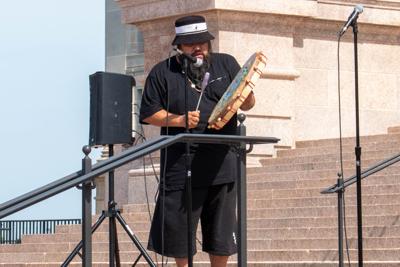

Before OU was established in 1890, it was the traditional home of the Caddo Nation and Wichita and Affiliated Tribes, according to the university’s land acknowledgment.
The land acknowledgment states that the territory OU was built on once served as a hunting ground, trade exchange point and migration route for the Apache, Comanche, Kiowa and Osage nations.
OU faculty discussed the implementation and importance of recognizing land that belongs to Native American tribes and actions that need to be taken in addition to land acknowledgment.
Teara Lander, vice president of OU’s Office of Diversity, Equity and Inclusion, said the purpose of the statement is to highlight and bring respect to the nations the land belongs to.
“You try to acknowledge the people, the time, the land, the commitment and also acknowledge what is currently happening or what goals and aspirations we have as an institution as well,” Lander said.
The university’s land acknowledgment statement was created by the OU Land Acknowledgement Working Group in August 2020. Lander said the group first started discussing the statement in 2019.
“There was a lot of research done on what other universities were doing with land acknowledgment statements, what they look like and how were they going to be implemented,” Lander said.
Lander said the group was made up of Native American faculty, staff and students including the tribal liaison officer at the time, Johnny Poolaw. Since then, the tribal liaison position has been molded into the OU associate vice president of tribal relations, now held by Tana Fitzpatrick.
At OU, land acknowledgments are not mandated statements to include in class syllabuses, Lander said. It is instead a resource available on the OU DEI and Native American Studies department websites.
Brian Burkhart, interim director of Native Nations Center and philosophy professor, said though land acknowledgment is important to recognize who OU's land originally belongs to, it is only a “first step.”
“Something beyond just the way that the land acknowledgment sits now — it's just this document that is an official OU document, but it just kind of sits there,” Burkhart said. “People use it or they don't, based on their particular intentions. There's nothing from the university that kind of creates a consistency of asking for its use in syllabi, or whatever. … It's just a thing that individuals can pick up and use if they choose and that's really all that it does.”
Burkhart said due to concerns that more needs to be included, there must be a better process for developing the land acknowledgment.
“To be able to take those concerns and make sure that (the statement) isn't just something we wrote at one time, and then it's just a law that can't be changed,” Burkhart said. “It's a living document that continues to, in a live way, respect our relationship with Native Nations as those develop and grow.”
Fitzpatrick said she first remembers hearing a land acknowledgment when she lived in Arizona from 2005-15.
“As someone who did not grow up in Arizona — I'm not a member of any of the tribes out in Arizona — you can just feel the respect,” Fitzpatrick said. “It's a respect to the land that you're on and to honor the people who are stewards of the land. It's such a simple, easy thing to do.”
A member of the Crow Tribe of Montana and a Sioux, Ponca and Chickasaw descendent, Fitzpatrick said when she went on a trip to Montana, she was overcome with emotion the moment she stepped into the airport. The land in Billings, Montana, she said, was where she was from.
“That draw, that feeling of being attached to the land was so significant to me that I realized that, and I'm only speaking for me, was something that I think I could feel was like a shift,” Fitzpatrick said. “I didn't even know it because I'm just existing in this lifetime, but maybe that's something that's been passed down the generations from being force-removed because we aren't tied to the land here as Ponca people, but up in Crow country that's where we've always been.”
To make sure the land acknowledgment effectively represents the importance land has to the people it belongs to, Lander said the land acknowledgment statement must be coupled with action.
“It does feel kind of empty sometimes when you say the statement, and then we don't talk about it ever again in our semester,” Lander said.
Burkhart said though the land acknowledgment is a way to remind everyone the land belongs to Native American nations, it is not all the university can do to respect the tribes to which the land belongs.
One thing Burkhart said the university could do is to provide free tuition for Native students. The University of California, the University of Colorado and the University of Arizona have already provided Native American students with free tuition, Burkhart said.
By working with Fitzpatrick, Lander said the DEI office is finding ways to further educate students and provide resources and opportunities to learn more about Native American cultures. Additionally, she suggests attending programs and events held through Native American Studies.
Fitzpatrick also said people who are interested in learning more about the tribes in Oklahoma could visit the tribal websites or visit public cultural events in order to learn more about the culture.
Although land acknowledgment statements may use the past tense, Fitzpatrick said the most important thing is to remember OU is on Native American land.
“We're not a past tense people. We’re very much present tense and we're thriving,” Fitzpatrick said. “It's important for people to understand that we're not stuck in the past here. We're still very much here.”


