
David McLeod lived and watched the experiences of Friday night through a unique blend of perspectives: a professor in the Anne and Henry Zarrow School of Social Work and a former police detective who was also a SWAT operator for six years. Now, he dedicates his research to forensic social work, large-scale trauma from violence and child protection.
Days after a nearly 90-minute Friday night lockdown that sent the OU community into panic over reports of an active shooter on campus, McLeod said the trauma people experience from gun violence or threats of gun violence is extremely real. He related it to how cows graze in the same patterns or along the same path in a pasture. Human brains react similarly with the same neural pathways igniting every time a gun violence threat occurs.
McLeod said the OU community feels the trauma and weight of mass shootings because they are extremely plausible on OU’s campus.
“We've had close to 150 mass shootings at this point (in the U.S.),” McLeod told OU Daily. “So the threat of gun violence on our campus, the threat of a mass shooter, active shooter scenario on our campus is not fiction. It's not make believe. It's not something that couldn't happen. In fact, we all know to some degree, that it is something very, very well that could happen.”
As of Thursday, 149 mass shootings have occurred in the U.S. in 2023. As of April 7, there have been 14 school shootings with injuries and deaths, according to Education Week. Between 1966 and February 2023, there have been nine mass shootings on college campuses, which signifies at least four or more people killed.
In 2022, there were 647 mass shootings with at least 21 of those having five or more fatalities, according to research conducted by the nonprofit Gun Violence Archive.
OU experienced its own mass shooting threat last Friday.
At 9:24 p.m. that night, OU sent an alert to community members reporting an active shooter on the South Oval. Almost immediately, law enforcement from throughout Oklahoma City metro area responded to aid the Norman Police Department and OU Police Department.
At 10:53 p.m., almost an hour and a half after the initial alert, OUPD issued an all-clear after law enforcement found no threat to campus.
On Sunday night, OU President Joseph Harroz Jr. sent a community-wide email saying OU, alongside the FBI, found Friday’s incident to be a result of international swatting. Swatting refers to false calls made to law enforcement with the goal of triggering a large response.
When Ashley Richmond saw the alert on Friday, she said her gut reaction was to cry. Richmond lives in Tampa, Florida which is 1,316.7 miles away from OU. She immediately texted her freshman sister, worried for her safety as Richmond searched for more information.
“It's horrible to think about your loved ones hiding,” Richmond said. “I was nervous to call her because I didn't know exactly what was going on. I didn't want her phone to ring. … Luckily, she wasn't on campus (on Friday). But it's just a horrible feeling when your loved one is in that situation.”
Hours before OU’s swatting incident, a shooter killed five people at a beach in Isle of Palms, South Carolina. On March 27, a 28-year-old former student killed six people, including three children, at The Covenant School in Nashville, Tennessee. On April 10, three days after OU’s false alarm, a 25-year-old man shot and killed five people and injured eight at a bank in Louisville, Kentucky.
On Monday, Yukon Public Schools closed after a student allegedly made a threat to Yukon High School.
In 1966, a 25-year-old student and ex-Marine killed 14 people and injured 33 people after climbing the University of Texas Clock Tower. This shooting was the deadliest college campus shooting until the Virginia Tech shooting in 2007 left 32 people dead.
“It’s not if this happens anymore,” McLeod said. “In our collective consciousness, we have accepted that it is now when will it happen. … We didn't question if it’s real, especially not at first, because we've all accepted the fact collectively that it's plausible and realistic.”
Trauma is not only living through a physical event but also the threat of events like Friday, McLeod said. McLeod explained that moments generating such intense – and in this case widespread – panic can cause a physical injury to brains.

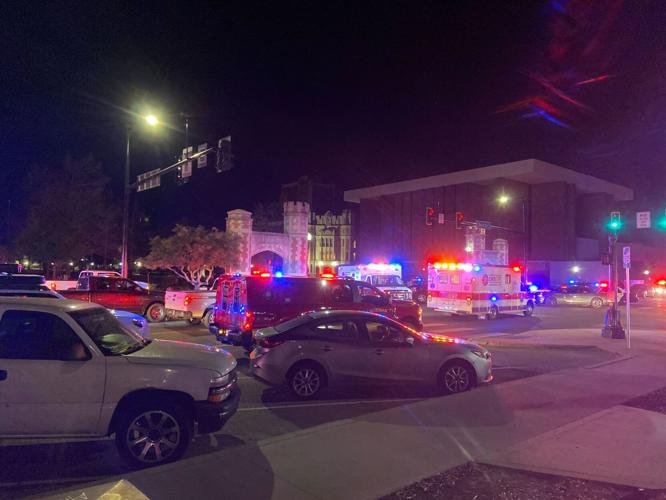
Emergency services respond to active shooter threat on Boyd Street and the Parrington Oval around 10:40 p.m. April 7, 2023. An all clear was issued by OUPD at 10:53 p.m.
On Saturday, David Surratt, vice president for Student Affairs and dean of students, sent an email suggesting mental health resources for students and faculty at the University Counseling Center.
After the incident Friday, the UCC did not reopen as it was after hours, according to a university spokesperson. They said a “reasonable” number of calls were made to the UCC in connection to Friday’s event as well as local and national news of mass shootings and swatting. UCC staff did adjust schedules to accommodate calls and needs from Friday, the university spokesperson wrote.
Richmond said as mass shootings and swatting increase in the U.S., she grows more afraid for her loved ones' safety in public places and schools. She said, whether the situation was real or fake, she still is feeling the effects of it.
Swatting has grown increasingly common in the U.S. This month, around 36 calls attributed to swatting threatened school districts in New York. Schools in Utah and Pennsylvania also have experienced cases of swatting in late March.
In December, swatting impacted about half a dozen schools in Oklahoma, including school districts in Tulsa, Stillwater, Bartlesville, Perry, Miami, Enid, Medford, Durant and Ardmore.
The FBI issued a statement in relation to swatting in Oklahoma in December, urging law enforcement and community members to take every threat to campus safety as real until determined otherwise.
According to the Associated Press, from June 2022 to March of this year, the FBI has found roughly 250 false reports of bomb threats or active shooter threats on college campuses.
Kelly Scheurich, a health and environment senior, said she hopes law enforcement and campus administrators use last Friday as a practice run for the worst-case scenario the OU community feared on Friday night. She said she hopes law enforcement and community members will ensure the safety of the community whether the threat is seemingly real or not.
McLeod said, while he was reassured by law enforcement’s quick reaction Friday, he said people might and probably will change how they respond if another such alert happens.
“Actually, I am afraid it usually does change how people respond,” McLeod said. “If we just think about it from the context of basic human behavior, it’s like the story of how the little boy cried wolf.”
McLeod related it to the threat of severe weather and tornadoes in Oklahoma. Given how Oklahomans endure tornadoes every year, some people become less afraid or take fewer precautions, watching the weather from their porches or not seeking shelter even if the threat is imminent.
McLeod said, because of human nature, law enforcement, students and faculty could change their responses as swatting calls increase.
“The law enforcement response Friday was pretty incredible,” McLeod said. “… Anytime we have to take a second to question if something is real, then it slows down the way we're able to respond. That's not coming down on anyone, that's just something that all of us are going to struggle with. Next time something happens, we'll all (wonder), ‘Is this real?’ And that could cost people their lives.”
On Saturday, several lawmakers from Norman urged university presidents to rethink and strengthen safety and gun policies on campus. In Oklahoma, people 21 years and older can open and concealed carry a firearm without a permit.
At OU, guns and firearms are not allowed on campus. Similarly, Oklahoma State University does not allow firearms on campus, however, there are exceptions based on law enforcement and needs for classroom instruction. People may also hunt on campus property if given permission and people with a permit and permission from the OSU president may carry a handgun on school property.
McLeod, Richmond and Scheurich said more needs to be done in terms of gun control and mental health support in the U.S. and on OU’s campus.
McLeod said fighting for extreme gun control won’t solve any issues as each side will continue to fight for their positions. However, he said taking small steps can ignite real change.
He said it starts with voters, especially students.
“You can dream about fantastical, wonderful, utopian policies. That's cool. I dream about it, too,” McLeod said. “But what's gonna probably work for us is finding ways to take a step at a time and working together, listening to each other, finding ways one step at a time. Most importantly, I encourage young people to find every way possible to become politically involved, to vote, to be present, to share their voices.
“We are a campus of 30,000 people. If all the young people in this space voted, we could change Oklahoma. … I trust that if you expressed your voice then we would have a different state to live (in). I would bet on you. That's why I'm here.”
Other stories about Friday's active shooter lockdown:

This story was edited by Alexia Aston and Jazz Wolfe. Nikkie Aisha and Teegan Smith copy edited this story.


