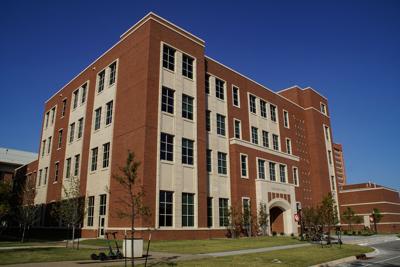

Members of the Gallogly College of Engineering illustrate how diversity, equity and inclusion programming helps students adapt to a diverse world by creating opportunities for students, faculty and staff to connect across cultures and backgrounds.
The Gallogly College of Engineering Diversity and Inclusion Program was first established in 1980 as OU's Minority Engineering Program to recruit and retain underrepresented minorities in engineering, promote inclusivity and create support systems.
Over the years, the program’s name has evolved from Minority Engineering Program to the Multicultural Engineering Program and is now the diversity and inclusion program, but the core purpose of the program has remained unchanged. Adapting to meet the needs of the changing student population is a priority, according to Lisa Morales, executive director of the Gallogly College Diversity and Inclusion Program.
According to the American Society for Engineering Education, there was a decline in student continuation to the second year in engineering programs from 2014 to 2015 across Asian, Black, African American, Hispanic, Latino and white ethnic groups.
Morales said students come into the college with different experiences and knowledge, so the program exists to help support them, encourage students to stay with the degree and give them experiences to thrive in the field.
In May, Sen. Rob Standridge (R-Norman) authored a concurrent resolution in May to defund any state-funded higher education institutions that do not eliminate DEI programs. The resolution cannot be approved until the next legislative session, which begins on Feb. 5.
Scott Cady, director of the Gallogly College Diversity and Inclusion Program, said the program follows a three pillar model: academic support, financial support and professional development. The program offers a first-year orientation class, peer-to-peer tutoring, scholarship and tuition waivers and a variety of meetings, talks and programs for career preparation.
“Each student is unique, so everyone has different needs. … We try to kind of fill the gaps. What does each specific student need so that we can build that strong community so that we're graduating a lot of really good engineers here in the college?” Cady said.
Cady said a common misconception is that there is an exclusive membership or application process. He said the program’s services are open to everyone.
“When we say diversity and inclusion, inclusion means everyone, so anyone can be involved in any of those aspects,” Cady said.
Jorge Lopez, mechanical engineering senior, has been involved in the program since his freshman year. He serves as a tutor and a teaching assistant for the program’s first-year class.
Lopez said his first year at OU was marked by the start of COVID-19. It was hard for him to find community. He said the diversity and inclusion program was where he made connections, met peers and was exposed to new experiences on campus.
Cady said it is an honor to be able to work with the program.
“It is all about the students, just being able to see their successes,” Cady said. “You know, we see them through adversity and fight through some of the struggles, but then being able to see them come through the other side — it's pretty amazing. It's definitely an amazing opportunity, and I'm very proud to be a part of it.”
Morales said the connections students make within the Gallogly College Diversity and Inclusion Program help retention and graduation rates because they feel supported.
“Relationships that students create during that first year or during that Summer Bridge (program), the relationships that are created in the study rooms, the relationships created as first-year students, … that network of relationships help students stay in engineering,” Morales said.
Morales said another important element the program helps foster is relationships between students and faculty. Morales said many Gallogly College faculty engage with the program in events such as a lunch series where students can sit down with them and learn about their research and ask for career advice. Morales said this helps break down boundaries between professors and students.
Morales said what’s special about the program is that it does not stop supporting students after their first year. Students can stay with the program throughout the entirety of their time at OU. She said this sense of connectivity has created a strong alumni community who give back to the the program through financial support and networking opportunities.
Lopez said the impact the program had on his life as a freshman motivated him to stay involved in the program and take on leadership roles.
“That’s what inspired me to give back to the future classes coming through the program and to try and be there to support them like they supported me,” Lopez said. “I wanted to facilitate those connections that are built in class and try to help build a community within our program.”
This story was edited by Peggy Dodd and Taylor Jones. Grace Rhodes and Avery Avery copy edited this story.


