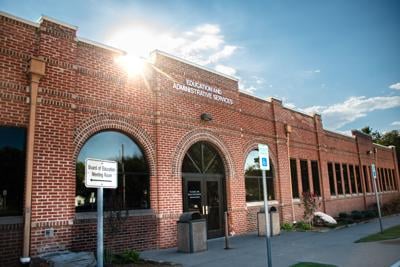

With over 16,000 students attending a total of 26 schools and academies, Norman Public Schools is the eighth largest school district in Oklahoma, according to its website.
Located in a college town, NPS offers a variety of ways to get OU education majors involved in the classroom.
The Jeannine Rainbolt College of Education offers its elementary education majors practicum and tutoring opportunities, which are faculty-supervised field work experiences. Students are also required to complete a semester-long, full-time teaching internship, designed to prepare them for certification.
Oklahoma has consistently ranked near the bottom nationally in public education with funding struggles and low test scores. A recent report ranked the state No. 14 for teacher “opportunity and competition.”
Math practicum at Lincoln Elementary School
Anna Christian, an elementary education senior, said NPS helps prepare OU students for post-graduation opportunities by offering required practicum courses at some of its schools.
“Norman is a college town due to OU, and (with) NPS’ proximity, they are heavy on making sure that the educators here are educated,” Christian said.
Christian is required to complete practicum courses through the school district. She has spent two semesters at Washington and Wilson elementary schools, helping first and second graders build literacy, fluency and comprehension skills. This semester, Christian is working on a math practicum at Lincoln Elementary.
Christian said the courses she’s taking at OU allow her to practice pre-K through third grade math, going hand-in-hand with the work she does at Lincoln.
“It’s all kind of reinforcing everything that we’ve learned up to this point and getting us ready to do our preinternship and our internship programs,” Christian said.
While the literacy practicum was a twice-a-week commitment, Christian said the math practicum only requires four 30-minute visits over throughout the semester.
Christian said the college of education helps students get involved in the practicums.
“They help you go with each step to build up to the next,” Christian said.
According to Christian, NPS teachers sign up to have OU students do practicums in their classrooms, then students choose a time and class area that works best for them.
Christian said the practicums have helped her understand what it looks like to make and implement lesson plans.
“I’ve enjoyed (the practicums) thoroughly, …” Christian said. “It’s helping me learn those tools with somebody who’s been in the field a long time.”
Christian said combining her usual courses with classroom work can be overwhelming, but the college eases students into it.
“They build up (a system) so you feel more prepared,” Christian said. “They have you work one-on-one with a student and they have you observe a classroom, and then they have you working with a small group, but you’re not actually teaching until your final semester.”
Inspired by her practicum experience, Christian hopes to specialize in literacy or math education in the future. With the state of education in Oklahoma often being politicized, Christian said her primary goal is to make a difference in the lives of students.
“The current political climate is sort of affecting what we’re able to teach our students, …” Christian said. “As much as policies are a big factor, a bigger factor for me is I’m still making an effect on these students’ lives.”
Tutoring at Reagan Elementary School
Catherine Cotton, an elementary education junior, works with a second grader twice a week at Reagan Elementary. Cotton is paired with one student for the semester and tutors them for about an hour on Monday and Wednesday.
“It’s been probably the highlight of my semester, …” Cotton said. “I’ve loved it so much and really been able to build a connection with my student.”
Cotton said that while tutoring is one part of a class she’s taking, she also makes lesson plans. She then implements those plans into her tutoring sessions each week.
“I can read about this stuff in a textbook all I want,” Cotton said. “When I actually go and get to see how students are actually learning and what techniques work best, that has really solidified what I’m learning.”
Cotton said balancing her time was difficult at first, but planning lessons ahead of time has helped.
“It was kind of a lot because we were making lesson plans and we have to have those submitted the day before tutoring, …” Cotton said. “But now I’ve kind of gotten into a rhythm with it. Especially now that I see what my student needs, and I can kind of start planning ahead for it.”
Cotton said working for NPS has shown her what to look for in districts post graduation.
“I’ve seen a lot of the resources they have for their students, …” Cotton said. “I’ve also been able to witness a lot of their support for first-year teachers. And so I’ve learned (that) even if I don’t teach in Norman, I want to teach in a district that has similar values and similar support.”
When asked about how the politicization of education in Oklahoma might affect her passion for teaching, Cotton said she wants to be there for her future students.
“No matter what the political climate is, I just want students to know there’s one person at least that cares for them,” Cotton said.
Teaching at Whittier Middle School
Evie Jackson, a language arts education senior who graduated in fall 2025, spent her final semester in a middle school classroom. Jackson student taught at Whittier Middle School, where she worked eight hours a day, five days a week.
“I am their teacher, …” Jackson said. “It’s a full-time job.”
At the beginning of the semester, Jackson was placed with a co-operating teacher, also known as a CT, who supervises and mentors student teachers throughout the semester.
The CT also advises OU students who are navigating teaching for the first time, according to Jackson. She said her CT has helped her balance her time while finishing her degree.
“I have an absolutely wonderful CT, …” Jackson said. “One of the first things she told me was ‘You do not take anything home.’ … I have done okay at keeping the two things separate.”
Throughout the semester, Jackson slowly took on more responsibility in the classroom. Jackson said she started by teaching lessons her CT had planned but later moved on to becoming the primary teacher for about three weeks.
“You do all the planning, you do all the grading, you do all the stuff. And your CT still has to be available to you, but they can be in the break room,” Jackson said. “Theoretically, you are the only teacher in the room.”
Aside from her CT, Jackson receives support from a university supervisor, someone who has experience working in a classroom and can offer teaching advice. She said the university makes sure students have all the resources they need.
Jackson said OU’s language arts education department handled most of the CT and classroom placement process. Jackson filled out a survey about her school and grade preferences, and department heads matched students to schools and teachers.
“They sort of handle most of the hard work there,” Jackson said.
Jackson believes student teaching with NPS has been a great networking opportunity and hopes to work with the district in the future.
“I absolutely love NPS,” Jackson said. “Everything that I have noticed about them and how they run their schools and how they treat their teachers just seems really uplifting. … I would love to work there at some point in my career.”
Jackson said her career goals consist of teaching middle school, earning a master’s degree and trying her hand at working out of state. Jackson believes working out of state will help her avoid teacher burnout.
“At some point, I would love to work out of state just because I think that a lot of really great teachers either become burnt out or become jaded to the profession, …” Jackson said. “The way that you avoid that is you keep moving. Maybe that doesn’t mean necessarily getting a new job every few years, but it means making sure that you are keeping up on the latest research and meeting new people at conferences and taking time to visit other classrooms in your school.”
Jackson noted her passion for reading and how book bans can affect education.
“I love English so deeply. Reading and writing are my two great passions in life,” Jackson said. “(Politicians) are trying to remove some very key aspects of ELA education, specifically just with books getting banned.”
Despite these challenges, Jackson said she hopes her future classroom will be a safe space for students.
“If they know that they can come into my class and feel safe and feel supported and know that I have got their back no matter what,” Jackson said, “then I think it’ll all be worth it.”
This story was edited by Ana Barboza and Natalie Armour. Arthur Shamayev and Sophie Hemker copy edited this story.


