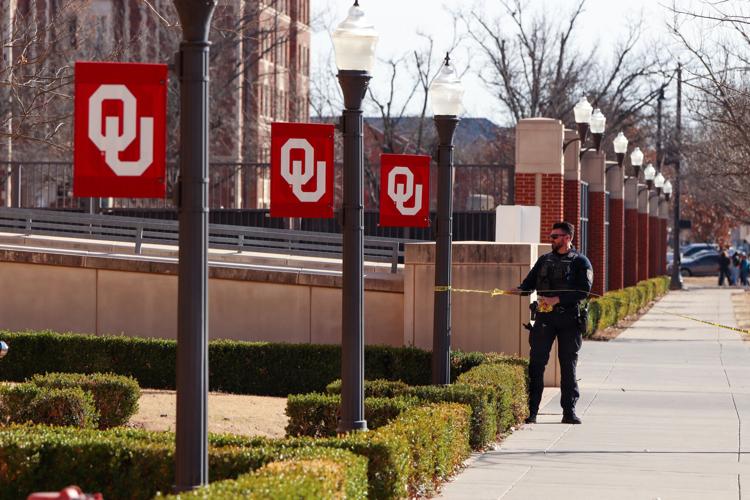
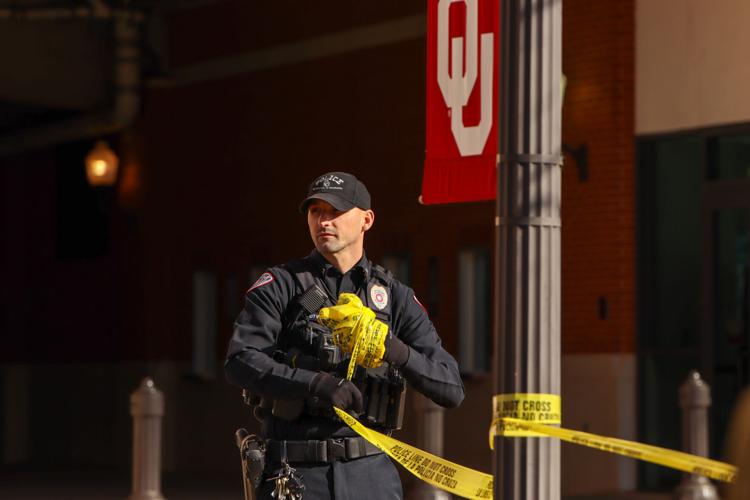


Norman Police Officer during the suspicious package alert on Feb. 16.
This story is part of OU Daily’s summer magazine. This publication will be available in mid-April on racks around campus and online at oudaily.com.
When a call reporting an active shooter on OU’s Norman Campus came in, David McLeod, interim director of the Anne and Henry Zarrow School of Social Work, immediately checked to see if his college was holding nighttime classes.
McLeod rushed to figure out where the potential shooter was on campus and worked to make sure that his students and faculty were safe.
“How do we lock the building down? How do we make sure everything, everyone, is taken care of and safe?” McLeod said he asked himself that night.
On April 7, 2023, Friday night plans were interrupted at 9:25 p.m., when OU sent out an alert warning students of a potentially deadly situation:
“There is an active shooter at the Van Vleet Oval. Take immediate action now. Run. Hide. Fight!”
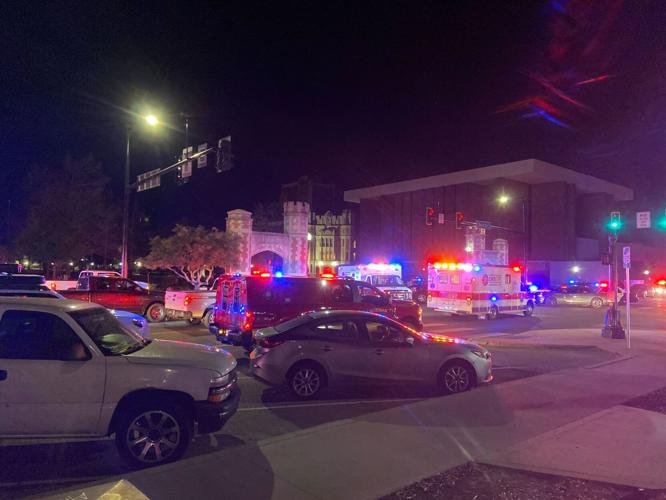
For the next 90 minutes, OU’s campus would be on a complete lockdown. The South Oval would be blanketed with a sea of blue and red flashing lights as first responders from eight different state agencies rushed to investigate a possible active shooter threat.
OUPD issued an all-clear at 10:53 p.m., determining there was never any threat to campus. Those 90 minutes were the result of a swatting, the act of falsely reporting mass violence to attract the attention and services of several law enforcement agencies, a situation that has become more frequent in past years across the nation.
Between April 4 and 9, 2023, 10 universities were swatted including OU: Clemson University, University of Florida, Boston University, Harvard University, Cornell University, University of Pittsburgh, Rutgers University, Middlebury College and Wake Forest University.
Before joining OU’s faculty, McLeod was a police detective and SWAT operator for six years in Sherwood, Arkansas.
“Something I think when we look at all these (swattings) on college campuses over the past year is, why?” McLeod said. “Who would benefit, why do we want to have all this fear and disarray on college campuses?”
In 2008, the FBI released a blog post detailing the “new phenomenon” of swatting, calling the schemes fairly sophisticated. The post read the reasoning behind these swattings include ego-driven factors and bragging rights.
McLeod said the impact of calls can stick with community members as they begin to unpack how they felt during the incident.
“The idea of a shooting on campus is terrifying,” McLeod said. “I don’t want my colleagues to lose their lives. I sure don’t want my students to lose their lives, and it’s just not funny. … It’s worse than a bad joke, the consequences can be really significant and they can last a long time.”

Norman Police Officer retrieving caution tape during the suspicious package alert on Feb. 16.
Signs and frequency of false calls
Two months after OU’s swatting, the Norman Police Department released four calls, three to the Norman Police Department’s non-emergency line and one to 911. The calls included simulated gunfire, locations and suspect descriptions, leading officers to the Bizzell Memorial Library.
One caller told operators a 6-foot-tall white man was heading north to the library carrying an AR-15 rifle. Another called from inside the library, saying their friend had been shot in the stomach and leg. A final call reported shots at “Ravenson Hall,” a nonexistent location on campus. Gunshots were heard on these three calls.
OUPD Chief Nate Tarver was part of the response to the South Oval. Upon reflection, Tarver said there were certainly signs that would point to a swatting attempt but nothing could be confirmed until officers responded.
“Don’t get me wrong, even with all those clues, when we get them, we’re still gonna go to the building, we’re still gonna go check it out,” Tarver said. “We have too many people on campus. Our responsibility is too big not to ensure that there is not something going on, and we need to make sure that everyone is safe.”
Tarver pointed to the use of the 10-digit NPD phone number rather than the quicker 911 as one of the first red flags he noticed. While students typically refer to the Van Vleet Oval as South Oval and the Bizzell Memorial Library as “the Bizz,” the callers used the official names of those locations, another thing that stuck out to Tarver.

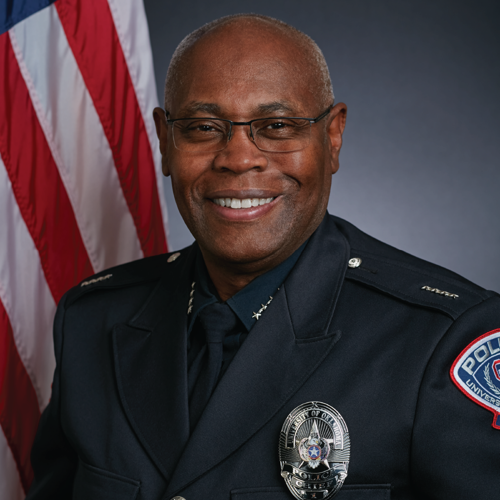
Chief Nate Tarver was recently named OUPD chief of all three OU campuses.
“In the heat of the moment, those aren’t things you sit there and think, ‘I wonder, why would they say that?’ when we should be moving toward going over there to find out what’s going on,” Tarver said.
Amy Klinger, director of programs at the Educator’s School Safety Network, said most swatting calls sound similar to the ones NPD received. Klinger’s organization specializes in K-12 safety.
In the 2022-23 school year, the Educator’s School Safety Network found that the most frequent violent incident in K-12 schools was false report of an active shooting. Over 63% of all violent incidents were swatting calls.
False reports increased by 546% from the 2018-19 school year to the 2022-23 year. As of April 1, 128 false reports have been called into K-12 schools this academic year.
“We know these things occur, and so we should be having these conversations beforehand. We should be talking about what swatting is, what it means and how people should respond,” Klinger said. “We should be talking about all different types of response so that people feel competent and capable to respond so that you don’t have that sense of panic.”
Klinger said the increase of swattings can partly be attributed to the fact that the calls generate panic, achieving the response the swatters set out to get through their false report. Klinger said swattings are meant to cause anxiety and chaos, and callers want to make people feel unsafe.
“Swatting stops working when people are prepared, when people know what to do and they’re empowered to do it, and they feel less anxious, and they understand what’s happening,” Klinger said.

Emergency services respond to active shooter threat on Boyd Street and the Parrington Oval around 10:40 p.m. April 7, 2023. An all clear was issued by OUPD at 10:53 p.m.
Lessons learned from April 7, 2023
As OU community members began to unpack the swatting event, responding agencies began to do the same. McLeod said swatting calls lead departments to review their responses to the incident and any associated calls.
“(Swatting) changes the way that we police communities and think about covering communities, and respond to changes, the way that we respond to calls or threats or incidents like that,” McLeod said.
In the days following April 7, OUPD started examining how they responded along with analyzing the calls from that night. That’s when they were able to point to some of the mistakes in the calls.
“We evaluate it to see how we can do better, because we try to do better every time we go through an incident, see where we might have made mistakes, or where things could have been improved,” Tarver said. “We did a lot of good things that night.”
The swatting on April 7 brought swarms of law enforcement to campus, from Oklahoma Highway Patrol, Oklahoma State Bureau of Investigation and police departments from Norman and surrounding communities.
Tarver said in some ways, the April swatting was almost like practice for an actual event.
He said the swatting was a waste of resources and time initially, but as he thought more, Tarver saw it as a learning opportunity. While most departments have some kind of simulated training event, Tarver said the April swatting had anxiety and elevated emotions a real active shooter event would have.
Klinger said departments have the opportunity to debrief and evaluate following a swatting, similar to what Tarver’s staff did. In terms of new policies post-swatting, departments can examine the call as it comes in, look for those warning signs of a false report, and respond accordingly on top of tracking the location of a caller, Klinger said.
“The ability to dial up our response and dial it back, to be able and have the capability to respond quickly and very aggressively and very impactfully to save people and to ensure you’re responding, but also to be able to dial it down,” Klinger said. “To be able to quickly pivot to something that is clear very quickly that it’s swatting, and so we can still respond, but maybe not an all ‘one size fits all’ kind of response.”
OUPD’s evaluation of calls was put into practice on Feb. 17, when someone called in another false active shooter threat on campus, seemingly directing law enforcement to Evans Hall.
Instead of the “Run. Hide. Fight!” message sent during the April swatting, the university sent an alert that instead read:
“Reported Law Enforcement emergency on Norman campus in area of EVANS HALL. Avoid Area.”
Tarver said likely within the first minute or two, a dispatcher could determine whether the call is an active situation or a false report, which happened with the February call to Evans Hall.
In a call to the 10-digit NPD non-emergency line, obtained by OU Daily, the caller told the dispatcher they were “at the main entrance” to the university and would not say a building name or street name, a seemingly odd way to describe a location on campus given OU has no official entrance. The caller, however, gave the exact street address for Evans Hall, 660 Parrington Oval. The call also had simulated gunfire.
Body camera footage from that day showed NPD responding to campus, closing down the Parrington Oval and parts of Boyd Street. A police incident report obtained by OU Daily labeled the event as a domestic disturbance.
“Our officers went over (and) said, ‘Hey, this sounds like this is not the real deal,’” Tarver said. “But, we’re gonna go over, and we check and we listen.”
In less than 20 minutes, an all-clear was issued for campus. Only a few OUPD officers responded to the call, which found no threat to Evans Hall or anywhere near OU.

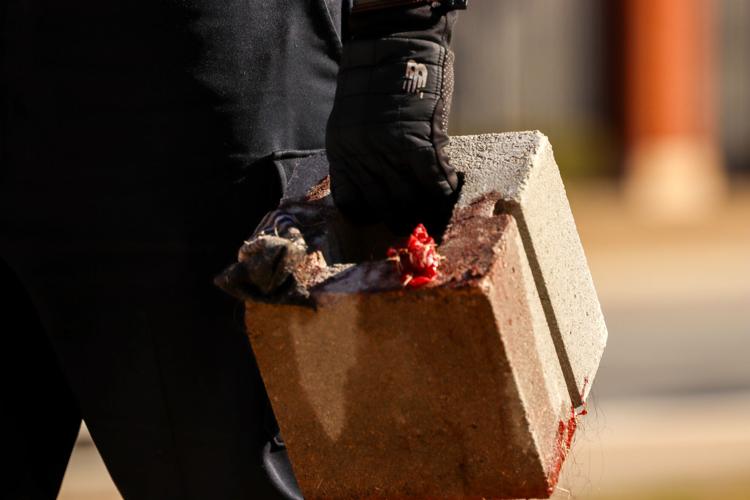
A part of the suspicious package on Feb. 16.
Impact
In December and January, Harvard University was swatted multiple times. There are instances where several school districts are targeted in swatting calls within a similar time frame. On Jan. 17, 13 school districts in Iowa received calls reporting false incidents. In October, 10 districts were swatted in New York.
McLeod said when these events happen several times over, it works its way into how the brain assesses situations, creating a boy who cried wolf situation. The implementation of this into the thought process is unavoidable, McLeod said.
“When we hear about false alarm, false alarm, false alarm, it changes our culture and our ability to or how we think about our own public safety systems and the ways they need to respond,” McLeod said. “We've come through a cycle.”
The frequency of swatting calls can leave community members questioning whether all calls are legitimate or not. This questioning can lead to risks, given the claims of swatting calls.
“Because of the nature of those calls and the risk that’s involved, seconds literally matter,” McLeod said. “You do that enough and then we have situations, scenarios, where we respond slower than we should, or in ways that aren't as effective as they could be. And then people can lose their lives.”
In the name of safety for the campus community, Tarver said the department is required to send RAVE alerts by the U.S. Department of Education through the Clery Act. Signed in 1990, the Clery Act requires colleges and universities to report campus crime data, publicly outline safety policies and procedures and send timely warning and emergency notifications.
The act requires crimes including robbery, assault, burglary, homicide, sexual assault, hate crimes, motor vehicle theft and arson to be reported to campus communities.
In January, fines for violating the Clery Act were raised to just under $70,000 per violation. In March, the U.S. Department of Education fined Liberty University $14 million due to several violations of the Clery Act, including the failure to notify campus security authorities of crime statistics and their obligations. Tarver said on the night of April 7, 2023, the notifications sent were within the requirements of the Clery Act, adding that some people felt uninformed while sheltering from a potential shooter. The U.S. Department of Education requires messages to be sent every 15 to 20 minutes, according to Tarver.
“We didn’t get the messages out as timely as we should have, … because my dispatchers are having to deal with a plethora of phone calls,” Tarver said.
Since the swatting, OU changed its practices. During a false alarm at Gaylord Hall on Feb. 16, RAVE alerts were sent more frequently than the night of the swatting.
Post-swatting, Tarver said there was a lot of support for the department coming from the OU community, leaving Tarver confident in OUPD’s response on April 7.
Tarver said as far as the department is concerned, officers will continue their duty to respond to all calls. He pointed to the panic alarms around the OU Health Sciences Center campus in Oklahoma City, saying they go off quite often.
On Feb. 9, OUHSC had a false alarm scare through those panic buttons when one was triggered inside the College of Dentistry. There was a police presence on the campus that afternoon as a result.
“We can’t afford not to take them seriously,” Tarver said. “The one you ignored is going to be the one that’s the real deal.”
As departments begin to adapt to the reality of swatting calls, Klinger said swatters will begin to look for new ways to target communities. According to Klinger, the future of campus security, and its possible threats, leave departments in a position where they must be aware of all ways people could target campus.
“Swatting, the way that we’ve seen it, is going to be replaced with something else. It’s going to be replaced with some other threat or some other way to try to traumatize folks,” Klinger said. “That’s why the work of safety is so important to be ongoing because you have to continue to adapt, you have to continue to look at trends and see what’s happening and try to stay a step ahead.”
Read more from summer magazine:


This story was edited by Karoline Leonard, Anusha Fathepure and Ismael Lele. Natalie Armour, Avery Avery, Mary Ann Livingood and Nikkie Aisha copy edited this story.


