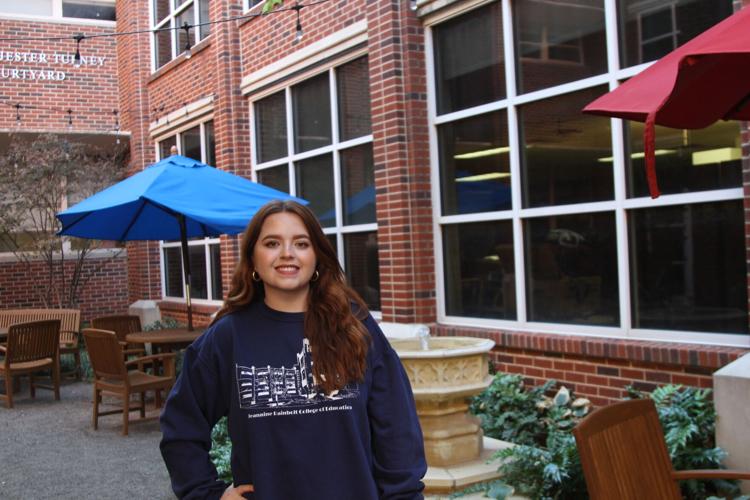
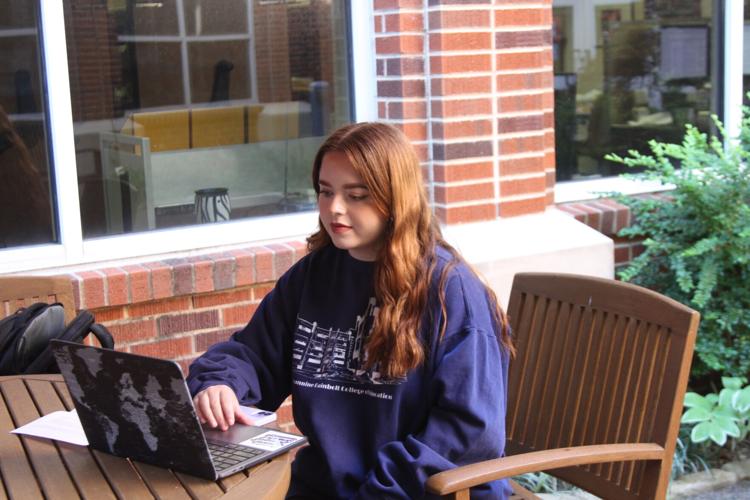

Jacie Doyle-Lackey abandoned her plans for law school and transferred from Oklahoma City University to OU in the hopes of becoming a teacher. She was inspired by her parents’ teaching careers in Oklahoma.
“They told me my whole life, ‘Don't be a teacher,’” Doyle-Lackey said. “But I couldn't help it. That's where my heart is.”
Doyle-Lackey decided to focus on social studies education at the OU Jeannine Rainbolt College of Education. Now, as a senior, she serves as the president of the Oklahoma Aspiring Educators Association, or OEA, in connection with the Oklahoma Education Association.
Doyle-Lackey said, although her passion for education continues, she has come to learn the many faults of the Oklahoma public school system through her involvement. She said this year’s midterm elections are more crucial than ever in terms of Oklahoma education.
Joy Hofmeister, Oklahoma’s superintendent of public instruction and the Democratic gubernatorial candidate, switched her political party in October 2021 to run against Republican incumbent Gov. Kevin Stitt in response to his actions and beliefs surrounding public education, like his lack of efforts to increase teacher pay and his goal to eradicate certain race and gender conversations from schools.
Ryan Walters, a Republican, and Jena Nelson, a Democrat, now vie to become Oklahoma’s next state superintendent. Nelson was the 2020 Teacher of the Year and teaches English composition at Classen SAS Middle School, and Walters is a history teacher at Millwood High School and McAlester High School.
The future of race conversations, school funding and teacher pay are on the ballot this November. As Doyle-Lackey and other aspiring teachers prepare to enter the workforce, they are examining their future leaders with a closer eye, deciding how each topic will impact their careers in Oklahoma.
“You have two candidates that are polar opposites of each other,” said Katherine Bishop, the president of Oklahoma Education Association. “In the midst of all that, you're in a state that has the lowest voter turnout year after year. … Everything is decided by someone who's elected. So every election, every one of them — from the school board race to a state House race — every one of them, education is on the ballot.”
Stitt signed House Bill 1775 into law in May 2021, prohibiting public schools from teaching that a person, because of their race or sex, is inherently racist, sexist or oppressive, either knowingly or unknowingly. Currently, the OU Black Emergency Response Team, American Association of University Professors and American Civil Liberties Union of Oklahoma are challenging the state law, saying the bill suppresses their right to talk about race and gender issues and prevents discussions of a complete U.S. history.
The bill led to several conversations surrounding race and gender in public education, with educators saying the language of the bill is vague and up for interpretation. This led to conflicting decisions and targeted attacks on teachers, school districts and certain curricula, Bishop said.
Over the summer, the Oklahoma State Board of Education voted 4-2 to downgrade Tulsa Public Schools’ and Mustang Public Schools’ accreditation status after the districts were found to have violated HB 1775 during implicit bias training for teacher.
The State Department of Education only recommended the downgrade be to “accredited with a deficiency,” but the board, made up of Stitt’s appointees, took it a step further by downgrading the school districts to “accredited with warning.”
In 2021, Hofmeister said she believed the bill should not have been rushed through by legislators before consulting educators.
She voted against the accreditation downgrade for Tulsa and Mustang. Walters advocated against Hofmeister during the state board’s meeting, saying she failed the children of Oklahoma by allowing pornography in schools.
Several Oklahoma school districts removed books by minority and female authors, including Lorraine Hansberry’s “A Raisin in the Sun,” Maya Angelou’s “I Know Why the Caged Bird Sings” and Harper Lee’s “To Kill a Mockingbird,” to avoid downgrades or complaints.
Megan Lambert, the legal director of the American Civil Liberties Union of Oklahoma, described the bill as being so vague that educators don’t and can’t be expected to understand what is being restricted and the consequences for violating the law. Because school districts are leaving it up to the teachers to abide by the law, she said many are “playing it safe.”
“When students, especially those who are not heterosexual or white, see only that (white, heteronormative curriculum) is in their schooling, that results in students feeling othered and separated and overlooked,” Lambert said. “Lessons are bare bone or nonexistent.”
Doyle-Lackey said, because Oklahoma is a conservative state, the bill was not a surprise, but the vagueness of the bill was. According to the Pew Research Center, 60 percent of Republicans in Oklahoma reported to be conservative and 18 percent of Democrats reported being conservative. The State Election Board says 50.1 percent of Oklahoma voters are registered Republican and 32.9 percent are Democrats.
Summer Boismier, a former Norman High School teacher, resigned over the summer when a parent complained that, by displaying a QR code to Brooklyn Library Books Unbanned in her classroom, she violated the state law. Walters called for the state board to revoke Boismier’s teaching certification, saying he was speaking for all parents and children in the state of Oklahoma.
“There is no place for a teacher with a liberal political agenda in the classroom,” Walters said. “Ms. Boismier’s providing access to banned and pornographic material to students is unacceptable and we must ensure she doesn’t go to another district and do the same thing.”
In response to Walters’ request to revoke Boismier’s license, Nelson said HB 1775 frightens teachers, as the law is too “ambiguous.”
Doyle-Lackey said her peers are worried about being unable to accurately teach topics of race and bias if politicians who support the bill remain in office.
Lambert did not explicitly say which candidates are conflating these issues, but she did say the issue is statewide and isn’t slowing down.
Lambert and Doyle-Lackey said race and gender curriculum is one of the leading issues for public schools as the general election approaches. The way Stitt and Walters govern classrooms will be “detrimental” to social studies and English education in the state, they said.
“There's a lot more to teaching than just teaching to the test,” Doyle-Lackey said. “We have all these outside legislators controlling what we can teach, but (these laws) don’t address anything that actually happens in schools.”
Doyle-Lackey said HB 1775 is harmful for educators, as it prevents all voices and students from being represented in Oklahoma classrooms and curriculum.
“(The bill is) a way to promote Eurocentric education and white supremacy, which does suppress students of ethnic minorities,” Doyle-Lackey said. “It also further suppresses students who identify with different gender identities or have different sexual orientations. We're not really adjusting (to) the dynamic society of students and how they're changing, and we're not meeting their needs.”
Bishop said, in conversations with other educators, that the topic of school vouchers is swaying the votes of teachers.
Walters and Stitt, among other state legislators, tout school choice. They argue that vouchers allow parents to make the best decision possible for their kids by letting them attend private schools or be homeschooled over public schools.
Vouchers help pay part of a student’s private tuition using taxes that would normally be allocated toward public schools. Private and charter schools, however, are not responsible for providing free transportation, meals or supplies, Bishop said.
Stitt described vouchers as “scholarships” for students during a discussion on education with the Leadership and Policy Center for Thriving Schools and Communities at OU. He said vouchers help students get out of public schools with poor records and low test scores, instead of funding the school.
Stitt said the schools would not be fixed from within during the discussion at OU. He said his goal is to allow individual students to leave public schools with high dropout rates or low test scores.
Nelson disagrees, believing it is more important to fund public schools than private schools, according to her campaign website and in debates. Hofmeister also disagrees with Stitt and Walters on school vouchers, calling them a “rural school killer.”
Bishop said although the concept seems beneficial on the surface, she believes they are detrimental to education in Oklahoma. She said vouchers would likely go to students enrolled and paying tuition at private schools before being offered to children at public schools.
Around 90 percent of Oklahoma children attend public schools, according to the Oklahoma Education Coalition, or the OEC, and the Oklahoma Parent Legislative Action Committee. Both the OEC and Oklahoma State School Boards Association oppose vouchers, saying they take money away from public schools and that the state already has transfer laws allowing students to attend schools in other districts.
“Anytime that you take public dollars and start putting them to a private entity, you will start eroding that public entity,” Bishop said. “Even if one student goes to a private school and takes a voucher with them, there are still 19 other kids in that (public school) classroom. There's still a teacher in that classroom. There are still all the expenses that are required to be paid. So it is a way to dismantle our public schools.”
In September, the State Department of Education released new data on test scores, showing how some scores have improved amid the pandemic.
The Oklahoma State Department of Education reported that the number of students who scored at their grade level increased for each age and subject area with two exceptions.
In 2022, about 2.6 percent fewer eighth graders showed mastery of science in their grade level compared to 2019. Fewer high school juniors were proficient in math, with only a quarter of all Oklahoma students scoring at grade level in math.
The results indicate the majority of Oklahoma students scored at a basic or below basic level. Below basic, according to the State Education Department’s report, means students are not on track for college or career success.
Bishop said people need to look at test scores holistically. Overall, she said the state is doing better than it has in years past, but issues like the teacher shortage, teacher pay, low resources and money spent per student all contribute to these test scores and the education of Oklahoma children.
In the 2020-21 school year, Oklahoma Public Schools ranked 45th in the nation for per-student spending of about $10,553. Education support professionals in the state made an average of $28,246, ranking last in the U.S.
Oklahoma ranked 39th in the nation for its average starting teacher pay of $38,074. The state is 34th in its average teacher salary, which is $54,762.
During the discussion with OU THRIVE, Stitt said Oklahoma teacher pay has been increasing and the state is “ahead of the game” compared to the rest of the country.
“Teachers normally don’t get into this profession to get rich,” Stitt said in the discussion. “They get into this profession because they have a heart for young people.”
Stitt also explained that his administration was preparing to pay teachers six figures. Stitt claimed the state was the top in the country for teacher pay, state test scores and per-student spending.
“I don’t know where the governor got his figures from, but we are (at) the bottom,” Bishop said.
Bishop and Doyle-Lackey said the teacher shortage is exacerbated by Oklahoma not having competitive pay for teachers. Doyle-Lackey said teachers “wear a lot of hats,” and they often have to pay out of pocket for school supplies, classroom necessities and more.
Bishop said part of the reason test scores are improving is that, after the pandemic, federal relief money was given to education, leading to increased scores.
“We've made improvements, and I think we've lost sight of that,” Bishop said. “There's a lot of money that came into every state, especially our state, with federal relief dollars to help make up for any disruptions that happened during the pandemic. We've shown that our students have made up and gained on their test scores, so there is the example that putting more money into (education) does help. Our test scores showed that.”
Walters pledged that, if elected, he will stop federal funding from entering Oklahoma to prevent federal oversight in public schools. Doyle-Lackey and Bishop said this federal funding creates equity, creates jobs, pays the bills and is the support every student and teacher needs.
“(Cutting federal funding) will have a tremendous impact on education. Many of our salaries are paid through federal funding. Federal funding was created to bridge that gap and provide equity,” Bishop said. “It provides services for our students with disabilities, our students that are economically disadvantaged and to make sure that our students who are English learners or Native American … have an equitable funding source.”
In comparison, Nelson supports increasing and requesting more federal funding. Nelson expressed her support for Hofmeister’s annual education budget request in September, which would include a $5,000 pay raise for teachers.
“From day one of my campaign, I have been clear that providing the pay, resources and support Oklahoma teachers need is critical to preventing teacher flight and expanding the amount of quality educators and support staff including paraprofessionals,” Nelson wrote in a press release.
Aiyana Henry, the associate dean for professional education at OU Jeannine Rainbolt College of Education, said teachers are vital for students’ careers and futures. She said despite the controversy and turmoil education has experienced in the state, it is an exciting time to be a teacher.
“If you think about it, in all professions, anything that we've done, we were inspired by a teacher,” Henry said. “There was a teacher that helped create a pathway for us to be where we are.”
Bishop and Doyle-Lackey said getting out to vote in November is the most important thing. They both explained that voting with education at the forefront of the mind is the only way to improve the state as a whole.
Doyle-Lackey said she still dreams of being an educator. She hopes to inspire students and teach history that is accurate, transparent and all-encompassing. She said the only way she can do that is if Oklahomans vote for education.
“It's crucial for the public, not just aspiring educators or current teachers, to recognize the impact that public education has on students and teachers,” Doyle-Lackey said. “Education, at its basic roots, can help people overcome economic inequality and social inequalities. Oftentimes, I feel like teachers and students just get left out when people go to the polls, but I feel like this time, more than ever, it's important for people to recognize the importance of our field.”


