
This fall, several Oklahoma public schools were hit with a wave of threats and a shooting at a Choctaw High School football game that resulted in the death of a 16-year-old boy.
Safety concerns and proposed solutions followed, with Norman experts and school professionals offering different perspectives regarding school safety and resource officers in Oklahoma and Norman Public Schools.
On Aug. 22, Ellen Ochoa Elementary School of Union Public Schools in Tulsa received a bomb threat. Faculty said they believed the threats were in relation to an altered video reposted by Oklahoma State Superintendent Ryan Walters on X, formerly Twitter, that morning.
The threat at Ellen Ochoa Elementary School prompted a week-long string of threats against multiple Union Public Schools sites.
On Aug. 25, a shooting at a Choctaw High School game killed a 16-year-old boy and left four others injured.
On Sept. 15, Union Public Schools received more bomb threats against five of its sites.
On Sept. 26, the Norman City Council postponed funding four additional school resource officers.
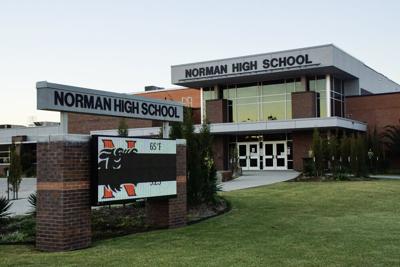
On Sept. 28, Norman High School reported a threat of violence from a former student. In response, Ward 1 Councilmember Austin Ball advocated for the funding for additional school resource officers. Ward 2 Councilmember Lauren Schueler said postponing the school resource officer vote was still necessary.
In mid-October, Norman Public Schools approved the funding of 17 school resource officers, placing one in each school in the district. The officers were funded through the Cleveland County Commissioners.
On Nov. 14, the Norman City Council approved $900,995 for four additional full-time school resource officers. The vote increased the funding from nine full-time school resource officers to 13, fulfilling the Public Safety Sales Tax.
Sheri Bennett, assistant principal at Washington Elementary School, said school resource officers are a beneficial aid and source of comfort for the school.
“We are so grateful to have a trained officer that can carry a gun and be a buffer for us and our students,” Bennett said.
Bennett said Washington Elementary staff members have become increasingly aware of safety threats and created specific plans in case of emergency. She said Washington Elementary uses the Rave app, a state-required safety app that allows faculty to report suspicious behavior.
Amber Wells, Washington Elementary’s school resource officer, was hired in August. She said her primary job as a school resource officer is to keep schools secure and act as a mentor to the students.
“I get involved with the kids. If they're having a bad day, I'll sit and talk with them. I'll walk them to their classes, or if they need help with something, I'll go help,” Wells said. “We don't want them to run away from us. We want them to run to us if they're in trouble.”
Before becoming a school resource officer, Wells began her law enforcement career at the Pottawatomie County Sheriff’s Office in 2015. She said she will receive additional training next year but did not specify what that training was or what agency it was through.
Stephen Ellis, a philosophy professor at OU, said he doubts school resource officers can both ensure school safety and manage the mental health of students.
According to Ellis, Black students experience contact with school resource officers more frequently than non-Black students — another reason for his doubt.
According to the Advancement Project, a civil rights nonprofit, 80% of police assaults in public schools have involved Black students from 2011 to 2021. Black students are over twice as likely to be reported to police than white peers, according to ACLU North Carolina and the U.S. Department of Education.
“Even if these are just crimes and (school resource officers) just respond to them, they're escalating those things out of the school disciplinary system into the judicial system,” Ellis said.
Instead, Ellis said Norman would benefit more from funding school counselors. He believes counseling and school discipline should not be the jobs of school resource officers. For Ellis, counselors are optimal sources for student mental health and could determine which students may be potentially dangerous.
According to the American Counseling Association, a third of school shooters received mental health evaluations prior to the shootings and a reported 87% experienced bullying. In 2019, the U.S. Secret Service created a threat assessment prevention plan for school shootings, which included monitoring concerning student behavior.
Bennett said mental health support should be taught in schools to aid students throughout their lives and prevent crises, citing social-emotional learning.
Social-emotional learning, also known as SEL, is an educational method designed to strengthen emotional skills for social, academic and professional environments. In 2022, state Sen. Shane Jett (R-Shawnee) proposed a bill to ban the social-emotional learning curriculum, considering the program to “psychologically manipulate” children.
“Social-emotional learning is very important to elementary students as it sets the foundation for mental health as they grow older,” Bennett said. “Learning how to regulate your body and emotions at a young age can help a student with issues later in life that would cause mental duress.”
Wells said mental health is a primary issue regarding school safety. As a result, she said she watches the students for signs of mental distress.
“It's not a gun control issue, it is mental health and that has always been on the back burner,” Wells said. “Oklahoma has failed in dealing with mental health.”
Wells cited State Question 781, which proposed transferring prison funding for drug offenses to mental health and drug addiction treatment. The question was approved in 2016, but according to Oklahoma City Free Press as of 2022, the fund has not seen an increase since the year of its approval.
Oklahoma Rep. Jacob Rosecrants (D-Norman), who was a former Norman school teacher for five years, said school mental health is a major issue for him. He said he has been trying to grant $5,000 stipends for school psychologists since his election, citing the lack of school psychologists in the state.
He added a lack of mental health support works in tandem with a lack of gun laws to create unsafe school environments.
“If you have mentally questioning kids, maybe they shouldn't have access to a weapon of war,” Rosecrants said. “I think red flag laws work as long as they're enforced the correct way.”
Red flag laws are laws that allow for the removal of weapons from individuals deemed threatening to themselves or others. In 2020, Oklahoma legislators passed the first “anti-red flag gun law” in the country, regarding red flag laws as unconstitutional.
For Rosecrants, the concerns over school safety are part of a broader systemic issue in the state capitol. He said as political polarization and cultural divisions over policy increase, schools have become a target.
“They now make our public schools the battleground and when you have a battleground, you have casualties,” Rosecrants said. “The kids are going to be collateral here.”
Though school safety concerns have increased, Rosecrants said the situation will improve as he hopes school safety policies will be controlled locally.
“These things are cyclical, but we are going to go through some really dark times,” Rosecrants said. “I'll keep fighting if that gives hope to folks and in the end, I think we can get back to where local control takes over.”
Bennett said Washington Elementary’s faculty are committed to ensuring school safety even if the safety in Norman Public Schools may be uncertain.
“I work with educators who understand that kids are our future leaders and we must do the best we can to push them forward into the next generation,” Bennett said. “I honestly hope (school safety improves), but until we put funding into more social-emotional learning for our school-age students, I seriously doubt that it will.”
This story was edited by Alexia Aston, Taylor Jones, Karoline Leonard, Ismael Lele and Anusha Fathepure. Nikkie Aisha copy edited this story.


