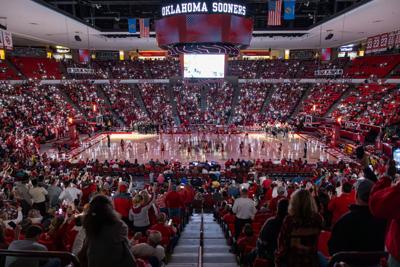

Just past the entrance to the OU basketball arena in the Lloyd Noble Center are the muted sounds of hype music and the bustle of a crowd excited for the game. Once inside, the noise grows and the excitement of each attendee is clear.
It is that excitement and love of both sports and the city that led Team Norman and city leaders to seek to expand with a proposed $1 billion entertainment district that would include a new OU arena.
However, some are concerned that the speed and cost of this growth are too great to be feasible, especially as there are surrounding districts with proposed projects that could provide much of the same thing.
Oklahoma City residents will vote on Tuesday to construct a new arena less than 30 miles from Norman that would house the Oklahoma City Thunder and double as a concert and multipurpose event venue.
A few miles away from the proposed Thunder arena lies the ongoing construction of OKC Fairgrounds coliseum to replace the Jim Norick Arena. This venue will house mainly rodeos and horse shows.
With each venue under construction or up for deliberation, residents are questioning how much each could contribute to the metropolitan area.
“(Oklahoma City is) building a brand new arena. (Norman might) build a new one. … Will they be competing against each other for events?” Ward 7 Councilmember Stephen Tyler Holman told OU Daily. “And what type of things can we actually expect to be able to get here outside of OU athletic events?”
Proposed University North Park Arena
Team Norman, a task force dedicated to preparing and bolstering OU’s 2024 move to the Southeastern Conference, proposed plans in September for a $1 billion entertainment district, which would include an OU arena, multi-family housing and commercial locations.
The multi-purpose arena would host concerts and shows, but OU basketball and women's gymnastics would be the central tenants. The venue would hold roughly 8,000 seats and while the university would be the facility's anchor tenant, OU would only use roughly 25% of its availability.
For Holman, it is less of a concern what the other percentage of event availability is at the arena and more on what exactly would be surrounding it.
“For the most part, an arena is an arena,” Holman said. “Events would be held there. People would go to basketball games and gymnastics, even concerts potentially and whatever else. But to me what, what is around it?”
An application for a Nov. 30 pre-development meeting stated that University North Park, LLC plans to rezone the property along Interstate 35 between Rock Creek Road and West Tecumseh Road to facilitate a mixed-use, master-planned community, for residential, hospitality, entertainment and compatible commercial uses and opportunities.
Preliminary designs for the district show restaurants, retail stores, offices, hotels, a parking garage and outdoor spaces.
To possibly help finance the district, Norman City Council adopted a resolution in a Nov. 14 meeting, forming a review committee for a possible tax increment finance district, or a TIF, in the entertainment district.
A TIF is used to support the redevelopment, infrastructure and community-improvement projects in a certain area with the intent of stimulating private investment in an area in need of economic revitalization.
Holman said there are two sides in the city’s debate over this district.
One is arguing in favor of the district because it could generate new sales tax and economic activity, and there would be entertainment that would drive people to Norman.
The other side argues there's no guarantee an entertainment district would bring in visitors and could end up cannibalizing the sales taxes generated in other areas such as downtown or Campus Corner.
Plans for an OU arena in University North Park was first introduced in 2017 with several OU professors speaking against the project, citing its lack of economic viability and potential loss of Norman’s cultural identity.
One of those professors, Stephen Ellis, an associate professor in OU’s Dodge Family College of Arts and Sciences and expert in economic philosophy, said even though the newly proposed district could include constructions other than the arena, the overall cost of the project may not be feasible considering the level of demand for such a place in Norman.
“When you look at all of the empirical evidence, like from economic studies and stuff about this, you can make a certain district thrive, but it's usually done because it soaks up stuff that would have gone other (places),” Ellis said.
While it could be beneficial to have this district, Ellis said there are other things the city should prioritize such as working on the replacement, repair and rehabilitation of up to 18 bridges across the city as voters approved in October.
“There's a lot of competition for what's roughly the same amount of money. … This looks like it's a way of the city (to) sort of to pick winners, if you will,” Ellis said.
Scott Martin, president and CEO of the Norman Chamber of Commerce, said the proposed University North Park district would meet a unique niche that would differentiate it from other venues in the surrounding area. With its proposed size and places for housing, retail and dining being built around it, Martin said the district could bring a new environment to attract different audiences.
The location of the project, Martin said, would be around other hotels, retail and dining areas, so Norman residents could see an OU game and find a place to eat or shop nearby.
“The other two projects are speaking about one stand-alone facility, … but in Norman you're talking about a roughly billion dollar total project that will include an arena, parking garage, some really unique retail, some outdoor entertainment space, hotels, (a) conference center, apartments, other single-family housing and offices. It's a true live, work, play project,” Martin said.
Proposed Thunder Arena
The Paycom Center, which currently houses Oklahoma City’s only professional sports team, the Thunder, is a staple in downtown Oklahoma City.
The round, brightly lit arena draws a crowd year-round, given its frequent concerts and other entertainment events.
From 2022-23, the average attendance of a Thunder game was 15,534 attendees per game. There are currently 18,203 seats in the Paycom Center.
In September, Oklahoma City finalized a proposal for a new downtown arena for the Thunder, an approximately $900 million construction to which Thunder ownership has committed to contribute about $50 million.
The Thunder have committed to play in the new arena until 2050 and the plan to construct the arena and verify the Thunder's commitment is conditional on the result of Tuesday’s temporary 1-cent sales tax vote by Oklahoma City residents.
The University North Park district would be financed in a TIF district, which is not put to a vote.
The capacity for an average NBA arena is about 18,790 seats. The newly proposed Thunder Arena would be the largest of the proposed venues in the Oklahoma City-Norman area, according to Steve Hill, chief of staff for the Oklahoma City mayor.
Hill said the Paycom Center was originally built for a hockey team, meaning a new arena would require much needed improvements, like better locker rooms or, for concerts, backstage space.
“We have an NBA team playing in a very cheap arena. … It's worked for us. I mean, they've been there for 15 years and it's been fine, right? But we've really been kind of coasting on what we should have for an NBA team,” Hill said.
In 2022, the Paycom Center set a record for the number of comedy and music shows it hosted in a year, bringing in 37 concert events. Hill and other supporters of the new Oklahoma City arena hope this number would continue to grow with the development.
Hill said the new arena would allow for larger backstage areas for artists that other venues and the previous Paycom Center do not provide.
“The Norman (arena would be) smaller and it should be because it's a slightly different purpose, but an arena like a concert and professional sports arena, it's going to be about 20,000 people in the bowl. What you really need (is) not the space that's in the bowl. … One of the struggles that we have with Paycom in regard to concerts is that we don't have the luxurious backstage area that live stadiums or arenas are able to pitch to artists,” Hill said.
As for the feasibility of this new arena bringing more revenue for multiple different businesses across the city, Ellis said he has his doubts due to “trade-offs” businesses make when new ones are built.
“If you owned a bar close to the Thunder stadium, your business did great, but if you owned a club that had different kinds of entertainment, you got hurt because others out-competed you,” Ellis said.
With the Thunder arena proposed and in discussion alongside the smaller, but similar, venue-type Norman arena, Ellis said he believes there would be competition.
“OU has been a very successful basketball program and I think it took a little bit of the shine off college basketball to have a pro basketball team in the area,” Ellis said. “Now how much that competitive effect was is a little bit hard to quantify.”
Ellis said in addition to these venues possibly competing with each other, they would also not provide a new source of income. Based on research, Ellis said there is no drastic economic change in Norman per month even comparing months where there are zero home football games or three.
As an example, Ellis said if OU football were to suddenly leave Norman, it would hurt the economy, but it would not take the city a long time to recover from it because other things would fill in. This is another reason he believes a new arena and entertainment district would make no great economic change in Norman.
With the upcoming vote for the construction of the new Thunder arena, Hill said residents in Oklahoma City have the choice to vote on whether they think this is good for the city and if they want it to be a part of it.
“If you want to be a great city, you have to do great things. You have to build great buildings and that type of thing. I think that the current mindset in Oklahoma City is that we would like to be a great city,” Hill said.
OKC Fairgrounds Arena
Oklahoma City leaders broke ground in February for the new OKC Fairgrounds coliseum, a $144 million project which will seat about 4,700 for horse shows and will include retractable seating to accommodate up to 7,500 people for events currently held in the Jim Norick Arena like concerts, graduations and high school wrestling and basketball games.
Unlike the proposed Thunder and University North Park arenas, construction is underway and expected to conclude in 2025.
Critics of the district in Norman are concerned about having three arenas within a 30-mile radius of each other, possibly competing for venues and events. According to Scott Munz, spokesperson for the OKC Fairgrounds and a former booking manager, each district will possess a unique quality, making competition possible but not damaging to the success of any venue.
“All three of those (arenas) are distinctively different and it's mostly based on the size and type of business or type of events they have at each one of them,” Munz said.
The new proposed Thunder arena, Munz said, would fit larger concerts and shows than the proposed Norman arena or the new OKC Fairgrounds coliseum would.
The fairgrounds coliseum, which has yet to be officially named, will be home to events including Oklahoma Secondary School Activities Association basketball games, event forums and Disney on Ice, like the proposed Norman arena is set to house outside of OU athletics. However, Munz said it will mainly be a hub for horse and rodeo shows, which differentiates it from the other venues.
As for competition between the venues for attracting concert events, Munz said in his concert booking experience, he has seen less competition based on location and more based on what sort of space and capacity an individual venue can provide.
Munz said bookers look for availability. Places like the proposed University North Park and Thunder arenas would have peak seasons due to the sporting events they would house, which might even out where some bookers choose to go.
The Thunder play games from late October to mid-April. OU men's basketball runs from November to early March.
“We're in the horse show and livestock business … and (the Thunder is) in the professional sports and concert business,” Munz said. “We don't have the physical capacity with the number of seats.”
It is the difference in services that arenas provide, Munz said, that truly defines the economic and social use they have in the city and surrounding area.
With two of the three possible venues in the metro area still up for debate, Holman said it is the job of residents and university students to decide what they want for the events they wish to go to.
“I just want everybody to keep an open mind and understand that it is a pretty complicated matter,” Holman said. “There's a lot of research on the issue of TIFs and arenas, entertainment districts and public investment. Everybody should really take the time to consider some of that, look into it and form your own opinion about it.”
The story was edited by Alexia Aston, Anusha Fathepure, Karoline Leonard and Peggy Dodd. Mary Ann Livingood and Grace Rhodes copy edited this story


