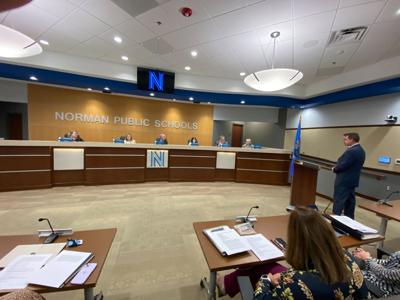

The Norman Public Schools Board of Education approved a new school resource officer program Monday.
The new five-year agreement with the city would add four additional officers, totaling 13 SROs within the district. Justin Milner, NPS associate superintendent and chief operating officer, said the four additional officers would be assigned to elementary schools.
Milner said the SROs go through different training including behavior, mental health, threat assessment, CPR and first aid. He said officers are responsible for criminal law issues, not school discipline issues and that it is important to “stay within each other’s lanes.”
“The parties acknowledge that law enforcement plays an essential role in maintaining safety in the community and in the district. However, the use of arrest and referrals to the criminal justice system for ... typical school behaviors can adversely affect students and erode confidence in and respect ... for both the school administration and law enforcement,” Milner said.
The new SRO program will be effective July 1 to June 30, 2029.
Annette Price, Office 3 board member, said she wanted to commend the city and the district for coming to an agreement on the SRO program.
“(SRO training) is something I’m very proud of, especially when we consider that not all families may feel safer with an armed security guard in the school buildings,” Price said. “We’ve recognized that and we try to ensure those officers are trained in the same trauma-informed practices the rest of the staff and faculty of the schools are trained (in).”
The board members thanked the district and the city for working hard on the agreement after several meetings. Dirk O’Hara, the board’s vice president, said he appreciates the work to make the agreement happen as the ultimate goal is to keep students, parents and educators safe.
The board also discussed revisions for its academic achievement policy and the parents' bill of rights.
Holly McKinney, NPS executive director of teaching and learning, recommended changing the language of the Strong Readers Act under the academic achievement policy.
The recommendation would remove language prohibiting the automatic promotion to fourth grade of a student who has not shown evidence of reading proficiency and good-cause exemptions for promotion.
McKinney also recommended updating the language for retention in middle schools so that if a parent would like to retain their middle school student in sixth or eighth grade, they would present written documentation and meet with or contact the principal, which would be placed in the student’s permanent record.
NPS doesn’t retain or promote students in high school, McKinney said, as these decisions are made based on the credits earned.
McKinney also recommended addressing a student’s participation in commencement ceremonies. In the revision, a student would need 21.5 of the 23 required graduation credits to participate. If a student has not met the requirements, they could apply for an exception that would be reviewed by the school administration and student services.
McKinney said Policy 5007 under the parents' bill of rights would need changes to its language. Some of the changes include a parent's right to make health care decisions for a minor child, unless otherwise prohibited by the law, and a parent's right to direct the upbringing of a minor child within the boundaries established by law.
Other language updates include that parents may choose to restrict their child’s access to or opt out of school library books and resources, or choose to opt their child out of receiving a Pioneer Library card.
Mary Ann Livingood copy edited this story.


