
Content warning: This article contains descriptions of racism targeting Black Americans, homophobia and mass violence.
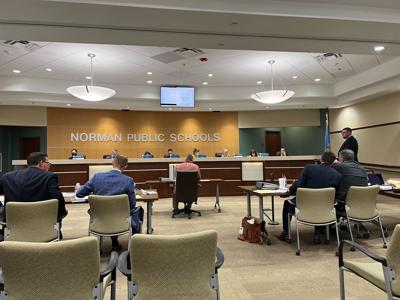
The Norman Public School Board of Education decided to terminate history teacher Richard Cavett’s employment, claiming he violated numerous school policies and FERPA when he leaked a “hit list” written on the Norman High School bathroom wall, months before Uvalde, after a 14-hour hearing on June 18.
A little over an hour after adjourning into executive session, the school board decided to terminate Cavett’s employment in a vote of 4-1, with Board Member Alex Ruggiers being the only vote against.
On the morning of Feb. 17, a large amount of graffiti was discovered in a girls bathroom at Norman High School, including anti-gay and racial slurs, language consistent with slut-shaming and a list of 10 students with the threat of a possible mass shooting signed at the bottom — marked to happen on Feb. 28.
Students began posting photos of the writing to their personal social media pages, making its way around the NHS student body and eventually landing in the hands of staff at around 10:28 a.m., according to testimony and statements given during the hearing.
At that time, the school principal, Hallie Wright, forwarded the first set of pictures reported to her to the two school resource officers: Lee Greenwood and Alexander Webb.
At 11:35 a.m., a student in one of Cavett’s history classes returned from the bathroom and reported the graffiti to him. Cavett asked her to send him the photos, providing his phone number.
Wright, along with two assistant principals, began investigating the event. Cavett returned to teaching until his designated lunch period at 12:06 p.m., when he went off campus for lunch, something he didn’t usually do. At 12:09 p.m., Cavett forwarded photos, including the unredacted list of the girls' names, to his friend Pixie Quigley. He was aware of Quigley’s media contacts.
“I don’t trust (Norman Public Schools) to not bury this,” Cavett wrote. “If these made it to the media, that’d be great.”
Quigley posted the photos, along with ones sent from her daughter, to a private Facebook group, Learn Safe Norman. She forwarded the photos to several media outlets in the local area.
“Die” was written below the names, accompanied by other phrases such as “get ready” and “don’t come.” A specific threat was written on one stall: “shooting up this damn place 2/28/2022.”
OU Daily decided against publishing these photos due to their graphic content, though they were shown during the hearing on June 17 with the names of the students blurred. This publication was also sent the original photos in February but did not publish at the time.
Quigley’s Facebook post stayed up until 2:19 p.m., following several teachers expressing their discomfort in releasing the children’s name. During that time, several parents with children on the list reached out to thank Quigley.
Those parents said NPS administrators told them next to nothing about the threat to their children.
At 3:02 p.m., the first email connected to the incident was sent to all NHS parents declaring the threat not credible.
Two more graffiti lists with the same names of students were found on Feb. 18 and Feb. 22. No email was sent to parents when those lists were found.
On March 22, Cavett was interviewed by school administration and placed on paid leave shortly after.
Feb. 28 passed without an act of mass violence at Norman High, but, three months later, a shooter entered Robb Elementary School in Uvalde, Texas, killing 21 and wounding 17.
In the weeks following the Uvalde tragedy, backlash has fallen on Uvalde Police Chief Pete Arredondo, who responded to the scene without his radio and was unaware he was in charge of the scene. The shooter in Uvalde was in the building anywhere from 40 minutes to an hour before a border patrol unit shot and killed him.
Uvalde police originally claimed that a teacher had left a door propped opened after going to get her cell phone from her vehicle, later becoming the access point of the shooter. Later, the teacher accused of leaving said door open publicly said she ensured the door was closed. A spokesperson for the Texas Department of Safety later told the Associated Press the door was closed, and it should’ve locked automatically, but this feature failed.
The actions of Cavett lead him to Friday, June 17: the day of his termination hearing based on Superintendent Nick Migliorino’s recommendation.
I'm at the NPS termination hearing for history teacher Richard Cavett for @OUDaily. Cavett leaked photos to the press through a friend following a Feb 17 shooting threat at Norman High School.
— Peggy (@pegdodd) June 17, 2022
Prior to opening statements, Cynthia Rogers, a professor of economics at OU, and Stephen Ellis, an associate professor and graduate liaison in the department of philosophy at OU, were listed under the superintendent’s witnesses, but both refused to take the oath and testify.
Karen Long, legal counsel for the Board of Education, told the two that they must be sequestered due to their placement on the witness list, though they would not be testifying and only attended the hearing as members of the public.
Sean Rieger, the administration’s attorney, said the reason why Rogers and Ellis were placed on the list was because of extensive social media posts regarding the Cavett case and events prior to the hearing that are important to the case. The pair were asked to leave the meeting numerous times. Eventually, Rogers agreed, but Ellis refused and he was escorted out during a five minute recess.
During opening statements for the superintendent, Rieger claimed that Cavett had sent a student to the bathroom to specifically get pictures of the graffiti. Cavett then, in this supposed series of events, texted Adriana Knight, an assistant principal, to arrange a meeting.
Rieger said he had no doubt Cavett wanted to protect children, but the act was “morally” wrong. He claimed that Cavett had violated the Family Educational Rights and Privacy Act and NPS policies, arguing that instead of protecting students from violent threats, he exposed their privacy online and in the media.
Cameron Spradling, a member of Cavett’s legal team, said in his opening statement that Cavett’s defense will not be based on accusing Migliorino of wrongdoing, but on the fact that Cavett exposed a miscommunication between school administration, Wright and school resource officers.
In what Spradling called an “avalanche of errors,” Wright instructed the graffiti be painted over before Norman Police Department investigators could see them and released a statement to parents stating there was no threat to the school.
Spradling claimed Cavett was likely the last individual to see photos of the graffiti, and in fearing that NPS would “cover up” the threat, decided to go to the media.
“Shooters don’t go into administration buildings. Shooters don’t go into principals' offices. Shooters go where the mass causalities will be,” said Spradling. “Anyone who’s judging Richard Cavett’s action in the administration building is not on the ground with the students.”
Cavett had previously served in the military and taught at Oklahoma City Public Schools prior to working with NPS. Next year would’ve been his fifth year with the district.
The administration’s counsel argued to Cavett that he knew publicly posting these photos would bring trauma and harm to the girls listed. Cavett did not notify 911, resource officers or NPD, nor did he contact any parents outside of Quigley.
Cavett admitted that he did lie to the district about sending the photos in an article from the Oklahoman. Cavett told the superintendent’s lawyers at the hearing that he was scared of retaliation.
During questioning, it was revealed Cavett had been apprehended by NPS administration after he referred to Migilorino as a “dumbf---” and expressed he would like to punch him. Cavett later apologized to Migliorino, and over a year later, he requested HR remove the letter of admonishment.
Also in his testimony, Cavett said he discussed the threat and shared the photos with Jon Otto, another history teacher at NHS and a friend. The superintendent’s lawyers pointed to this, saying it showed another instance where Cavett lied to school administration, as Cavett had said to the administration that he did not share the photos with Otto.
Otto had asked for the list to see if one of his students were listed, so he could keep an eye out for them and assist them throughout this traumatic event, according to Cavett.
Cavett clarified that he sent the photos because he had expectations that the school would interview students to find out more information and place the school under a lockout until an investigation commenced or was completed.
Knowing that communication “wasn’t the district’s strength,” Cavett described a series of other incidents, also from this past school year, like vandalism, bullying, auto accidents and sexual assault that he said was not communicated to parents.
The administration’s counsel asked what evidence Cavett had to prompt sending the photos to members of the media, to which he answered “silence” from the administration.
Following Wright’s email on Feb. 17, the next time the school discussed shootings with parents was on Feb. 25 in an email from Migliorino, three days before the one listed in the threat, according to evidence shown by Cavett's lawyer Barrett Bowers.
The first time Cavett was asked to be interviewed by the school was on March 10. Cavett wasn’t told the school was investigating him but was still investigating the incident.
“I care for my students and every teacher knows I’m not exceptional,” Cavett said. “When you see students, even students that aren’t yours, but students in your community that are being threatened with violence or something like that, I’ve seen the results of (violence), I’m vigilant.”
Cavett said in another class before his lunch period, he assured the students that the incident was being investigated — something he now claims he knew the district would want him to say.
FERPA, a federal law that protects student information and records, did not cross Cavett’s mind when he decided to send the photos, according to his testimony.
Bowers presented a quiz about FERPA, required by all teachers of NPS, that Cavett took and passed. He claimed that the quiz did not properly prepare Cavett to make a difficult decision.
During the hearing, Cavett’s attorneys showed evidence of district communication from the Robb Elementary School shooting where a Facebook post from the school at 11:43 a.m. on May 24 told the public the school was under lockdown due to gunshots.
Bowers used the Uvalde school shooting to show that “communications from school districts make a significant difference” and to demonstrate how important communication between parents and the school is during massive emergencies, something he argued is a weak point in NPS.
Other witnesses included Wright, Quigley, two parents of children on the “hit list” and Associate Superintendent and Chief Human Resources Officer Holly Nevels.
During her testimony, Wright said roughly three weeks before the graffiti incident, she had sent out an email to staff with administration and resource officers’ phone numbers. In the email, she told faculty and staff to contact those people in case of emergencies and with questions about investigations. She also encouraged the use of the RAVE app.
The RAVE app is used as an alert system to emergency personnel, administration and staff that provides a brief description of a situation of urgency. However, it is not a requirement of school staff.
Wright said Cavett never reached out to her personally or either of the resource officers, nor did he use the RAVE app to express concern about the graffiti. NPS also has a feature that allows individuals to anonymously report incidents, but Cavett did not do that either.
Wright said it is difficult to find out who discovered the graffiti, as the freshman girls bathroom has at least 30 stalls. She also said that by 11 a.m., students were being interviewed and handwriting samples were being collected.
As a principal, Wright said she decided not to release information to parents before Cavett sent photos to Quigley because so much was still unknown, including the level of seriousness of the threat.
Some of the girls on the list went by different names and, according to Wright, the first photos she saw had the "hit list" crossed out. The parents of the girls were contacted by Greg Willis, an assistant principal, beginning at noon and throughout the rest of the day, Wright testified at the hearing.
According to Wright, it was Knight who received a screenshot of Quigley’s Facebook post including the pictures of graffiti that afternoon. When she saw the photos on social media, she was “shocked” and “angered,” especially at the uncensored names.
Wright agreed with that it was “immoral” to share the photo with slurs and unredacted names.
As far as the relationship between Wright and Cavett, Wright said they had a good relationship, and she wished he would’ve told her about his concerns with the school district.
It was revealed through photo evidence that Cavett had given out his personal phone number. During Cavett’s meeting with Wright and Knight, he told them that the student had AirDropped the photos.
AirDropping is something exclusive to Apple devices, and the student who sent the photos had an Android.
Wright denied all claims from an Oklahoman article that no one checked on the girls’ mental health in her testimony.
Cavett’s defense showed messages praising Quigley for her actions and claiming that school staff “patronized” them when they went to the office requesting information. Another message said the school had told a parent about Quigley’s post.
Wright said when she read the messages from Cavett to Quigley, she wondered if he “had a grudge” against NPS.
“He’s trying to make this look like I’ve covered something up and I wasn’t keeping children safe, when I pulled in every resource and person from the district level … to keep kids safe,” Wright said. “I think he should be ashamed and embarrassed as an educator for what he did.”
Quigley, during her testimony, said her daughter, a sophomore at NHS, sent her photos of the graffiti at the same time that Cavett sent them to her. Quigley’s daughter wasn’t physically in school that day due to illness but was able to see the graffiti as it circulated around social media.
When asked by administration lawyers, Quigley said she wouldn’t have cared if her daughters name was unredacted had her name appeared on a similar list. She said the goal of posting the photos was to keep children safe.
“My main concern was I wanted to find the parents or people who recognize the names so that they could be notified and be told their kid is on it and take appropriate measures,” Quigley said.
Tanya Hawkins, whose daughter was on the list of student names, testified in support of Cavett, saying that in no way did his actions hurt or “retraumtize” her daughter.
Often throughout the hearing, the list of girls' names that had been threatened was repeatedly referred to as the “w---- list” by the administration's counsel and principal. In one of the photos, the phrase “Norman w-----” appears above the girls' names, sparking the term in the hearing.
“He did his job, which is first to protect students,” Hawkins said.
Hawkins said her daughter would’ve testified in support of Cavett if she did not have to work the same day.
Melissa Barnett, whose daughter was also on the list, said she went to NHS on Feb. 17 immediately after her daughter sent her pictures, in hopes that she could either inform school administration of the threat or know where the investigation stood.
There, she spoke to Willis, the assistant principal in charge of contacting parents about the incident, who told her that because a certain date had been used in the threat, it was likely just for attention-seeking purposes and not serious.
Her daughter did not attend school on Feb. 28, but Barnett agreed with Hawkins that Cavett caused her no harm. She was upset the school had not offered her daughter counseling options.
The last witness, Nevels, said Cavett broke his contract and FERPA laws when he posted photos without students’ names redacted and when he lied to administration about his actions on that day.
The hearing began at 8 a.m. on Friday, June 17, and after a little over 14 hours, the school board announced their decision around 10:30 p.m.
“I think it’s important that he public knows that we consider Mr. Cavett a hero,” Spradling said following the decision. “Attention was drawn to Norman Public School and everyone was on high alert, and we have Mr. Cavett to thank for that.”


