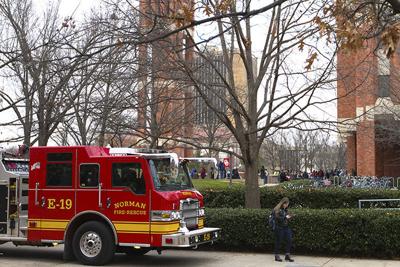

As of April 14, Norman Fire Department first medical responders are able to provide a more advanced level of emergency care.
Twenty-nine first responders are now certified to give heightened care, according to a press release. The change is a means of providing a higher level of care to the community in life-threatening situations, Assistant Fire Chief Travis King said.
In a typical year, the Norman Fire Department responds to nearly 8,700 medical emergency calls, interim Fire Chief Jim Bailey said in the release. Bailey added in the release that medical emergency calls account for approximately 69 percent of the fire department's total calls.
King said he believes the advanced emergency medical technician training will give medical first responders an ability to administer a higher level of care to people making emergency calls for assistance. He said EMTs with basic, intermediate or paramedic levels of skill now have additional skills to utilize in the field to provide more effective treatment on scene.
“A basic firefighter can now provide an advanced airway, do an epi-pen or provide aspirin on scene," King said. "An intermediate EMT can do an IV, fluid administration, full intubation and provide medicines for diabetic comas, as well as Narcan to reverse people that have had a drug overdose. Our paramedics will now be able to perform the full level of their skill once EMSSTAT paramedic services arrive on scene. If we have a multi-patient scene, like a car wreck, they can now be assigned a patient to provide their complete skill set. This will enable us to expand our care and be able to provide a higher level of care much earlier in an incident.”
Being able to perform these additional tasks with the advanced EMT training will decrease the amount of things EMSSTAT paramedics have to do once they receive the patient, King said. This will shorten the scene time and allow paramedics to get patients to the emergency room faster than normal.
Basic and intermediate EMT training consists of one or two semesters' worth of education, King said. He said the advanced EMT training given to EMTs at the paramedic level will take about two years to complete.
EMTs at different levels of the advanced EMT training will also be strategically assigned throughout the fire department to provide an appropriate level of personnel availability for emergency calls, King said.


