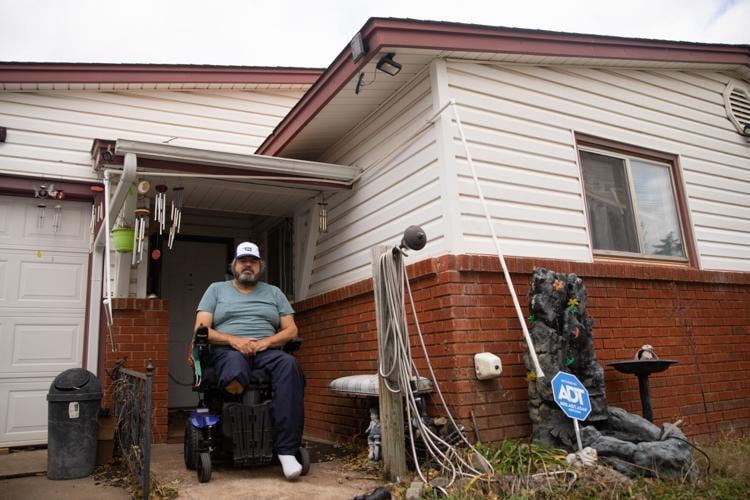

John High has continued to push for more accessible public transit options despite the City of Norman’s efforts to accommodate people with disabilities.
High has used a wheelchair since he developed gangrene, which led to his leg being amputated below the knee four years ago. Unable to use a vehicle, High uses Norman’s public transit system, operated by Embark, to travel around Norman independently.
High is the former vice chair of OK Americans Disabled for Attendant Programs Today, or OK ADAPT, a national grassroots disability rights organization, and a member of Progressive Independence Center for Independent Living in Norman, a nonprofit agency providing independent living services to people with disabilities.
High said he first realized the importance of advocating for individuals with disabilities six years ago when he saw a man in his wheelchair dauntingly look at the steps of a two-story public building on Gray Street in Norman.
“Most people who are disabled have given up on Norman,” High said. “(The Norman City Council) always say they’re going to change, but then they never change things.”
High said he loves Norman, but wishes the city would do better.
“Our sidewalks really need to be up to par,” High said. “There are so many things going wrong with Norman, and it's hard to keep up with it.”
High said there is room for improvement regarding sidewalks and the bus system. He hurt his knee when he was thrown from his wheelchair on a Robinson Street crosswalk, but said the crosswalk has been repaired since then.
Norman has alleviated curb cutting and uneven parts of the sidewalks, Ward 1 Councilmember Brandi Studley said. On Nov. 7, sidewalk repairs began along the north side of Robinson Street from Crossroads Boulevard to NW. 36th Avenue. With help from an Americans with Disabilities Act committee, Norman identified areas that individuals in wheelchairs would have difficulty accessing, she said.
“We do a really good job at listening to those needs, trying to fix those issues as we see them and accommodating the needs of those people in our city,” Studley said.
High said Norman’s transportation services have improved a little but still need a lot of work. Some buses in Norman do not offer Wi-Fi, he said.
High also said blind people are at risk on crosswalks, which don’t always have a verbal cue for the timer’s last 10 seconds. OU Daily visited several Norman crosswalks to verify the timers did not include a verbal cue.
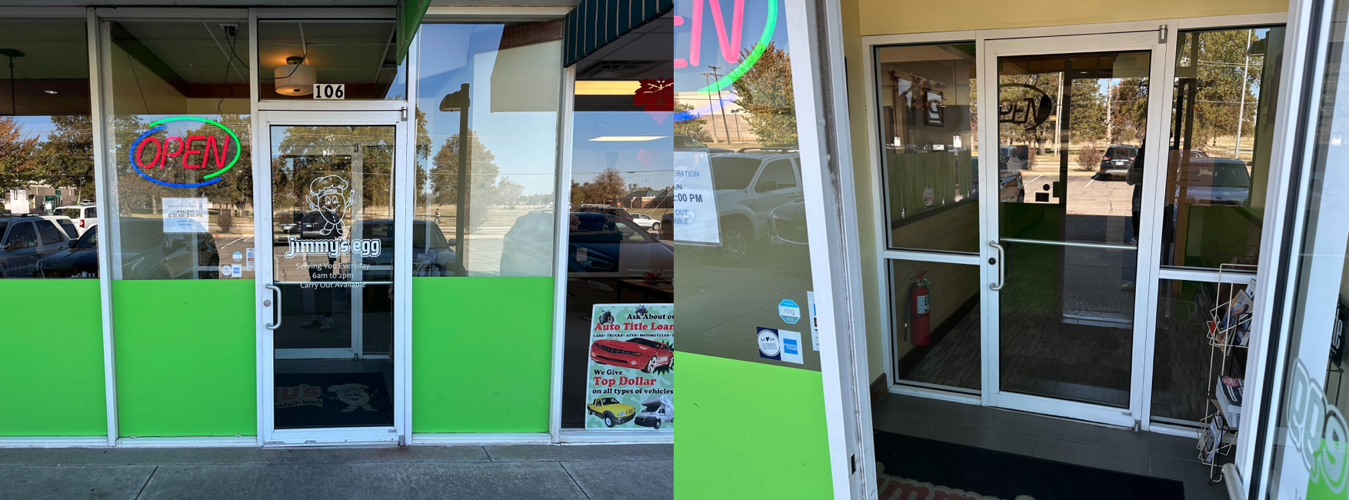
High said an example of poor engineering in regard to accessibility for disabled people is the Jimmy’s Egg on Alameda Street. He said there was no way for an individual in a wheelchair to maneuver through the tight double-door entryway.

The entrance of Jimmy's Egg at 1000 E. Alameda St. on Nov. 17.
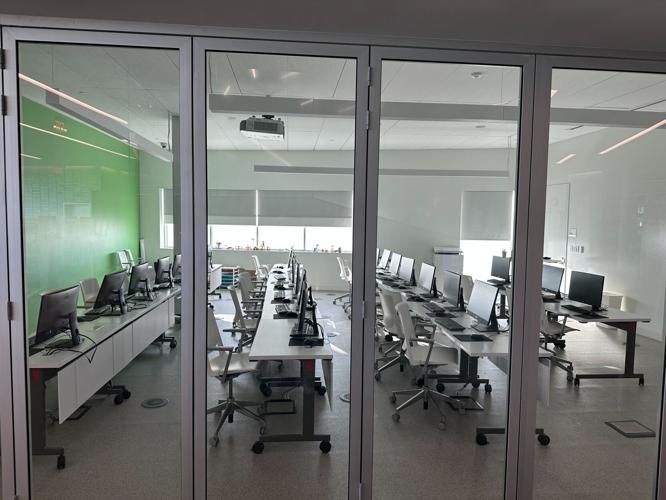
High said it also wasn’t possible for him to move around with his wheelchair in Norman Public Library Central’s computer lab on the second floor.
Aaron Pence, manager of the Norman Public Library Central’s computer training center, said the computer room can be shifted around to better accommodate individuals with wheelchairs. The library also offers MacBooks and Dell laptops to be checked out and used anywhere in the building.
“We're excited to accommodate every member of the community in an open space that's inclusive for anybody that wants to come in here,” Pence said. “If something needs to look different or better, then we're always happy to work hard to get that done.”

The computer lab on the second floor of Norman Public Library Central on Nov. 17.
The City of Norman’s policy says no people with disabilities can be excluded from participation in, be denied the benefits of or subjected to discrimination in all programs, services or activities, the Pioneer Library System’s website reads.
High also said he’s dealt with multiple bus drivers who complained about stopping the bus for him, creating a negative environment on the bus. Snowy weather conditions or construction can present difficulties for disabled individuals at fixed bus stops, in which case the bus driver should stop somewhere else if it's a safe area to load the wheelchair.
“It feels like Norman’s not a friendly town for people with disabilities, and that's what it's supposed to be,” High said.
High said the Embark phone operators and bus drivers are not geographically familiar with Norman, with the call center based in Oklahoma City.
“The drivers really don't know Norman like they used to when (the public transit system) was based at OU,” High said. “You have to know your city before you can give advice about where to go.”
OU ran Norman’s citywide system for roughly 40 years until 2019, when the university decided it did not want to be involved in running or funding the public transit system, Ward 7 Councilmember Stephen Holman, chair of transportation, said.
Holman became interested in Norman’s transportation services years before running for city council. He was exposed to the Dallas Area Rapid Transit when he lived in Dallas during his childhood, and began riding Norman’s city bus as a freshman at Norman High School, he said. His interest in city planning and infrastructure sparked a desire to run for city council.
“There's still a lot that needs to be addressed as far as people being able to get around freely,” Holman said
Holman said Norman witnessed issues in its transportation for at least 50 years. Although the public transit system began at OU, Holman said it grew to serve the entire city over the decades.
While OU had an effective partnership with Norman, the university decided it wasn't in their best interest to operate the citywide bus system, Holman said.
Cleveland County’s one-quarter cent sales tax, which was used to build the F. DeWayne Beggs Detention Center in 2012, became Norman’s solution for its transit system when the tax for the jail expired in March 2020. In place of the previous tax, Norman voters approved a one-eighth percent sales tax as a dedicated funding source for public transit operations without raising the current tax rates.
In April 2021, voters approved the five-year Street Maintenance Bond in Norman, which funded the continued repairs and improvements of streets. Residents first approved the program in 2005 and have since approved it every five years, according to the City of Norman. Norman also purchased two $160,000 vans equipped with handicap-aid-accessible lifts in Sept. 2022.
“We do have a very good program that’s very successful,” Holman said. “It's been widely, heavily supported by voters, but there are definitely maintenance issues ongoing.”
With a population of almost 130,000 residents in Norman, Holman said it can be a challenge to adequately maintain the full infrastructure of 200 square miles of paved roads.
Holman said four new electric buses were purchased to replace the older ones with the help of grants and local matching funds. Each electric bus is at least half a million dollars, he said.
The ADA requires buses on fixed routes to be large enough to accommodate everyone, eliminating smaller buses as a cheaper alternative, Holman said.
Studley said Norman’s current transportation system for individuals with disabilities requires those individuals plan 24 hours in advance for the citywide paratransit system.
Richard Anderson, chairman at OK ADAPT who uses a wheelchair, said this affects their employment opportunities, social life, entertainment, being an involved parent and even their mental and physical well-being.
“I don’t really have my life planned 24 hours before every day. It's unfair to ask that particular segment of our community,” Studley said. “At the same time, I am happy we are a city that can provide services to people that may have disabilities. I just wish that we had more microtransit services.”
Holman said a pilot program for microtransit services is in discussion, which would fill in the gaps where the fixed route bus system doesn’t stop, but needs to.
Microtransit is a publicly regulated transit service that utilizes multi-passenger vehicles like cars and vans to provide on-demand or semi-fixed routes, according to a handout in a council meeting’s agenda packet on Oct. 18.
“For a lot of folks, it’s not possible to go somewhere whenever they need on a whim, and it should be,” Holman said. “We've had a lot of advocates for the ADA community and Norman that have wanted us to come up with a way to fill those gaps missing in our transit system.”
Holman said a microtransit system would accomplish two goals: to help riders get from their location to the nearest fixed stop or destination and act as an accessible transit rideshare service.
“If Oklahoma is serious about bringing rail transportation, then on-demand transportation is a must, no ifs, ands or buts,” Anderson said about the Regional Transportation Authority of Central Oklahoma’s plan for a commuter rail to connect Norman and Edmond.
The goal of Norman’s microtransit services is to make the system more efficient and better serve the people that need it, so they can easily get to work or school reliably, Holman said.
“It's a huge step forward to where we should've been before now and I'm really excited for it to get launched,” Anderson said about the on-demand service. “This could be a blueprint for other cities or even the state to follow.”
As imperfect as the current system is at transporting people efficiently, Holman said, it’s still the bus routes that people have grown accustomed to. Changing them in any way could be challenging, because some routes may not exist, he said.
Anderson said Oklahoma is still using transportation ideas and services from the 1980s.
“Our governors, legislators or the state's transportation committee really don’t understand the magnitude of this problem even though we have told them time after time for years,” Anderson said.
Holman said the council’s plan is to transition to a new route system by July 2023 and work with Embark beforehand to ensure riders are aware of the changes. He said he encourages OU students to give feedback about how Norman can improve transportation and address those issues going forward.
The fight isn’t over for High, who said with Progressive Independence’s aid he will continue to advocate for people with disabilities until Norman reassesses sidewalks, bus routes, stops and potential microtransit services.
“I look out for the other people who can't and won't speak up, and feel like second-rate citizens because they don't have the accommodations they need to make sure they can do what they want to do,” High said.


