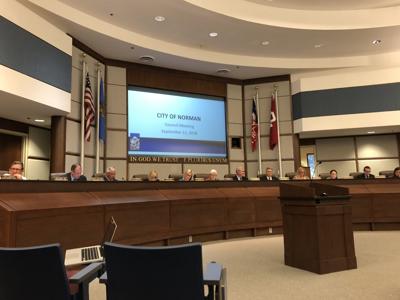
City Council is working on balancing and approving the upcoming fiscal year’s budget, which could include cuts to services in light of the failure of two propositions to fund stormwater infrastructure.
Propositions 2 and 3, which aimed to provide more money to fix flooding issues in Norman, failed on the April 2 ballot, and Ward 7 councilman Stephen Tyler Holman said council has directed city staff to find $1.3 million in cuts to balance the city budget and ensure that stormwater issues can continue to be funded.
“The general fund cannot take on the increased costs projected for stormwater,” Holman said. “It cannot do it without cutting significantly.”
Breea Clark, Norman’s mayor-elect, said trying to plan this budget has been difficult without the stormwater funding that the two propositions would have provided.
“Right now we’re focusing on budgeting and trying to gauge what kind of impact the failed election will have going forward,” Clark said.
Proposition 2 was a bond to fund stormwater infrastructure projects, and Proposition 3 was a utility fee. Lynne Miller, Norman mayor, said the city needed the utility because it didn’t have enough money to address the growing need to contain flooding. The fee would have generated over $4 million dollars annually to add to the $3 million that Norman already spends on stormwater.
Miller said whatever the council does budget-wise will be a “Band-Aid,” not a long-term solution to the problem.
“It's not just about what we're going to do with the budget,” Miller said. “It's what are we going to do in the long term? Is there any other way to fund this besides a bond and a utility?”
The city’s reserve fund has enough money to continue to spend at the same rate for two more years, Holman said.
“And (then) we’ll have to make very painful and deep cuts if we don’t make some pretty painful and less-deep cuts now,” Holman said.
Norman also has mandates to improve its water quality from the Oklahoma Department of Environmental Quality and the Environmental Protection Agency, Holman said. Under these mandates, the city must reduce pollution in Lake Thunderbird by 2035.
“Which sounds like it’s far away,” Holman said. “But it can take 20 years if we do everything right to reduce the lake pollution by the amount they’re requiring us.”
This relates to stormwater because streambank erosion — in which storm runoff carries sand and dirt into the lake — is partially to blame for the poor water quality, Holman said.
If Norman doesn’t take the appropriate steps to address this, it will have to pay a $10,000 per day — per violation — fine, Holman said. Right now, Norman’s water treatment plant is addressing the poor water quality by heavily treating it, which Holman said is expensive. He said the goal of the two propositions was to preempt the problem and prevent the need for this spending.
Miller said city stormwater staff has already proposed a plan to the Oklahoma Department of Environmental Quality — a plan that involves costly measures like getting street sweepers and hiring more cleaning crews, which she said the city doesn’t have the money to do.
Holman said social services could be the first to go in budget cuts.
“Sometimes when there’s a serious budget problem and the public really needs to understand that it’s serious, you need to make cuts that the public is going to see and feel,” Holman said. “And when I say ‘the public,’ that means members of the City Council too, because we live in Norman.”
Council had also tried to pass a stormwater utility fee back in 2016, but it failed by over 70 percent. The April 2 vote was closer, with about 60 percent of people voting no. But all three City Council members said they don’t know when, or if, the city will try to pass another utility fee of this kind. But Miller said she’d like to do a “forensic” to see what went wrong.
“One of the things that I think we have to figure out is whether we go back to the people for a vote in a year, or two years or three years,” Miller said. “What do we need to do in terms of educating people about why this is such an issue?”
Clark said stormwater issues affect OU students just as much as other residents. She said she wants to see the university get involved in trying to solve the problem.
“If OU students could have been registered to vote and voted, then they could have handled (the April 2) election,” Clark said.


