
Editors note: This article was updated at 10:56 a.m. to further report an email sent by Ward 8 Councilmember Scott Dixon clarifying that of the two regular meetings city council has per month, he'd like to have one scheduled in the morning and one scheduled in the evening.
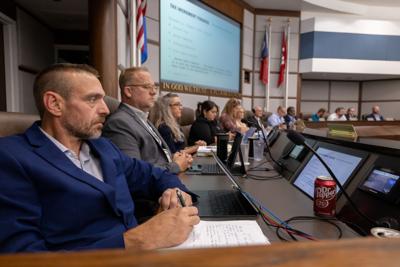
Norman City Council members and Normanites voiced reasons for and concerns about proposed time changes to council meetings, which could limit how many items are discussed.
At the Oct. 15 study session, council discussed a proposed ordinance that would change the regular meeting time to 5:30 p.m. — instead of 6:30 p.m. — every other Tuesday and provide that no “business” would be discussed after 9 p.m. unless approved by a majority vote.
Interim city attorney Rick Knighton said the limit would not apply to comments, and if council met until 9 p.m., it would immediately enter public comment. Knighton told OU Daily after the meeting that staff will return to council with an adjusted amendment at a later date.
According to Knighton, the adjusted amendment would propose council not discuss any new item after 9 p.m., and instead, it would roll onto the following week's agenda. However, if a decision on an item that began before 9 p.m. goes past the proposed stop time, council will continue its discussion until a decision is made.
Ward 1 Councilmember Austin Ball said he thinks council should try the 9 p.m. limit without cutting off any item that’s in progress.
“I was very adamant that if we did that, then it would be: If it's 9 o'clock and we're already on an item that we don't stop, we finish the item out,” Ball said. “Everybody's there to talk about it.”
Ball said he’s against anything that would disrupt public comment because it is a key feature of local government. The ordinance allows for council to vote to extend the meeting, which he said would need to happen for important items.
“That's the one opportunity for people to come up and say anything they want to say to us, and I think that's very important,” Ball said. “And having (comments) at the end of the meeting, I think that’s the best place.”
Ward 7 Councilmember Stephen Tyler Holman, who announced his intention to run for Norman mayor in September, said he was against any time limit because it would push agenda items to future meetings.
“In my 12 years on council, I've served with four different mayors, and all four of them have made attempts to alter the meeting times or sign ups or things like that,” Holman said. “Every single attempt has not improved how the meetings function. If anything, it made them more chaotic and more contentious.”
If there must be a time limit, Holman said he would amend it to be 11 p.m. instead. According to Holman, preserving time for public comment is crucial because it is how residents weigh in on policy.
“City hall is where we do (public comment), and it's where the public has the most access and the most ability to impact change,” Holman said. “So I do not agree with limiting and cutting off public comment, even if it's public comment I don't agree with.”
Ward 5 Councilmember Michael Nash told OU Daily he was against the proposal because council should finish with an item the night they begin it, and it would be a “hassle” to end early.
“I think it would be very disruptive, and it would put up a barrier to public participation, to cut the agenda short and reconvene,” Nash said.
Nash said if his constituents wanted the time change, he would vote in favor of it to represent them.
Ward 3 Councilmember Bree Montoya said she wanted council meetings to remain at the time they are, because a majority of them do not go very late.
“I knew whenever I decided to run that there will be the occasional late council meeting night,” Montoya said.
Among the controversial items the council has discussed in the past few years, several decisions were made in meetings that lasted past 9 p.m., which many residents attended to voice their opinions.
The Sept. 17 meeting to approve the University North Park entertainment district project plan went until 1:10 a.m. the following day.
On Aug. 27, Norman City Council rejected the Oklahoma Turnpike Authority’s ACCESS Oklahoma project in a meeting that lasted over four hours. The project would have allowed the OTA to construct turnpike facilities through “critical areas” of Norman, including the Lake Thunderbird watershed and the Canadian River Corridor.
The conference and regular meeting on Nov. 14 that approved the allocation of $900,995 towards the addition of four school resource officers at Norman Public Schools lasted over eight hours.
The June 16, 2020, meeting, where council voted to allocate $865,000 — a portion of the proposed increase to the Norman Police Department budget — to other facets of the city, lasted over 11 hours, with protesters and their counterparts speaking out on the issue.
According to Montoya, the 9 p.m. limit would prohibit council from seeing any other items, but anything in progress would be completed. She said public comment about the item and miscellaneous comment would not be cut off.
“I would have been okay with the cutoff being 11 (p.m.),” Montoya said. “But then again, we're still going to have miscellaneous comment at the end, and so it'll still end up being a late night.”
Ward 8 Councilmember Scott Dixon wrote in an email to OU Daily that council should try out the time change.
“I like that it can be extended by a vote of the Council when needed,” Dixon wrote. “I’d hate to see any cutoff time be used to filibuster any agenda item. Again, I’m willing to give it a try and then adjust as needed.”
Dixon said of the two regular meetings council has per month, one should be scheduled in the morning and the other one in the evening, so community members can attend whichever meeting works best for their schedules.
“I believe we are looking for ways to make the meetings more efficient but maybe we’re there,” Dixon wrote.
Paul Wilson, a Ward 1 resident, said he was against the 9 p.m. cutoff because it silences community members who cannot make it to multiple meetings about one issue.
“There are people in the city that don't have the luxury like I do, where I can take every Tuesday off to come here, and if they postpone something (for) two weeks, they may not be able to be here and give their voice,” Wilson said.
Wilson said council should have the most substantial item of business be the only item on the non-consent docket, which houses items to be considered and further discussed during the meeting.
“I don't like being here at two o'clock in the morning any more than anybody else does, but we have a right to voice our opinion,” Wilson said.
Wilson said the three minutes allowed per person in public comment is not enough time. He said Mayor Larry Heikkila has also limited the number of speakers at past meetings.
“What about the people that didn't get a chance to voice their opinion, whether it's for or against?” Wilson said. “How do we get our voices heard if they limit the amount of … time?”
Instead of the proposed changes, Wilson suggested starting council meetings at 5 p.m. and rescheduling the study sessions that happen before meetings.
“(Council needs) to realize that we're here to voice our concerns, our approvals, our disapprovals, everything else, and they need to hear it,” Wilson said.
Rob Norman is an attorney for Cheek & Falcone and a founding member of Oklahomans for Responsible Economic Development, the group who created the petition against the University North Park entertainment district. Norman said he isn’t concerned about the start time being moved up an hour but rather the potential of the 9 p.m. cutoff interrupting important items and public comment.
Norman said there are many other things that could change to shorten meetings. According to Norman, council members have unlimited time for their announcements, and presenters can have as many people and as much time as they choose, which he said needs to stop.
“They can give everyone a chance to speak, everyone a chance to be heard and run the meeting in an efficient fashion,” Norman said. “So I think they’ve got a lot to work out.”
Ward 2 resident Mayumi Windler said city staff would need to consider how controversial an item is when placing it on the agenda so they can ensure there is enough time to discuss it.
“Maybe not a lot gets done,” Windler said. “That's a consequence of trying to limit the time that we're actually here. So that part is not so good.”
While Windler said she understands people don’t want meetings to go as late as they often do, she thinks changing meeting times is unnecessary. She is also concerned people who work may not be able to make the earlier meeting time.
Cynthia Rogers, an OU economics professor and a founding member of ORED, said she’s hopeful an earlier start time could be better, but she’s concerned the time limit could lead to filibustering.
“We shouldn't need to have a five hour meeting,” Rogers said. “Fifty people shouldn't need to come and feel like they haven't been heard once an item gets on the agenda, and I think that's a flaw in the process.”
Rogers said having a cutoff time could ensure council members are transparent and work with the public more prior to meetings.
“It’s an incremental change,” Rogers said. “Change that’s incremental, I think that always has the best chance.”
Stephen Ellis, an OU philosophy professor and ORED member, said for the time cutoff to work, council members will need to deliberate publicly before meetings, which he isn’t optimistic will happen.
Ellis said he also expects filibustering or council to cut off public comment, which would be a “disaster.”
“They need to put in the work beforehand, and they only amend things on the fly when there's a lot of public pushback,” Ellis said. “If you're transparent about what you're thinking already, you'll get that pushback over a much longer period of time. I think that would be better.”
This story was edited by Anusha Fathepure, Ismael Lele and Ana Barboza. Gretchen Schultz, Mary Ann Livingood and Grace Rhodes copy edited this story.


