Cars surround Redemption United Methodist Church, sitting on the road, on the grass, in every empty space that won't earn a ticket or tow.
Inside, the drivers sit facing one another, lined and waiting along the edges of a dim hallway stretching the length of the church.
It's a varied group, and they sit mostly in silence, muted in part by the lack of a shared language. Spanish, English, Vietnamese — they whisper left or right to loved ones while they wait to hear their names called.
Wherever they're from, whatever their tongue, they're all here for medical care — something none of them can afford.
Every Saturday morning, Fundación Manos Juntas converts the church into a free medical clinic open to anyone who shows up at the door. This amounts to about 8,500 people a year.
They need checkups. They need medications, often several. They have aches and pains and strange sensations they're afraid to ignore any longer, but most are uninsured or underinsured.
This problem isn't so rare in Oklahoma. According to the Oklahoma Health Care Authority, 14 percent of all Oklahomans are completely without medical insurance. That's 5 percent higher than the national average.
With no access to insurance and not enough money to pay out of pocket, they come to this weekly clinic provided by Manos Juntas. The volunteers with Manos Juntas can take a look, diagnose and have their patients walking out the door with prescriptions in hand, all free of charge.
Dozens of those volunteers, consisting mostly of OU pre-med students, show up to the church at 1320 N. Pennsylvania Ave. in Oklahoma City every week. They give their time to Manos Juntas and in return gain valuable hands-on experience that's hard to find elsewhere.
The clinic's expenses could be much higher, but because of the large number of student volunteers, it is able to focus most of its funds exclusively on patients.
Since founding the clinic, Oklahoma physician Boyd Shook has seen the value of a student volunteer workforce. About 80 percent of the 600 or so student volunteers Manos Juntas relies on every year come from OU.
“We couldn’t do it without them. They’re a very integral part of our patient care,” Shook said. “The overall system is completely dependent upon student volunteers. We could not exist without them.”
Shook is currently the only volunteer doctor on staff. Though third and fourth-year medical students are allowed to treat and diagnose patients under his supervision, the bulk of the volunteer force is pre-medical students.
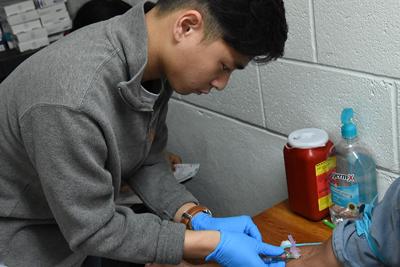
When pre-med junior Naomee Ryana first began volunteering at the clinic, she handled triage, checking height and weight and blood pressure and establishing the basic vitals. Now, she typically works the phlebotomy lab.
Tucked in a closet beneath the basement staircase, the lab fits two patients and three volunteers. It's cramped, but this is where volunteers take blood samples from their patients.
This is standard procedure for most visits and all first-time visitors, as the blood often carries bad news for Manos Juntas patients. Diabetes, high cholesterol and blood pressure — symptoms of diets as unhealthy as they are affordable — are the most common health problems seen at Manos Juntas, and it often comes as a surprise to the patients.
Ryana remembers sharing such results with a patient and giving him the necessary speech about diet and exercise. He explained that working three jobs and providing for a full house leaves little time or money for what she prescribes.
Kris Barnes is a fifth-generation Oklahoman and serves as the executive director of Manos Juntas. She knows it takes a lot of funding to do the kind of work Manos Juntas does in a state like Oklahoma, which has a high prevalence for diabetes and a per capita income $5,000 below average.
It takes about $300,000 a year, in fact, with half coming from Shook, along with some help from friends of his. The rest comes in donations, which can be a challenge to come by, Barnes said.
"The fact that we serve a high percentage of minorities makes it difficult to receive (donations)," Barnes said. "People think it's a clinic only for Hispanics."
That's not at all the case, she said — everybody is welcome at the clinic.
There are limitations on what Manos Juntas can do because of money and what sort of volunteers are available. These limitations are perfectly understandable, Barnes said, but that doesn't make them any less frustrating.
"I get calls every week from people with broken bones and I have to say 'sorry, we can't help you,'" Barnes said. "So they have to go to hospitals and get bills they can't pay."
The Children's Health Insurance Program, a historically bipartisan program providing an estimated 9 million children with coverage, is perhaps the biggest victim of the health care fight so far in Washington.
CHIP expired in late September after a 20-year run, and while efforts have been made on both sides to acquire the funds needed to keep CHIP going, no permanent solution has been reached. Oklahoma will be one of the last states to run dry on CHIP funding, but if it does, this could potentially put more of a strain on free clinics like Manos Juntas.
These aren't new issues, according to Shook. They weren't new in 1995 either, when he first established the non-profit. Poverty is a long-standing disease in the state, he said, and a cruel one.
"The quality of healthcare in Oklahoma is really, really far down the ladder," Shook said. "We have a lot of problems here that need to be addressed."
Many diseases these patients face could have been curbed if they had seen a doctor sooner, but the price tag just a single visit can carry deters the uninsured, Shook said.
Shook began practicing medicine in 1965, and over the years has personally and publicly advocated healthcare reform.
When the Obama administration implemented the Affordable Care Act, the impact was very noticeable, he said. Patients that he had been seeing for years at his free clinic were suddenly booking appointments to see him at his private practice.
Shook is quick to point out that this was a small handful of patients. He credits the Affordable Care Act as a step in the right direction, but the thousands who continue to line up for help from Manos Juntas every year are, for him, evidence that more must be done.
There's a lot of practical knowledge students take away from volunteering at Manos Juntas, but Shook said he hopes they gain some perspective and a healthy concern for the state of medicine, too.
"They see poverty at its worst and they see good health care management at its best," Shook said. "Some of the lessons that they learn here will go on into their practice later in life."
Hospitals, and the places like them, have been familiar to Ryana since well before starting on the path to medical school.
“I practically grew up in a series of hospitals,” Ryana said.
Her father's heart condition landed him in a number of facilities for long stays. The same condition took her grandfather’s life in his native Bangladesh.
It was difficult to watch him suffer through the same thing, she said, not sure if he’d survive it.
Over time, her father recovered and was able to live a full life. Money and American hospitals made the difference in why he survived and his own father didn't, she said.
Her family did well in America, Ryana said, and had access to means and resources many people, like the patients of Manos Juntas, simply don't. She wants to see those resources made more available, but under the new presidential administration, Ryana said she feels the future of healthcare is uncertain.
"It could be downhill from here, and I don't think the Manos Juntas population is prepared for that," Ryana said. "It's already bad how it is right now. How much worse could it get?"
Shook remains hopeful that large-scale health care expansion will come to be and that organizations like Manos Juntas won't be so necessary.
The debate and bluster in Washington doesn't dim that hope, he said. He's seen it all before.
"For those of us who were around when Medicare was brand new, we say it's the same thing happening again, but with Obamacare," Shook said. "For three or four years, people said (about Medicare), ‘This'll fail, this'll fail, we'll oppose this, we're going to kill it,’ but Medicare is extremely popular now. It survived that original crunch."
Whatever does or does not happen in the years to come, Barnes is certain organizations like Manos Juntas will still be needed.
"There's always going to be people who fall through the cracks, no matter how many programs you create," Barnes said. "There's always going to be people who don't meet the criteria you want and that everybody sends away."


