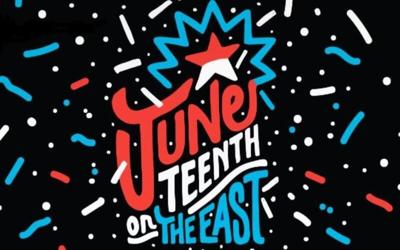

Jabee Williams, a rapper and community activist from the east side of Oklahoma City, will participate in an Oklahoma City Juneteenth festival, which will serve as a space to educate the public about the marginalization of the Black community throughout history and how people can support them today.
Juneteenth, a day Williams said should be considered “just as important as the Fourth of July,” dates back to June 19, 1865, when the news finally reached Galveston, Texas, the U.S. Civil War ended and enslaved people were freed.
In partnership with the “With Love Project” — an initiative Williams began with Oklahoma City artist and muralist Kris Kanaly to increase live art on the east side of Oklahoma City — the Juneteenth Festival will be an all-day event with live music, dance performances, live mural painting, spoken word, food trucks, vendors and local small businesses, Williams said. It will also feature artists including Sa-Roc, Propaganda, Conscious-Lee and SkipHill.
The festival will have four stages, Williams said, including the main stage, R&B stage, poetry stage and a kid’s stage for dancing.
Williams said Juneteenth is important because it marks the day Black people were finally free from slavery. He said it is important to continue spreading knowledge and educating the Black community about this part of their history.
“We want people to not only know where they come from but know what they come from so that we can continue to move forward,” Williams said.
Williams’ recent community activism included his performance at the Black Wall Street Legacy Festival for the Tulsa Race Massacre centennial. The Legacy Festival will continue its festivities for Juneteenth, with a festival in the Greenwood district from June 16-20.
Williams said one of the first-hand accounts he recalls reading about the Tulsa Race Massacre was related to doctors from Black Wall Street. He said he sees those educated people who owned practices over a century ago as an example of what the Black community is capable of accomplishing now.
“I think this is a way to reference and honor the legacy of those who were involved with the Black Wall Street,” Williams said. “(They are) really who we look to, especially as Black people, as kind of a staple on what we can do whenever we come together and operate businesses, and continue to learn and educate. ”
Williams also actively advocates for death row inmate and former OU student Julius Jones. Jones has maintained his innocence and amassed supporters through organizations like Justice for Julius as he pleas for his innocence.
To emphasize the need to share stories such as Jones’, Williams said “he's not the only one that this has happened to, and he's not the only one who this will happen to.”
“He's a personal friend of mine. He's somebody who I believe is innocent to a crime that he's on death row for, and what we're witnessing is a modern-day lynching,” Williams said.
Williams said it is important to continue voicing the stories of marginalized members of the Black community and stress the significance of the Tulsa Race Massacre in Oklahoma so people like Jones and survivors and descendants of the massacre can receive justice.
“I just hope that by continuing to tell his story, speak out, and share his voice and be a voice for him, and a voice for those who pass on in Black Wall Street and (hear) my music. (I hope) that we can see some of these things not only change, but we can also receive justice,” Williams said. “The people of (the) Tulsa Race Massacre haven't received justice, and Julius Jones hasn’t received justice.”
Williams said people often create their own narrative for movements surrounding racial justice, citing Black Lives Matter as an example. He said he feels it is important for artists to emphasize the value of Black community member’s lives by “telling the stories of the times we’re living in.”
“Whenever you don't see someone as your equal, as human, as somebody who has words of value, then it's easy for their life not to matter to you,” Williams said. “If you're an artist or any person, and (there’s) something that you feel like is right, or that you believe in, then it's important— if that is truly true to your heart— that you stand up for it. People are actually dying ... There are people's lives actually being taken at a high rate in this country here.”
Williams said said, he hopes his music and the art presented at the festival will create an enjoyable experience while also educating the public about the history and issues related to the Black community.
“Whenever I look back to the Civil Rights Movement, (or) to any significant piece of history, there is music we can attach to those times — that tells the story on time — there is art that we can attach to those times,” Williams said. “So, I feel like, if you're an artist, especially if you're someone who values the lives of all people, then it's important that you tell those stories because when people look back on 2001, the first thing they're going to look to is the art of those times.”
The Oklahoma City Juneteenth Festival will take place from 3-9 p.m., Jun. 19 on 23rd Ave. between Kelham Ave. and N. Hood Street.
Editor's note: This headline was updated at 1:27 p.m. on June 26.


