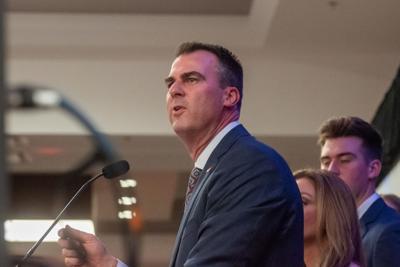

Indigenous community members criticized Gov. Kevin Stitt’s veto of a bill that would have allowed students to wear tribal regalia at high school and university graduation ceremonies, calling it hypocritical and disheartening.
Kamryn Yanchick, an OU alumna and former American Civil Liberties Union of Oklahoma intern, introduced the idea for Senate Bill 429. ACLU of Oklahoma wrote the bill in conjunction with Sen. John Montgomery (R-Lawton) and Rep. Trey Caldwell (R-Lawton). Yanchick based the idea on her experience graduating high school in 2018 when she was told she couldn’t bead her cap or adorn it with a feather.
“It harms nobody. It is a chance for Native students to be able to express who they are openly and proudly at such an important milestone and achievement in their lives,” Yanchick said.
After being passed with nearly unanimous, bipartisan votes with one nay in the House from Rep. Jim Olsen (R-Roland), the bill was sent to Stitt for approval last Tuesday. Stitt vetoed the bill Monday, among 23 other bills this session.
These vetoes came after Stitt’s notice to the Oklahoma Senate that he plans to veto any legislation that does not align with his education policies.
“I am vetoing this unrelated policy and will continue to veto any and all legislation authored by Senators who have not stood with the people of Oklahoma and supported this plan,” Stitt wrote in his notice to the Senate.
One of the bills Stitt has approved is Senate Bill 613 yesterday, a bill that prohibits gender affirming care for individuals under the age of 18.
In his veto message, Stitt said he wanted to leave the decision of students being able to wear tribal regalia to local school district officials.
Crispin South, vice president of the OU American Indian Student Association, said Stitt’s actions are childish and ineffective in running state government.
South said Stitt’s statement about leaving the decision up to local school districts was hypocritical.
“It is just rich coming from someone who, throughout the pandemic, stepped on school districts’ toes and prevented them from taking measures to prevent the spread of COVID,” South said. “Throughout his entire governmental career, he has done everything he can to implement full state control over individual school districts.”
In a statement on Tuesday, Cherokee Nation Principal Chief Chuck Hoskin Jr. said Oklahoma law already protects the right for Native American students to wear tribal regalia and this bill would just make those rights more clear.
“With this legislation, Governor Stitt had an opportunity to support religious freedom and families honoring their kids’ high school accomplishments. Instead, he’s chosen more division and insults to his Native American constituents,” Hoskin wrote.
Yanchick referenced Stitt’s tumultuous relationship with Oklahoma tribes, and said that this could have been an opportunity for him to show his support for his Native American constituents.
Yanchick encouraged others who are passionate about Senate Bill 429 to contact their local community leaders and representatives to encourage the legislature to override the veto.
South said it was disheartening for him to see this bill that has been a three-year long effort be vetoed in this way.
“It's just discouraging for … Native students across the state that are now once again at risk (of) being excluded from their own graduation ceremonies if they choose to wear tribal regalia,” South said. “Wearing tribal regalia is not something that is disruptive to graduation ceremonies or distracting really in any way. All it is is a celebration of our culture and who we are as as Native people existing in this state.”
This story was edited by Alexia Aston, Karoline Leonard and Jazz Wolfe. Mary Ann Livingood copy edited this story.


