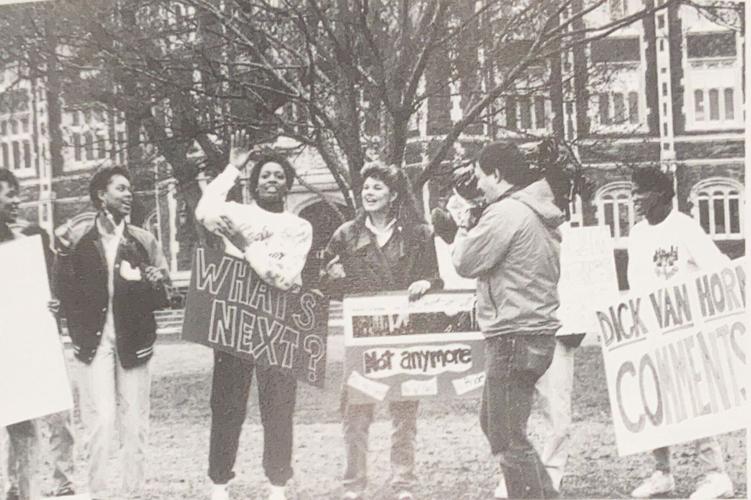




OU cut the women's basketball team in the spring of 1990, sparking national opposition and large protests outside of Evans Hall, led by members of the women's basketball program.
On June 23, 1972, “The Candy Man” by Sammy Davis Jr. was at the top of the charts in the United States. “The Godfather” was still dominating the box office. Iconic 70s fashion started to emerge, with the women’s liberation movement making pants on women mainstream. The public watched “The Mary Tyler Moore Show,” “Emergency!” and “The Brady Bunch” on T.V.
News across the country focused on deadly flooding in the Northeast from Hurricane Agnes. President Richard Nixon recorded the infamous “smoking gun” tape detailing the coverup of the Watergate scandal on June 23. The North Vietnamese army’s attack on South Vietnam, known as the Easter Offensive, was still underway, with less than 70,000 U.S. troops still fighting overseas.
News in Norman revolved around the planned Lloyd Noble Arena, set to be completed within the following year. Some OU students started summer classes, others taking on jobs or internships. The Sooners football team, led by head coach Chuck Fairbanks, had just begun training for the anticipated fall season.
On that same day — June 23, 1972 — the lives of students, athletes, professors, coaches and administrators were changed as Nixon signed the Education Amendments of 1972 into law.
The Patsy Mink Equal Opportunity in Education Act became the most famous of these amendments, though it is still known by its original moniker, Title IX.
Title IX prohibits schools and universities that receive federal funding from discriminating on the basis of sex in educational programs, activities and athletics.
Before Title IX, universities could deny women admission or require them to have higher test scores than men in order to be admitted. Universities were not expected to give scholarships or offer clubs to women; they were also not required to provide athletic teams or have fair admissions processes for women.
Women, such as Patsy Takemoto Mink, were denied from graduate programs as well as medical and law schools. Many women, especially if they had children, were not hired, as they could not be expected to work long hours.
Mink, after being denied from medical school and being seen as unhirable by law firms, decided to take a different route by becoming a politician. She took her drive, passion and life experience to become the first woman of color elected to Congress. She authored Title IX, which now bears her name, in hopes that women would not be treated in the same way she had.
For OU and universities across the country, Title IX took years to go into full effect. Even today, people believe the law needs to become more encompassing, specific and inclusive, so as to include people of all genders. Some even believe laws similar to Title IX, such as the Equal Rights Amendment, need to be passed in order to protect from discrimination based on sex beyond the education system.
Even so, members of the OU and Norman community reflected on how Title IX transformed their lives: offering a young Native American woman the chance to prove her worth on the softball field, allowing a local coach to advocate for her team and female athletes of all kinds, encouraging a local politician to run for mayor and shape young women’s minds in the field of politics, and shining a light on a young gymnast’s life decades after Title IX went into effect.
‘Contrary to popular belief the University of Oklahoma reserves a section under its vast athletic program for a phenomena referred to as women’s sports. Further wonders include the fact that the program does not consist entirely of the female cheerleaders.’ - 1976 “Sooner” yearbook
When Alice Fernando-Ahmie first walked on the fields at Reaves Park, she took her shoes off and felt the soft grass underneath her, saying the complex was better than what she ever could’ve imagined compared to back home.
Fernando-Ahmie is from Gallup, New Mexico, which was founded as an “Indian Camp” back when the Santa Fe railroad was moving west into Indigenous land. She grew up in box cars and learned to play softball with her two older sisters and her first-ever coach, her father.
Fernando-Ahmie played on the hard dirt and rocks on a summer league team, and competed against college-level athletes brought in by a local Catholic priest for summer competitions. In 1977, during one of these summer league games, Fernando-Ahmie pitched against one of the best hitters at the time, remembering she hadn’t been struck out all season.
Fernando-Ahmie struck her out twice, not realizing the player was one of Marita Hynes’, the head softball and field hockey coach at OU at the time. After that game, she said her life changed forever after being encouraged to play for the Sooners after she graduated high school.
“I was on my way home (after the game), and one of the players that I knew came over and asked me if I would ever consider playing for OU,” Fernando-Ahmie said. “(My family) didn’t have much, and so I had never even considered going to college, let alone playing anywhere. We didn’t have a high school team where you could recruit from back then. … I said ‘Sure,’ and I didn’t really know what I was getting myself into, but I wanted to continue playing.”
The following Monday, Hynes offered her a full scholarship through Title IX to come play at OU, and helped her pass her ACT and SATs. In 1978, Fernando-Ahmie felt the soft grass in Reaves Park, a step up from the dirt and rocks of the fields in New Mexico.
Fernando-Ahmie was a pitcher for the softball team. She didn’t know much at the time about Title IX or what it meant for her and other women across the country. All she knew was Title IX opened her up to the world outside of Gallup.
“Title IX opened up a whole new world for me, something that I probably never even imagined existed. It just took this little, really small-town girl and kind of got thrown out into the big world,” Fernando-Ahmie said. “It opened up a world of opportunity, not just for me, but for all women.”
According to Fernando-Ahmie, the batting cages and running track were underneath the Gaylord Family-Oklahoma Memorial Stadium, and the softball team would practice there or in the field house during the winter months. She said it was always smoky down there, as trash was being burned next to the practice areas, giving it the nickname, “Pneumonia Downs.”

The 1978 Sooner softball team led by coach Marita Hynes. Alice Fernando-Ahmie, one of the first recipients of a scholarship through Title IX, is on the far left of the front row.
Fernando-Ahmie said the softball program was a vision nurtured like a newborn child. The Women’s College World Series did not come to Oklahoma until 1990. Softball rarely, if ever, got any media coverage, and when newspapers such as OU Daily, then known as The Oklahoma Daily, or The Oklahoman did write about the team, they took up little to no coverage.
In 1978, OU was still becoming acquainted with having women’s athletics. The “Sooner” yearbook that year read, “Contrary to popular belief, the University of Oklahoma reserves a section under its vast athletic program for a phenomena referred to as women’s sports. Further wonders include the fact that the program does not consist entirely of the female cheerleaders.”
Fernando-Ahmie played at OU for three years before tearing her rotator cuff, a career-ending injury that sent her back home to New Mexico. She said it has taken her years to come to terms with what happened, saying she felt like a failure and didn’t deserve to tell people she played for OU, a now-powerhouse for softball.
She was asked prior to the 2022 Women’s College World Series to visit campus for an alumni reunion. Fernando-Ahmie met this year's national championship team, saying she felt especially connected to Jocelyn Alo, as she also grew up from humble beginnings and was creating a legacy as a young female athlete of color.
On a private Facebook page, Fernando-Ahmie was asked to write a letter to the 2022 softball team ahead of the WCWS tournament. She sat in her hotel room, with her tickets to the championships in hand, and reflected on how softball, Title IX and Hynes made her who she is today.
“The one thing we have in common with the players of this era is our love of the game,” Fernando-Ahmie wrote in the post, which was later republished by NDNSports. “Softball is our outlet for expression, and it touches a place deep in our soul. Without the game, our lives would be incomplete.”
Fernando-Ahmie said Title IX changed her life both athletically and academically, but more importantly, she said women of color were given opportunities they previously hadn’t received. Softball and Title IX proved to everyone that she was just as capable, powerful and important as anyone else, Fernando-Ahmie said.
“Back in my day, I longed to see somebody that looked like me playing at the college level. I never saw anyone. … I love my teammates, but I just wanted to see somebody that looked like me,” Fernando-Ahmie said. “Today, you see all of these young women of color, and it just really makes my heart feel good to see how well they've done. First of all, to be given the chance, and then to see how well they've done and just how they've excelled.”
Fernando-Ahmie said she looks at Title IX and sees it as opening the door for diversity, allowing women, especially women of color, to have the opportunity to receive amazing education and play athletics. Title IX advanced the rights of women tremendously, she said.
“To me, Title IX opened the door for us to prove that, as women, we have the power. We have the strength. We have the knowledge. We are capable of competing at a higher level,” Fernando-Ahmie said.
‘In all seriousness, Women’s Sports at OU is definitely lacking, but the void is not as deep as the grapevine would have it. - 1976 “Sooner” yearbook
The softball program at OU was founded in 1975, three years after Title IX. At the time it was passed, in 1972, OU had 11 sports for men and one sport for women: field hockey, according to a 1992 Oklahoman article.
Coach Amy Dahl led several of the newly-added women’s teams in their infancies, including softball through its first year. Dahl later became the director of the women’s athletic department, and coach Hynes took over the softball and field hockey teams in 1976, with a budget of only $1,250 for the softball’s travel expenses, equipment, uniforms and field rentals.
Still on a high from celebrating another softball state championship, coach Hynes said goodbye to Putnam City High School and prepared to start the next chapter of her life at OU. Walking through the four fields and small dugouts of Reaves Park, she looked over her new home, intending to take the softball program out of its infancy and into the force it is today.
While Title IX is best known for its impact on the lives of athletes and students, it altered the way female coaches were paid, hired and treated.
At PCHS, Hynes was the softball, women’s volleyball and women’s tennis head coach. She also assistant coached the women’s basketball and women’s track teams. Hynes said before and during the early stages of Title IX, coaching multiple sports was not uncommon.
“In those days, that’s what they expected of the women — to coach several different sports,” Hynes remembered. “It was not easy. Of course, the men all had just one sport that they coached.”
Hynes said she took a significant cut in pay in order to coach field hockey and softball at OU, and when she started, the university did not yet offer scholarships to female college athletes. In her first year, Hynes recruited some of the graduates from the 1976 state championship team she led at PCHS, offering a couple of them scholarships years later.
Although OU softball did not have a stadium or practice fields dedicated to them on campus, Hynes said Reaves Park was a blessing, as the majority of softball programs across the country did not have fields at all, let alone have access to four fields, the space Reaves offered.
“Honestly, at that time, there were very few softball programs in the United States that had their own complexes — very few,” Hynes said. “So, we felt like it was a real good thing for us to have all four of those fields and to be able to host tournaments and bring teams in. … We didn't know any better, but we couldn't even fit all of our players in those little dugouts.”
In 1976, many students and community members were concerned about the state of men’s athletics following Title IX and the addition of women’s sports. More specifically, many were concerned about what offering athletic scholarships to women could mean for the university.
The 1976 “Sooner” yearbook said, “In all seriousness, Women’s Sports at OU is definitely lacking, but the void is not as deep as the grapevine would have it.”
Hynes coached the softball team until 1984, and in those eight years as head coach, she led the team to 257 wins, which is the second-most behind current heach coach Patty Gasso.
Hynes became the coordinator of promotions in the OU athletic department after leaving coaching, and she later became the associate athletic director in 1995.
Hynes said one of the biggest memories she has from her time as associate athletic director is suggesting that the school needed to build a softball stadium at a meeting with other school and athletic officials. In honor of the legacy she left at OU, the field at the OU softball complex was dedicated to her, now named the Marita Hynes Field.
The stadium was completed in 1998 and has held the softball program since. However, in 2019, the university announced plans to construct a new softball field funded by Love’s Travel Stops.
Hynes said when she was a college athlete, women had some pretty tough times.
“We had one uniform, that one uniform for field hockey, volleyball and softball. And you were lucky if you played field hockey, volleyball and softball,” Hynes reflected.
Hynes said during her time in college, with that one uniform, the players and coaches were responsible for driving themselves to all of their games, whether home or away, as well as supplying their own equipment and gear.
Hynes said Title IX allowed her to be at the front and make a legacy for women in sports.
“It gave me the opportunity to be at the very beginning and see the growth and see the opportunities that we finally are having,” Hynes said. “I was at the early part of it. Now, it's even better. And I just love to think about how (Title IX) has helped women to be successful in sports.”
'I am appalled, angry and disappointed at the way the situation was handled. There are people in the athletic department that have supported us, but as a whole they have not.’ Caryn Kaufman, assistant women’s basketball coach, in an OU Daily article on March 30, 1990
OU transformed over the years because of Title IX, and even though women’s athletics were most heavily focused on, newly added programs, offices and policies protected people of all genders from discrimination and sexual violence on college campuses.
OU Daily mentioned Title IX for the first time in April 1973 after the Women’s Equity Action League, a national women’s rights organization, filed multiple complaints of sexual discrimination against chapters of Phi Delta Kappa, including the one at OU.
Following the passage of Title IX, many people were afraid of repercussions, including how educating women would mean the end of nuclear families or how women may infiltrate college football, as pointed out in a column in OU Daily by Lynne Persing in 1974.
In 1975, several male students used Title IX to ask for inclusion on OU’s pompon squad, though none showed up to tryouts that year. That same year, the university decreased funding from all intramural sports to help fund women’s athletics and meet Title IX compliance.
Also celebrating a 50th anniversary this year is the Equal Rights Amendment, which was approved by Congress in 1972 and sent to the states for ratification by the deadline, June 30, 1982.
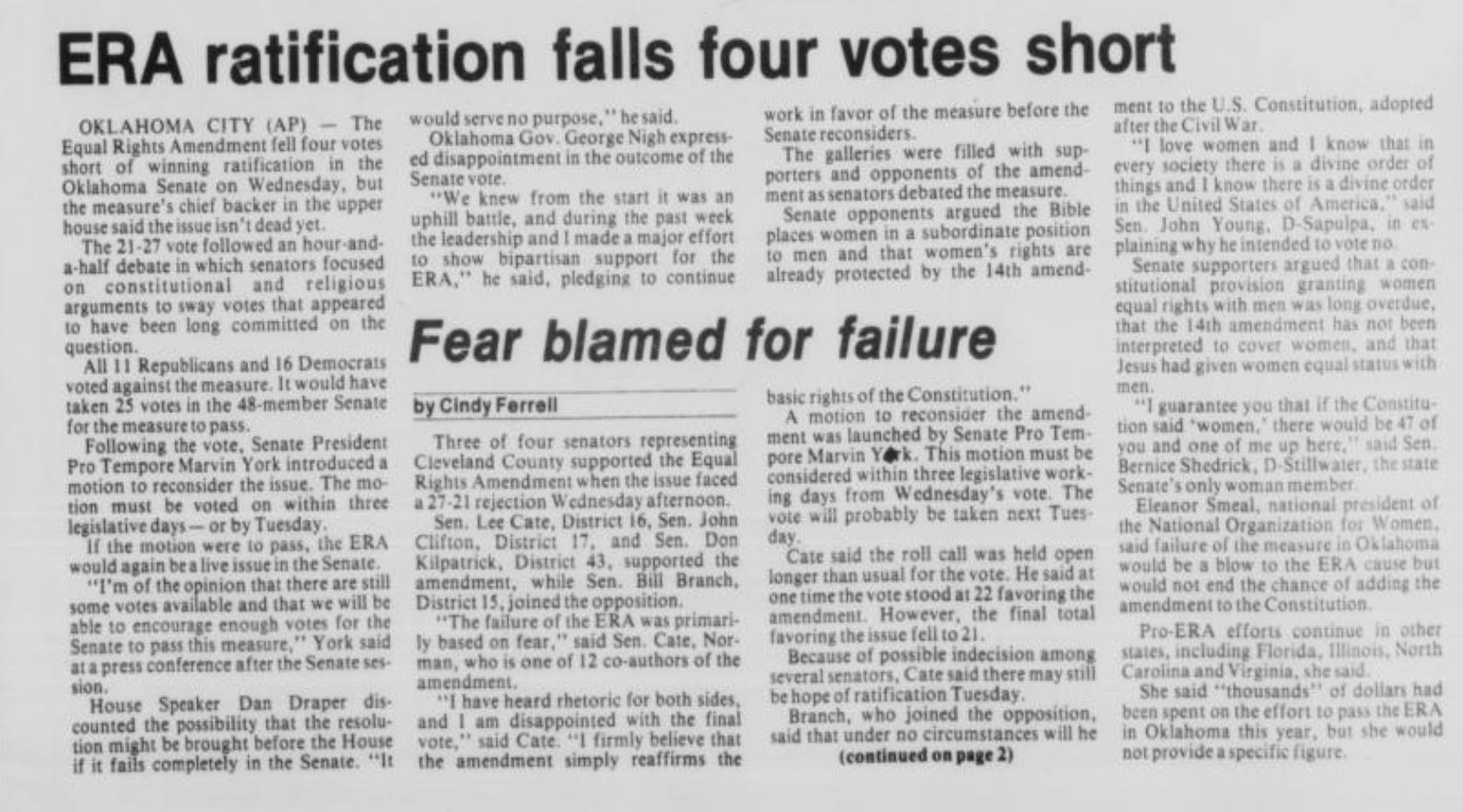
The Oklahoma Legislature voted not to ratify the Equal Rights Amendment in January of 1982, being one of 15 states to not ratify it in time for its deadline that same year. Oklahoma has still not ratified the ERA.
In January of that year, the Oklahoma Senate vetoed the ratification, failing by only four votes. The Oklahoma House of Representatives never brought it to a vote, making the state one of 15 that did not ratify the amendment by the deadline. Oklahoma has still not ratified the ERA.
18 years after the passing of Title IX, OU made national headlines in 1990 for an unexpected move in its athletic department.
The university announced on March 28, 1990, that it would be dropping the women’s basketball program, calling it a “failed venture.”
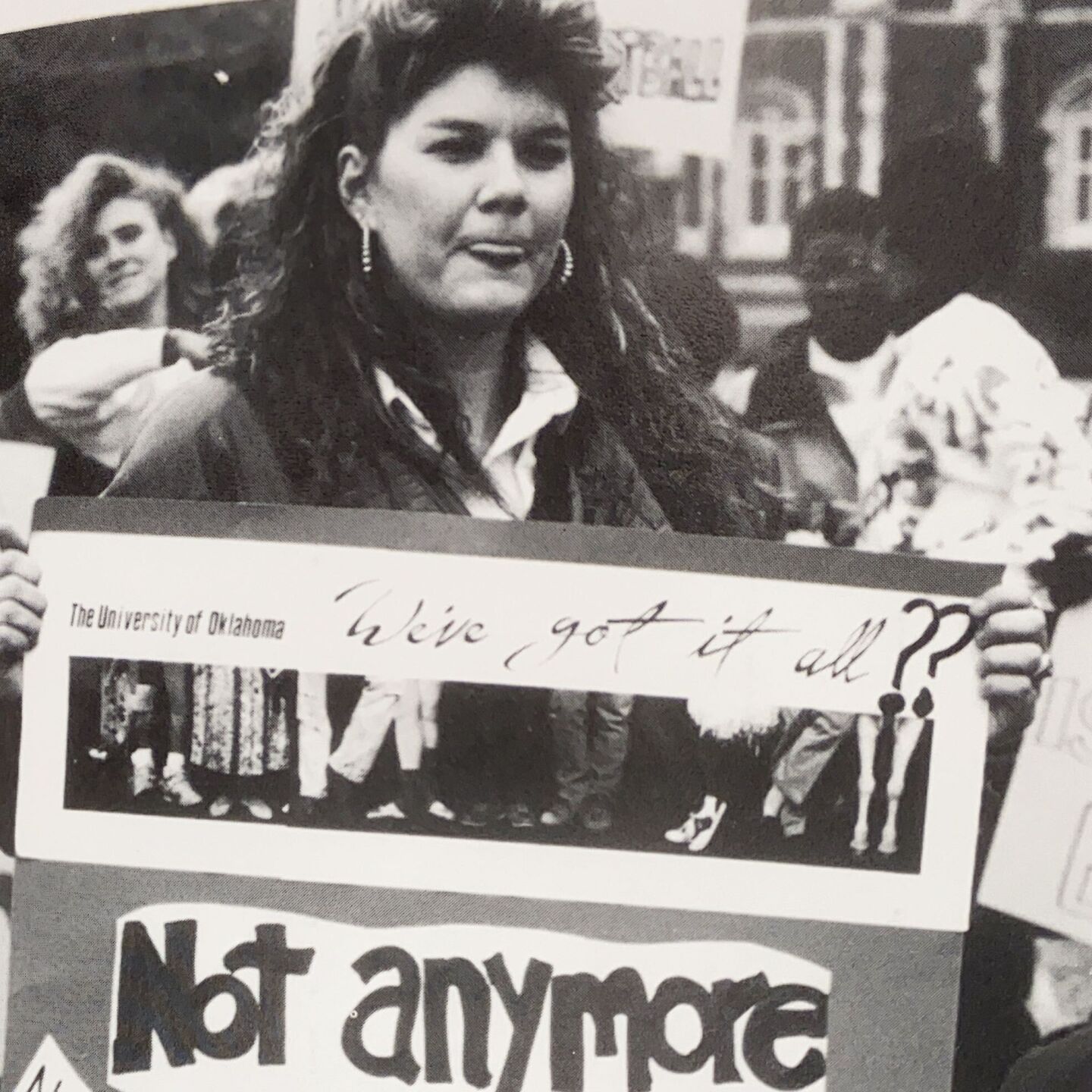
Tammy Rogers, one of the star players of the women's basketball team, protests outside Evans Hall with her teammates after OU cut the program in 1990. It was later reinstated eight days later.
The university faced backlash and lawsuit threats on the grounds of a Title IX violation in response to its decision. A day after the announcement, members of the women’s basketball team, other athletes and community members protested outside of Evans Hall. Protesters called for Richard Van Horn, the president of OU at the time, to join them and reinstate the team.
“I am appalled, angry and disappointed at the way the situation was handled. There are people in the athletic department that have supported us, but as a whole they have not,” Assistant Women’s Basketball Coach Caryn Kaufman said in 1990.
Eight days after the termination announcement, the university reinstated the women’s basketball program, with Van Horn saying he was “glad to have done something right.” He also insisted the decision to reinstate the team had nothing to do with the threatened lawsuits and claimed he had not violated Title IX in cutting the basketball team.
Nationally, Title IX has gone through several changes in the 21st century, namely when President Barack Obama’s administration released a “dear colleague” letter in response to an exposé by NPR and the Center for Public Integrity about sexual assaults on college campuses.
Universities, following the “dear colleague” letter, created offices centered around Title IX, hired coordinators and lowered their standard of proof for finding accused assaulters guilty. OU founded the Institutional Equity Office in 2012. The Obama-era policies surrounding sexual assault were later rescinded by President Donald Trump’s administration.

Protesters march to Evans Hall following President David Boren's comments about sexual assault, Oct. 11. The protest began at 1:45 p.m. in the Unity Garden.
OU was under investigation for Title IX violations as recent as 2016, when the university was one of 194 being investigated by the U.S. Department of Investigation. Over the last 5 years, OU has seen several revelations in terms of sexual harrassment, assault and violence, specifically in relation to former OU Drama Professors Tom Orr and Matthew Ellis. OU President David Boren also received several sexual assault allegations, however, the Oklahoma State Bureau of Investigation decided not to indict Boren of any charges.
‘So all the OU chickies, studs and rah-rahs scared out of their red OU beanies that women would be on next year’s Sooner football team can rest easy. But I’d advise the school spiriters not to hold their collective breath because the women will invade OU’s sacred sport sooner or later.’ - Lynne Persing in a July 13, 1974, OU Daily article
After retiring from elite gymnastics, Maggie Nichols moved into Headington Hall while her friends competed in the 2016 Rio Olympics. Nichols, though she dreamed of going to the Olympics, also dreamed of being a member of OU’s gymnastics team since she was 10 years old.
Even though she left elite gymnastics due to unforeseen circumstances, Nichols still was a star and leader at OU, becoming one of the most decorated collegiate gymnasts in history.
Without Title IX, Nichols may have never competed in college after retiring, or she may never have even had the opportunity to do gymnastics in the first place.
“It’s crazy to think that women didn’t have the opportunity to do athletics at all, and now to see where it’s gone and how much it’s improved — it’s amazing,” Nichols said. “My dream was always to be a collegiate athlete and to be able to experience it and be alongside so many incredible and powerful women. It's so amazing to see, but it is sad to look back and know that a lot of women didn't get the opportunity to do so. … I wanted to do it for all the women that weren't able to.”
After Title IX was passed in 1972, several fans of OU athletics worried women would ruin men’s sports, infiltrating teams such as football and basketball and taking away potential scholarships and budgets for men.
On July 13, 1974, Persing published a column in OU Daily, saying “All the OU chickies, studs and rah-rahs scared out of their red OU beanies that women would be on next year’s Sooner football team can rest easy. But I’d advise the school spiriters not to hold their collective breath because the women will invade OU’s sacred sport sooner or later.”
K.J. Kindler, the current OU women’s gymnastics coach, is a complete “badass” and “so powerful,” Nichols said. She said training under a female coach, especially one like Kindler, was amazing and has changed her for the better. Nichols said Kindler helped her fall back in love with gymnastics.
Nichols was the first athlete to speak out about Larry Nassar, former team doctor of the U.S. women’s national gymnastics team and convicted serial child molester, but she didn’t let her past diminish who she wanted to become. Nichols continues to advocate and speak to students on college campuses and female athletes about sexual assault, and ending the stigma and silence surrounding the topic.
Nichols said she learned about Title IX at a fairly young age, doing projects in school focusing on the act and how it changed the lives of women and athletes in the country. While in college and even after, Nichols said she feels the effects of Title IX and its power on students’ lives.
“I think it is improving so much, and it has just continued to ensure that women get the same opportunities as men, especially in athletics,” Nichols said. “In my own experience, it was super cool to be here at OU and really see women's sports flourish through my years there. Seeing gymnastics and softball starting (to be) on ESPN and big networking channels like that is super cool and is amazing for college athletics.”
Nichols said Title IX can always be improved, but rights for all people need to especially be improved outside of schools and universities. Specifically, she said it is important that women’s athletics receive the same amount of television time and pay as men.
Nichols believes it is important for young women to find “powerful” female role models in their lives, one that will advocate for what they believe in and never take no for an answer, someone like Kindler to Nichols.
“I know that you feel that you might not have equal opportunities in today's society, (but) things are changing, and if you really do work for something, you can achieve it,” Nichols said. “Never let anyone tell you that you can't do something. … I really strive to fight for what I believe in and show that women can do the same (things) men can do. We're just as capable.”
‘Sooners found that OU’s beauties ranked among the nation’s best early in the fall when the Miss Football contest was held here and students compared the top college beauties of the nation. … No wonder men outnumber women on this campus.’ - 1965 “Sooner” yearbook
Cindy Rosenthal, former Norman mayor and former professor of political science at OU, said Title IX was a “game-changer” academically for women.
Rosenthal was the first woman to be tenured in the political science department and the first woman to reach full professorship in the department at OU, according to Rosenthal. She said sometimes, as a woman or a minority in a field, you are forced to shoulder extra responsibilities, obligations and pressures simply because you are who you are.
“I think there are certain pressures when you are the first or in a significant minority within a particular population,” Rosenthal said. “You are under some sort of heightened scrutiny for your performance, both your professional performance and your personal behavior. I think you shoulder some additional burdens to not screw up and to always be the absolute best that you can possibly be.”
At OU and other universities, beauty contests and pageants were common. The 1965 “Sooner” yearbook read, “Sooners found that OU’s beauties ranked among the nation’s best early in the fall when the Miss Football contest was held here and students compared the top college beauties of the nation. … No wonder men outnumber women on this campus.”
Rosenthal said being the only woman in the room put enormous amounts of pressure on her, especially in political science, as the field is dominated by men to this day. She said as a politician, there are more expectations for women than men.
Rosenthal said though she doesn’t think about it as much anymore, she thought about Title IX often while she worked as a professor and as a politician. She said she always thinks about encouraging women to follow political careers because the country and world needs more of them.
Rosenthal said, at times, women are their own worst enemies, as they were taught in society for years to doubt themselves. She wants to encourage women from all walks of life to achieve their goals despite any hesitations they may have.
“Don't ever doubt your qualifications or your abilities because, oftentimes, we are our own worst enemies in terms of discouraging ourselves or second guessing or thinking,” Rosenthal said. “I think that women are demonstrating every day that they have the talent and the wherewithal, the toughness, the creativity and the trustworthiness to be great public servants.”
Fernando-Ahmie, Hynes, Nichols and Rosenthal each said Title IX changed the course of their lives and of every woman’s life in education. All four women spoke about how they hoped they left a legacy and could inspire or pave a way of change for other women and people of all kinds in the future.
Fernando-Ahmie said she’s beyond thankful to have, in some small way, contributed to the legacy of OU softball and the legacy of “powerful” female athletes that followed her.
“If you were to trace the history of OU softball back from the super highway of today to its humble beginnings, you’d find a narrow path of lightly trodden grass. I’m thankful to those that came before me to blaze that trail, a trail that would lead me to who I am today,” Fernando-Ahmie wrote. “I reflect on how (about 50) years ago, a young Native American woman’s footsteps pressed down a few blades of grass on a path that in some small way helped a young Hawaiian woman find that path and achieve greatness.”


