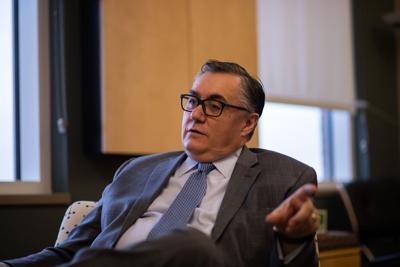

It took one particularly influential fourth grade physics teacher, an engineer father and a big imagination to launch Tomás Díaz de la Rubia from the rugged mountains of Asturias, Spain, to a modest dorm room in Albany, New York.
“The idea was to come to the U.S. to spend a year abroad in college,” Díaz de la Rubia said. “That was 1981.”
Thirty-nine years later, Díaz de la Rubia is in his sixth month as OU’s vice president for research and partnerships. The position oversees all research efforts at the university and builds strategic connections between funding, research, areas of need and the development of technology.
Excitement around impact potential for Díaz de la Rubia’s work in research reached all the way to Oklahoma Gov. Kevin Stitt, who spoke with Díaz de la Rubia when he was contemplating moving to OU.
“My top priority in higher education is to ensure our universities have every competitive advantage to participate in and produce the best research in the nation,” Stitt said in a press release. “I commend the University of Oklahoma for its vision to grow research opportunities at the institution and for its active recruitment to bring top-tier talent to the state. It was a pleasure to meet with Tomás Díaz de la Rubia while he was considering the offer, and I am confident his leadership will elevate OU’s reputation on the national stage.”
The world-renowned scientist worked in a government-funded defense lab as a deputy director and chief resource officer overseeing national security projects. Díaz de la Rubia also directed an energy consulting firm and served as the chief scientific officer and senior vice president for strategic initiatives at Purdue University.
“Every job I’ve had, it’s just been a great time,” Díaz de la Rubia said. “I tell you, it’s been fantastic.”
Curious child to college cosmopolitan
Díaz de la Rubia said it all began when an elementary physics teacher made science accessible and interesting to him through hands-on, intriguing experiments that used a variety of equipment.
“He was demonstrating things with pumps and cars going on inclines and things falling,” Díaz de la Rubia said. “He had all kinds of gadgets he would bring to class, and I was like, ‘Wow, this is great.’ They were very simple concepts, but it just caught my attention. It was exciting and very hands-on.”
At home, Díaz de la Rubia’s father, an engineer, planned and built various projects for his job. Díaz de la Rubia said he spent his childhood watching his father “tinkering with stuff all the time.”
After absorbing every physics and astronomy book he could find, Díaz de la Rubia graduated high school in Spain and started college at a nearby university. After visiting family in Albany, Díaz de la Rubia decided to move his studies to the States.
Díaz de la Rubia’s journey to OU began with his work at the State University of New York at Albany, where he received a bachelor of science and a doctorate in physics.
Adam Lipson, Díaz de la Rubia’s best friend from college, said he once doubted the duo’s chances of ever succeeding at anything other than “tennis and drinking.”
“I think if you would’ve looked at both Tomás and I in college, you would have never guessed we’d both be successful, productive adults,” Lipson said.
Lipson is the president, co-founder and CEO of the New York-based Network and Security Technologies, a cyber-security consulting firm.
Díaz de la Rubia and Lipson met when Lipson visited his girlfriend, who lived in the same dormitory as Díaz de la Rubia. Lipson said he was instantly drawn to Díaz de la Rubia’s childhood stories and eclectic, exciting tastes from his European upbringing.
“Formula One race car driving, fine dining, pâté, how to cook paella, different cheeses, what he felt the best varietals of coffee were,” Lipson said. “He was the only guy at Albany that wore a gold Cartier watch.”
Lipson said the two quickly became best friends. Díaz de la Rubia taught him things like driving a stick shift, tailgating and, most importantly, the importance of a good sport jacket.
“In college, I used to wear a T-shirt and jeans,” Lipson said. “But when we went out, Tomás would insist on us wearing sport jackets. And even today, he goes to work with a sport jacket.
“When he comes home, he doesn’t take that jacket off. He wears it when he cooks dinner, he wears it during dinner, he wears it right up to the time he walks into the bedroom at night.”
From classroom to lab, and back again
After graduating college, Díaz de la Rubia left his friend in New York and headed west to join Lawrence Livermore National Lab in California, a research institution focused on defense and energy. There, he began a scientific career that would take him all over the globe working with the government, private sector and academia.
“I joined Lawrence Livermore National Lab as a postdoc,” Díaz de la Rubia said. “It was one of those things where you go there for a couple of years and then do something else. That lasted 24 years.”
Díaz de la Rubia chuckled and added, “My plans never seem to work.”
At the lab, Díaz de la Rubia began as a postdoctoral researcher and worked his way up to an associate directorship in chemistry and material science. Seven years later, he was appointed as the chief research officer and then deputy director for science and technology.
Lipson said he was surprised Díaz de la Rubia passed on opportunities to work for big financial institutions like JPMorgan Chase or Wall Street, where he could have enjoyed “higher compensation” and a “better, more cosmopolitan lifestyle.” Instead, he stayed at the government defense lab.
“But Tomás moved at an incredibly alarming pace (up the chain of leadership) at Lawrence,” Lipson said. “It really speaks volumes about who he is, that this is a guy who can get that far without a background in weapons and not being born on American soil. Being able to move at that rate post-9/11, when there was a particular sensitivity about those sorts of things, is just really remarkable.”
In 2013, Díaz de la Rubia spent two and a half years with Deloitte Consulting, a private consulting firm in Washington, D.C. that advises energy sector clients on how to utilize new technologies.
Díaz de la Rubia left the private sector in 2015 to research at Purdue University in West Lafayette, Indiana.
“(My wife and I are) in the middle of D.C., a big, thriving metropolitan area with restaurants and museums and cultural life,” Díaz de la Rubia said. “And then we were in the middle of cornfields. I mean, literally in the middle of cornfields. So many cornfields, and nothing around it.”
At Purdue, Díaz de la Rubia began as the chief scientist and executive director of Discovery Park and then served as vice president of the same program. Discovery Park is Purdue’s “collaborative research environment where interdisciplinary projects are connected through Purdue, Purdue Research Park and the world.”
Suresh Garimella, president of the University of Vermont and Díaz de la Rubia’s former supervisor at Purdue, said Díaz de la Rubia “truly energized” Discovery Park.
“What I was looking for was someone who would bring a strategic focus, great energy and big vision to Discovery Park,” Garimella said. “He did all that and more.”
Garimella said Díaz de la Rubia launched projects like the “Big Idea Challenge,” a research proposal contest that funds three to five winning teams with a “pool of strategic investment resources” to continue their projects.
“If (Díaz de la Rubia) could create even a fraction of what he did (at Purdue), OU will be in great shape,” Garimella said.
Scientist serving society
For Díaz de la Rubia, two things matter most in his work: a diversity of voices involved in every process, and research that serves the populations that need it most.
“If I’m an engineer and I develop a gadget, but there is no pathway to bring that gadget to the people that need it, or if it is the wrong gadget for that community, it doesn't matter that I developed a gadget,” Díaz de la Rubia said. “I may have written a paper about it. I may have gotten an award for it, but it's not really going to have any impact on society.”
To ensure that projects are worthwhile to all affected, Díaz de la Rubia said he prioritizes a marketplace of ideas to maximize value for humanity.
“When you really want to translate knowledge to impact on society, those voices from the social sciences, the humanities and other disciplines are critical because we need to understand what it is that is going to impact society,” Díaz de la Rubia said. “What is it that society really needs?”
Throughout Díaz de la Rubia’s long career, he said the most important factor in his research has been how to best serve communities most in need of innovation. Due to the classified nature of his work at the lab, he said he’s content to now be a part of something that directly impacts the lives of everyday people.
“Innovation is not an innovation unless it gets translated into a product that impacts people's lives and that has a benefit to society,” Díaz de la Rubia said. “That's an innovation. If I discover something in the laboratory and it stays in the laboratory, that's not an innovation. That's a discovery. ... The last eight years or so, my focus has been much more on thinking about how to really have a positive impact on society.”
Since Díaz de la Rubia came to OU, he said he has taken the same approach of prioritizing societal impact and a multiplicity of input from diverse voices.
In January, OU announced a $9 million research collaboration with the Universidad Nacional de San Agustín in Arequipa, Peru. The partnership focuses on bringing together a varied array of academic minds to study the environment and health in a region heavily impacted by the effects of climate change.
Díaz de la Rubia said the need for intervention in the Arequipa region has been exacerbated by the snowballing effects of climate change. He said the region has been especially affected by increased skin cancer rates from a depleted ozone layer and an unpredictable water source as glaciers melt with increasing speed.
Díaz de la Rubia first worked with the Peruvian university during his time at Purdue. When he moved to OU, he saw an opportunity to use OU’s resources to address the region’s issues.
“We have an opportunity (at OU) to create something very significant in Peru around the impact of climate change,” Díaz de la Rubia said. “You have to bring all of these voices together if you really want to translate knowledge to impact, and that's where we're going with this project.”
In the coming months, Díaz de la Rubia said he hopes his big ideas have the power to change people's lives at OU, as well as all over the world.
“That's how we're defining this strategic framework for research at the University of Oklahoma,” Díaz de la Rubia said. “Our ambition is to work across those traditional academic boundaries and work together to create solutions that will improve people's lives.”


