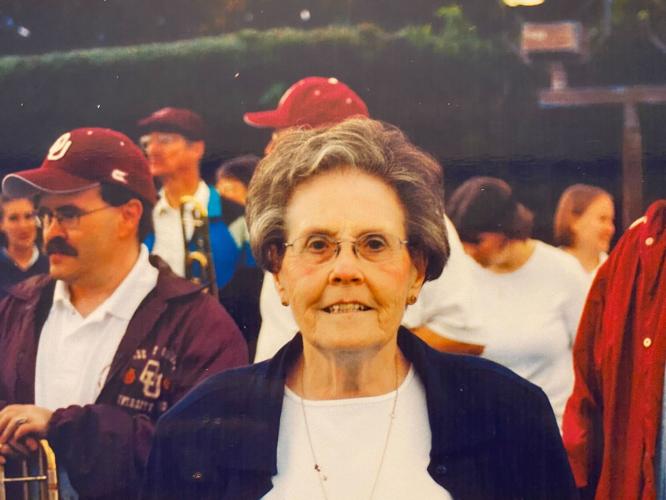


Ever since she was a little girl, Ellen Vanderslice knew she wanted to play the trumpet.
After she received her first cornet at 15, her passion for music grew. She later became a member of the Pride of Oklahoma in 1939 and made history as the first woman to march with the band on the field during the Oct. 11, 1941, OU football game against Texas.
“She was a person that you could always count on,” said Marilyn Kilgore, Vanderslice’s oldest daughter. “She did what she said she was gonna do.”
Kilgore described her mother as someone who was always eager to learn and try new things. She remembered the way her mother always had a good attitude growing up.
“I can recall, back when I was in elementary school, she would sit at home at night and call out my spelling words for an hour if I needed her to,” Kilgore said. “She was just right there with me, as long as I needed her to.”
Kilgore and Jane Thomas, Vanderslice’s youngest daughter, said as she got older, she never gave up on her passion for music. They recalled their mother’s constant love for music throughout her life and theirs.
“She played a solo at Carnegie Hall when she was 88,” Thomas said. “She never ever lost her love for (music). She wrote music. She's a composer. She taught music. She was funny. She is funny. Everybody loves her for who she is.”
On Feb. 3, Vanderslice died at 103 years old. At her funeral, members of the Pride of Oklahoma honored her with a trumpet performance.
She laughed and made others laugh, she treated people with kindness and loved her family more than anything in the world, Kilgore said.
Her family and friends remember her for her love and passion for music, her incredible personality, and most importantly, her perseverance to accomplish all of her dreams and aspirations.
The girl with the dream
Since she was young, she always was full of hope and imagination, Blake Kilgore, Vanderslice’s grandson, wrote in Vanderslice’s eulogy.
As a curious little girl in 1927, she found an old music stand in the attic of her grandparents’ house. She brought it down and pretended to play music with it, according to Vanderslice’s unpublished autobiography, “Just Me and My Trumpet.”
Her passion for music came from her grandfather, who used to play the harmonica, the first instrument she later learned to play.
Vanderslice’s parents enrolled her in piano classes because of her love for music, but she never felt connected with the instrument, according to the autobiography.
In the summer of 1934, Vanderslice received the Osgood cornet her dad used to play before he got married and, with no objections from the neighbors, she started to practice.
During her time at Stonewall Jackson Junior High and Capitol Hill High School in Oklahoma City, she was in orchestra and band.
In her junior year of high school, she moved to Duncan, where she continued her musical journey and played cornet solos with her high school orchestra.
In Duncan, she played nearly every week in civic clubs, she wrote in the autobiography. One week, she changed her old Osgood cornet for a new Conn Victor, a gift from Roy L. Hurst, a pastor at First Baptist Church in Duncan.
After graduating from Duncan High School, she earned an Associate of Arts degree from Duncan Junior College in 1939.
Vanderslice then transferred to OU as a junior in the fall of 1939 and decided to join OU’s marching band.
The first time a woman was allowed to be a member of the OU Band was in 1934, and even though they were members, they were not allowed to play with the band at football games.
In the fall of 1939, after some “fussing and fuming,” as Vanderslice wrote, women were only allowed to play in the stands at football games.
“(Vanderslice) thought, ‘I paid for a uniform. That's silly. I mean, we should be able to march,’” Thomas said.
In the fall of 1941, Vanderslice’s senior year at OU, football players, cheerleaders and band members made the annual trip to the Cotton Bowl Stadium in Dallas for the annual Red River Rivalry football game.
That year, female band members marched with the men.
During a stop in Denton, Texas, the band held a concert for the women at Texas Woman’s University, where Vanderslice performed a solo of “Miss Bluebonnet,” accompanied by the band, Vanderslice wrote in the autobiography.
After arriving in Dallas, Vanderslice and Naomi Ellis, another member of the Pride, were the first women ever allowed to march with the band on the field, with roughly 42,000 fans watching.
Although OU lost to Texas that day, Vanderslice and Ellis saw their accomplishment as a win for female members of the OU Band.
“I remember the band parading single file through one of the big downtown hotels. I heard several remarks, ‘Look, there is a girl’,” Vanderslice wrote in the biography.
Vanderslice later became the first woman to receive the Most Outstanding Woman Band Member 1941-42 award during an OU band banquet her senior year, according to the biography. In August 1942, she received her Bachelor of Arts in instrumental music education from OU.
‘Can you believe we’re getting paid to do something we love?’
After her time at OU, Vanderslice started working at Britton High School as a band director, where she was in charge of beginning and advanced orchestras, band and vocal music classes.
She also offered private lessons at Oklahoma City University and was part of the Oklahoma City Symphony after her graduation.
“She is hopping in the car with her cousin Hal, and they hurry … for their practice with the Oklahoma Symphony. On the way out, the director hands them their payment checks, and Ellen turns to Hal, ‘Can you believe we are getting paid to do something we love?’” Kilgore wrote in the eulogy.
In 1945, during a church revival at the First Baptist Church in 1945, Vanderslice performed a solo where she met her late husband, B.D. Vanderslice, who was the pastor at the church, according to Thomas.
“She played, and when she was leaving, she shook hands with the young pastor and thought, ‘He's kinda cute,’” Thomas said. “He must have had the same feeling because they were engaged two weeks later and married two months later.”
After marrying in 1945, Vanderslice quit her teaching job and the symphony to dedicate herself to her tasks as a pastor’s wife and church choir director.
The couple later had two daughters: Kilgore in 1947 and Thomas in 1953.
The family frequently moved around due to their father’s job, but Vanderslice provided the daughters an environment of “warmth and acceptance,” Kilgore said. She remembered her mother’s love for her kids and all the moments they spent together.
One of the ingredients of Vanderslice’s “secret sauce” to live a happy and long life, as Thomas called it, was her devotion to God.
“I'd say that my mom actually had a very deep faith. … She just accepted the love she sensed from God, and so we picked up on that,” Kilgore said.
The family moved to Denver in 1960. There, Vanderslice learned sign language so she could interpret her husband’s sermons. After moving back to Texas in 1966, she started working as a substitute teacher for deaf and hard of hearing students, Thomas said.
Vanderslice received a master’s degree in Deaf education from Texas Women’s University in 1974.
She worked at Crozier Tech High School in Dallas but later moved from school to school until landing at W.W. Samuell High School in 1968, where she remained until her retirement.
During her time at W.W. Samuell, she started a handbell choir with deaf and hard of hearing children. The method she developed consisted of color-coding the bells and the music, while using sign language for counting.
“All the time, my main interest was in music. I believed that deaf students, with a proper method, could ring handbells. I set out to develop such a method,” Vanderslice wrote in the biography. “They could do something some hearing people could not do.”
After she retired from teaching in 1988, Vanderslice and her husband moved to Albuquerque, New Mexico, for a “retirement adventure,” Thomas said.
Vanderslice's husband developed prostate cancer in 1993, so they decided to move back to Dallas to be closer to their daughters. After months of being in hospice care, her husband died in 1997.
After grieving the loss of her husband and finding herself with newfound free time, Vanderslice decided to go back to her longtime passion.
“There I was. No more elderly loved ones to care for. This became the time for me to again play my trumpet,” Vanderslice wrote.
After spending most of her years taking care of her family, Vanderslice received an invitation she couldn’t resist: the First Baptist Church Dallas Orchestra was looking for adult musicians to play during the Sunday morning services.
“My grandmother died in 1993. (My dad) died in ‘97. My mom took care of both of them until they died. She didn’t really have the luxury of being involved with anything else much because it’s a full time job,” Thomas said.
Vanderslice saw this opportunity and took her old pawn shop trumpet and practiced. The feeling of the trumpet became addictive to her, she wrote. She couldn’t resist playing with it for a few minutes, and after a lot of practice, she finally went to her first orchestra rehearsal.
She did car tours with the orchestra, Thomas said. She performed with the orchestra across the U.S. and visited countries like Argentina, Brazil, Kenya and Zambia.
‘The dream had come full circle, and she was full to overflowing’
Marna Keith met Vanderslice in 2010 while living at Highland Springs Senior Community in Dallas, and the two quickly became best friends.
Keith moved to the senior residence after her husband’s death in January 2010, two months before moving to the senior community where Vanderslice had been residing since 2008.
Keith said she still had some of her late husband’s hearing aid batteries, and offered them to any residents in need, later gifting them to Vanderslice.
Vanderslice and Keith confided in and loved each other. With a very close relationship, Keith remembered the times they spent playing rummy in their apartments and sharing meals.
“Ellen was fun,” Keith said. “She was witty, and had a quick sarcasm that I loved.”
Keith said her friendship with Vanderslice was surrounded by laughs, music and their love for each other.
One day, when Keith went to visit her friend, she found sheets of paper laid on the floor: a cookbook that Vanderslice had hand-written for her family. The pair spent a busy but fun day together trying to collate and stack recipes together.
Thomas said Vanderslice loved cooking for her family during holidays, and one of everyone’s favorite dishes that she made was her brisket.
“She made the best brisket. It’s my favorite till this day,” said Paige Dunn, Vanderslice's youngest granddaughter.
Dunn said her grandmother was gracious and loved her grandchildren, and, even though she was the youngest grandchild, her grandmother would always make her feel included.
“While I lived the closest to her, I would go visit her in Dallas, and I just remember she always loved to sit and watch Wheel of Fortune while she was eating and so we would do that together,” Dunn said.
Vanderslice was a woman who always wanted to learn and to teach and help others. Dunn remembered all the visits she gave her and the moments they spent together fondly.
“We can all see MaMa at her sewing machine, making school clothes for her Marilyn and Jane. Later, we see her making the matching robes and pajamas and sweat suits and dresses she fashioned out of pure love and labor for all of her clan,” Kilgore wrote in the eulogy.
In January, around 84 years after being a member of the Pride, four current members discovered her story and gave her a trumpet performance.
When Preston Loeffelholz, a meteorology junior, found out about the story of Vanderslice through his own grandmother, he immediately wanted to visit her.
“My grandma works with her granddaughter, and it somehow got mentioned that I was in the Pride, and they started talking about how (Vanderslice) was also in the Pride,” Loeffelholz said. “They sent a few videos to her, so I thought she would want us to come play for her.”
Loeffelholz told his idea to his friends and current band members Parker Huckabay, Cale Richardson and Seamus Meehan.
The four students drove to Tulsa, where they performed “Boomer Sooner” for her. They also shared stories about Vanderslice’s time on the Pride, Loeffelholz said.
“That was something that probably not a lot of people in the Pride have the opportunity to do,” Huckabay said. “To me, somebody who was in the Pride so long ago, and just get to make her day. … It was something that seemed really cool.”
Looking back at Vanderslice's role in the Pride, Huckabay said the visit was very meaningful for him and the other students, and that it was a good feeling to do something in her honor.
The four members also gave a trumpet performance after her burial, alongside Bianca Discher and Ruby Fried, who are also members of the Pride.
With tears of emotion, Thomas described the visit of the students as "the highlight of my mother’s life" and is very grateful for the acknowledgment and honor the Pride gave her mom.
“I just want to thank those boys. I can't believe how great they were to do that and to come give my mom the attention that she never really got,” Thomas said. “It was a great finale for them to come, to see her and make a big thing out of her life. That's such a great gift that she finally got acknowledged.”
Throughout her life, Vanderslice accomplished many of her dreams. She was a wife, mother and grandmother, but most importantly, she was a musician. Vanderslice was recognized for her work, Thomas said, and was always humble about her musical experiences.
“The dream had come full circle, and she was full to overflowing,” Kilgore wrote in the eulogy.
In August of 2017, Vanderslice was moved to The Grove, a retirement community in Tulsa, where she resided with excellent care, Thomas said, up until the moment of her last breath.
After their mother’s passing, Kilgore and Thomas decided to open the Ellen Vanderslice Pride of Oklahoma Endowed Scholarship Fund for students who are members of the OU Band.
Vanderslice grew up lower-middle class with a head full of dreams to study music. Thomas said she and her sister want this scholarship to help others going through the same experiences their mother went through while attending OU.
Thomas said her mother was always grateful to God for her life and that she wouldn’t be the person she was without her devotion.
“That’s why she had that indomitable spirit. That’s why she didn’t get down. That’s why she was grateful. That’s why she served in the church. That’s why she tried to do the right thing,” Thomas said. “She was wholesome, pure and old fashioned. … (Jesus) gave her this gift of music. Her greatest thanks was to her best friend Jesus.”
Vanderslice is survived by her two daughters, Marilyn and Jane; and her eight grandchildren, Julia, Meredith, Paige, Blake, Collyn, Carrie and Ben. She was preceded by her husband, B.D. Vanderslice; her father, Paul Judson Kirk; her mother Moddie Gibson Kirk; and her brother, Paul Judson Kirk Jr.
Editor's Note: This article was updated on March 23 at 10:13 a.m. to reflect the proper spelling of Texas Woman's University.
This story was edited by Alexia Aston, Karoline Leonard and Jazz Wolfe. Francisco Gutierrez, Alexandra Powell-Lorentzatos and Mary Ann Livingood copy edited this story.


