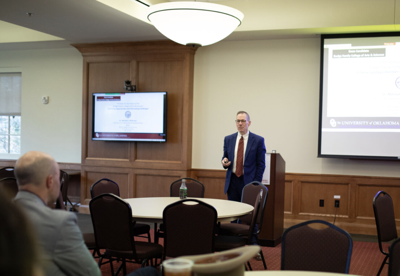


Mitchell McKinney, the second of five dean candidates of Dodge Family College of Arts and Sciences, held a public forum Wednesday to share his vision for the college with students, faculty and staff.
McKinney has served as the dean of Buchtel College of Arts and Sciences at the University of Akron since July 2021.
Previously, McKinney worked as a professor of communication and chair of the department of communication at the University of Missouri. He also served as the director and founder of the Political Communication Institute at Missouri.
McKinney served as a staff member in the U.S. Senate and as a White House fellow for the Domestic Policy office in 1993. He also served as associate director of the National Communication Association in Washington, D.C., and as president of the Central States Communication Association.
McKinney formerly taught at OU as an assistant professor in the department of communication from 1996 to 2000.
McKinney earned two bachelor’s degrees in speech communication and government from Western Kentucky University, a master’s in speech communication and rhetoric from the University of North Carolina at Chapel Hill and a doctorate in communication studies from the University of Kansas.
Building community
McKinney said his top priority is to care for the well-being of faculty, staff and students, including fostering an inclusive and collaborative environment.
“When I get to the point where I presume that I know more than the biologist, or I know more than the physicist, or I know more than the poet, and I can make the decisions for them, then we're all in trouble, folks,” McKinney said.
McKinney spoke about being a “dean of yes” who, when collaborating with fellow faculty members, will give chances to their plans for improvement.
“As an administrator, I've got to recognize a good idea, support it and bring it to fruition,” McKinney said. “I know as a leader, this notion of entrepreneurial and innovation must necessitate some level of risk.”
McKinney said he also recognizes the importance of students, adding they are just as important to building a world-class college as faculty and academic programs. He said he’s focused on improving enrollment and retention rates for students.

“The greatest imperative now is to care for those in this academic community and that's my primary role as leader of this community,” McKinney said.
Rather than cutting out majors with low enrollment numbers, McKinney is focused on reorganizing and facilitating collaboration between colleges and their programs.
“I guess we've had some students that are still struggling with declining enrollments in majors and head counts. That doesn't mean they're on the chopping block,” McKinney said.
McKinney said it is the responsibility of arts and sciences programs to protect and preserve democracy, specifically by teaching students and citizens the skills they need to be civically engaged.
“We are challenged with preserving our mission of intellectual inquiry and discovery, and we must be as an institution,” McKinney said. “I realize, as leader of art and sciences, it implicates us particularly.”
Language requirement
OU Provost’s Office requested in November an evaluation of the College of Arts and Sciences foreign language requirements, raising concerns from the OU community that the undergraduate language requirement would be removed.
McKinney said he dealt with a similar situation in his current position as dean of arts and sciences at the University of Akron, and that many institutions are grappling with similar situations.
“I actually saw the value in continuing to require language requirements for all. However, that's just my perspective,” McKinney said. “I should not and would not be in a position of willing my perspective on my colleagues.”
McKinney said the revaluation of language requirements at the College of Arts and Sciences should involve education value for students, and that focusing on a deficit distracts administrators from equipping students with necessary resources.
“You can't come to the table with a self interest argument,” McKinney said. “It's got to be grounded in how it serves our students.”
This story was edited by Peggy Dodd, Anusha Fathepure and Ana Barboza.


