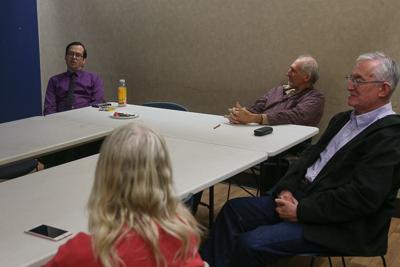
On a rainy Saturday, six people sat in a Norman Public Library meeting room with the lights dimmed. Among the group were a mechanic, a schoolteacher and a network engineer. One was a millennial, and one was in his 70s. But everyone in Meeting Room C share one commonality: all are on the autism spectrum.
The Norman chapter of Aspie Adults of Oklahoma, founded in 2015, meets every second Saturday of the month. The organization isn’t a support or therapy group — it’s a social setting for 18+ autistic people to share their experiences, frustrations and victories.
“We're more of a social organization where we try and meet up with other autistic people to kind of talk about our experiences and talk about difficulties, things that bother us,” said Tom Taylor, 44, the group’s co-chair.
At its March 26 meeting, Norman City Council passed a resolution declaring April as Autism Awareness Month. Taylor represented Aspie Adults at the meeting and said his speaking to council was a positive step for the community.
“The autism community tends to be represented by parenting groups,” Taylor said. “There's a movement ... about autistic people representing themselves and having a voice for themselves, and that's one of the things that our group tries to do is to be a voice for autistic people by autistic people.”
Lynnda Newbie, a group member and retiree, said she comes to Aspie Adults because she read that having more personal interactions leads to a longer, healthier life. She compared being in the group to growing up in a ‘50s neighborhood — no one excludes anyone else, because everyone is part of the same community.
“So, I get to come here and see everybody when we have a meeting, and sometimes they say really funny things, and sometimes I learn things, so I enjoy it,” Newbie said.
The name “Aspie Adults” is a reference to Asperger Syndrome, which was formerly classified as a separate form of autism. But Asperger’s isn’t a formal diagnosis anymore — Autism Spectrum Disorder has been the official terminology since 2013, although ASDs are distinguished by level.
Most everyone with a former Asperger’s diagnosis qualifies as having a Level 1 ASD, according to Very Well Health, a medical website.
The group uses “Aspie” in its name because many people with a mild ASD still identify using the term, Taylor said.
Taylor, also a father of three, studied political science, worked as a college professor and a campaign consultant, and now teaches eighth grade. He said he received his autism diagnosis a few years ago while working on his doctorate, after his OU graduate adviser brought up the possibility.
Taylor’s daughter was being evaluated for autism around the same time, and he said he started to recognize similarities in himself.
“So many people were coming out of woodwork and going, ‘Oh, we thought you knew!’” Taylor said.
And this situation isn’t uncommon in the autism community, he said. Many members of Aspie Adults weren’t diagnosed until adulthood, like Garnett Teakell, a 72-year-old former missionary and librarian, who said he learned he had autism by cataloguing books about Asperger’s at work.
“Ten years ago, I’d never even heard of Asperger’s,” Teakell said. “Until I came here, that’s all I had was books.”
There’s no one agenda for an Aspie Adults meeting, Taylor said. Sometimes members discuss a topic, sometimes no topic is planned, and sometimes they watch a film. But all meetings help members to escape what Taylor called “social games,” or patterns of interactions common to neurotypicals — people who don’t display autistic traits.
“There’s a comfort level (to the group),” Taylor said. “And a comfort level in a social situation for autistic people is kind of rare.”
At the last Aspie Adults meeting, members discussed uncertainties in their everyday lives: how much to talk in conversations, when it’s appropriate to leave a social situation, how to decide the line between acquaintance and friend, how to cope with rejection and how to handle confusing, performative behavior from neurotypical people.
Some members said they felt suspicious toward overly friendly people. But others, like Teakell, said they’ve learned to take interactions at face value.
“I’m going to strictly interact on what is visible and obvious,” he said.
But the group also talks about larger issues in the autism community. Taylor said autistic people experience high rates of violence, police brutality, suicide and unemployment — only 15 percent of college-educated autistic people have a job, he said.
“Are (autistic people) being discriminated against because they’re coming out saying they’re autistic, or are they being discriminated against because the fact that they’re autistic, whether they mention it or not, gives them difficulty going through a job interview?” Taylor said.
But everyone who came to Saturday’s meeting had a job or was retired, leaving members to discuss their good fortune amid an 85 percent unemployment rate.
A couple group members said choosing the right field was integral to their success in the job market. For 49-year-old Mark Wheatley, the founder and co-chair of the group, that field was computer science. For another group member, it was car mechanics. This member said his skill set as an autistic person makes him a unique asset — people on the spectrum often have highly logical brains and are able to focus on certain tasks longer than neurotypical people.
“For me, realizing there’s a niche in society that I fill that can’t be easily replicated by anyone else gives me a great sense of confidence and purpose that I wouldn’t have otherwise,” he said at the meeting.
Taylor added that everyone in the room was “high-functioning,” which is a term used to describe autistic people who exhibit milder symptoms. The phrase can be controversial in the autism community because of its focus on ability, Taylor said.
But in a world with so many social and professional norms, being considered high-functioning can mean the difference between employment and unemployment, especially when it comes to interviewing, Taylor said. The group even discussed the privilege behind the label.
“High-functioning doesn’t mean always-functioning,” Taylor said. “We’re going to have bad days, but we have fewer bad days than many of the members of our community.”
But certain parts of a work environment can still be a challenge. Taylor said autistic people are hypersensitive to stimuli, and teaching eighth grade can get loud and rowdy. To cope, he said he sets aside time to decompress upon arriving home.
“You can’t just walk out on a room of 20 kids, so you just have to tough it out,” he said.
But big groups aren’t always the only challenge for people on the spectrum. Aspie Adults members also discussed how to navigate dating situations, dating safety and relationships. They also talked about the fact that women have trouble getting diagnosed with autism because their symptoms can present differently.
The group agreed that coming to Aspie Adults of Oklahoma curbs feelings of isolation, which Taylor said can date back to childhood.
“When you’re autistic, you grow up feeling alone a lot of the time,” Taylor said. “You don’t build close relationships, and you just feel like a freak. And I think the group does a really great job of letting you know that a lot of those experiences ... are actually kind of common in our community.”
Wheatley said he appreciates the group’s focus on adult life and the specific challenges therein.
“It’s nice knowing you’re not alone,” he said.
Teakell said the group has given him the community he didn’t have before.
“(The group) makes you feel like you’re not weird as you always thought you were,” he said. “Here’s a whole group that I don’t have to feel inferior to because we’re all —”
“We’re all kids in the neighborhood,” Newbie said.


