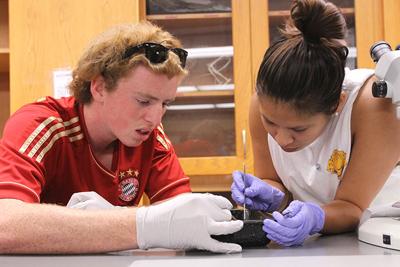
Once a semester, if that, lab coordinator Beverly Hall is approached by a student who doesn't want to dissect animals in one of the Introductory Zoology labs she oversees. This fall, that student was philosophy senior Samuel Regan.
Regan, who is vegan, believes animal dissections are unethical, and told Hall participating in them would be upsetting. Knowing in advance he'd be asked to participate, he had enrolled with the intention of seeking alternatives. In fact, Hall had one ready when his TA referred him to her office.
"She showed me this very antiquated looking CD-ROM that I could use in place of live dissections," Regan said. "But warned me that I would still have to look at dissected animals for the midterm and final exam."
The 1998-produced CD-ROM, which contains audio-visual exercises, is one of the few alternatives the biology department offers to students who wish to be exempt from dissections. The department has a history of working around such obstacles, from allergies to religious beliefs, but workarounds are not always satisfactory to the students involved.
Before the first week had ended, Regan dropped the course. Though he acknowledged people throughout the process had acted considerately, he said he found the dissection alternative lacking for two reasons.
"First, because I would still have to be involved with dissections [for exams]," Regan said. "And second, because I was nervous about the alternative making the course more difficult to me than it already was."
In allowing students to opt out of dissections, the biology department sets itself apart from other departments. If a student were to object on moral grounds to writing an essay in an English class, for example, his or her professor might laugh.
Professors in the biology department, however, take into consideration the students' moral and religious objections. Though dissections comprise an important part of some biology courses, the department is sensitive to dissent, Hall said.
"It's a touchy issue," Hall said. "It's not that they are not willing to learn the material … they just object to the methodology of the assignment. It's not like ‘I refuse to write that paper.'"
Despite the department's efforts, its accommodations are imperfect. Professors like Phil Gibson, who teaches Introduction to Biology, maintains that photographs and diagrams simply can't replace the experience of dissecting a real — figuratively — live animal.
"Sometimes even in a picture they might've moved some things off to the side," Gibson said. "You don't get a chance to see where it all is at. Moreover, dissection is also a very tactile experience. [It's good] just being able to feel these different tissues and organs … the way they actually are put together."
This was exactly what discouraged Regan from remaining enrolled.
"When given the CD, I was told [by Hall] it was not nearly as rich of a learning experience…" Regan said. "So, I had reservations using it, given the difficulty of the lab and the unfamiliarity of the course material."
Professors may fall on the side of the debate opposite to Regan, but they aren't void of sympathy. There's a reason Gibson is primarily a botanist. He much prefers dissecting plants to animals and he said he is wary of excessive dissections.
"These are all living things, and so you need to take as much as you can from this organism because when we're done with it, sometimes it's going to be dead…" Gibson said. "Just have that kind of respectful mentality for what's going on. That is what I want any student to do. A biologist not respecting living things would be like a historian not appreciating the past."
This sentiment, in addition to the price of dissection animals, has motivated Gibson to cut down on dissections in the course he teaches. He once gave students animals to dissect themselves during the diversity unit, but now he dissects a smaller number himself and puts them on display for them to see and touch.
Gibson's efforts to minimize the animals bought and used helps confirm what Hall says about the biology department more generally. She believes it is slowly decreasing the role dissection plays in teaching.
"I think that's the way of most of the professors," Hall said. "Our environment is so polluted, and we're losing animals. We're just all becoming more sensitive to the fact that if we don't need to dissect, let's not."
"But," she quickly adds. "It's still a great hands-on learning tool."


