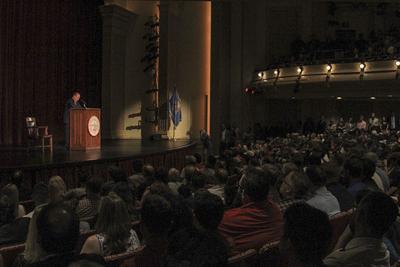
David Boren stood before a crowd in Holmberg Hall a little more than 23 years ago with great aspirations for OU — an honors college, a thriving international community, a diverse institution of leaders.
Wednesday, with many of these dreams realized, Boren took to the same stage before hundreds of students, faculty and staff and announced that his time as OU’s president — what he called the most rewarding period of his life — will soon come to an end.
Boren — 76 years old, with a distinguished career as a state legislator, governor and United States senator before moving to Boyd House — will retire as university president, effective June 30, 2018, pending the selection of his successor by the OU Board of Regents.
Boren said the decision was strategically timed to align with a period when the university is at what he believes to be its strongest point in history. Boren, who has struggled with health issues in recent years, including a heart surgery earlier this year and a herniated disk in 2005, also acknowledged that he is facing his own inevitable mortality.
“The calendar finally caught up with me — that’s the biggest thing,” Boren said. “I didn’t want to be president unless I could give every ounce of my energy to the job ... Time takes a toll on that, so I knew it was inevitable and I had to face it.”
The announcement sparked a widespread outpouring of gratitude for the leadership and vision exhibited by the man whose legacy is apparent in every dimension of campus — from the residential colleges housing nearly 600 upperclassmen in the heart of campus, to the 900 National Merit Scholars populating classrooms, to the 20,000 trees dotting all three of OU’s campuses.
Clarke Stroud, dean of student affairs, describes Boren’s legacy in one word: spectacular.
“To look back over the last two decades and see how far we’ve come — it’s just simply spectacular,” Stroud said.
No one could have foreseen the strides that would be made under Boren’s leadership, Stroud said, including OU’s recent ranking among the top 100 schools nationwide and top 50 public schools and the high quality of students and faculty members.
Keith Gaddie, chair of the political science department, said he has seen the university transform from one of disrepair when he first arrived into the thriving pinnacle of public education it has become today under Boren’s example.
“He started with the bones of a great university and he made it greater than anybody could have imagined,” Gaddie said.
Boren arrived at OU in 1994 with decades of public service under his belt. In his roles as governor of Oklahoma and U.S. senator, he championed education reform, fine arts programs, international outreach and bipartisan efforts.
Boren resigned his U.S. Senate seat two years early to accept the role as OU’s president, where he continued his dedication to the public sphere.
He initiated more than 30 new programs, among them the College of International Studies, an OU campus in Arezzo, Italy, the OU Health Sciences Center in Oklahoma City, OU’s University Research Park, a religious studies program and the Stephenson School of Biomedical Engineering.
These programs were the fulfillment of Boren’s visionary belief that the university could be a public school that offers as much intellectual challenge as any private institution.
“Because of you — because of the entire OU family — many of these dreams have already come true,” Boren said at a press conference Wednesday afternoon, reflecting on the decades of growth and success now behind him.
With the addition and renovation of more than 80 buildings and beautification efforts led by first lady Molly Shi Boren, OU’s campus has undergone a physical transformation that landed it recognition among the 25 most beautiful campuses nationwide.
Boren’s time at OU was defined by innovation, growth and success, but also shadowed by challenging circumstances and events, leaving him to deal with the consequences.
Boren, once one of the state’s most powerful politicians, has been unable to protect the university from state budget woes. Oklahoma has been in a severe budget crisis for the past few years, with state funding for higher education slashed by more than $30 million in the last year alone. Boren spearheaded 2016’s State Question 779, dubbed the “penny tax” measure, which would have added one cent to sales tax statewide with all of the profits going to education, but the effort was defeated in the November 2016 election.
The shrinking budget has been filled with consistent increases in tuition and fees and resulted in incentivized retirement programs for faculty and staff, even as the new Residential Colleges and the renovations to Oklahoma Memorial Stadium — projects that are worth hundreds of millions of dollars but funded through different means than educational expenses — were completed on opposite sides of Lindsey Street.
Boren has also taken national and local criticism in recent years regarding his response to violence against women. Most notably, Boren was part of the decision to let football player Joe Mixon remain on the OU team after breaking a female student’s jaw in 2014.
Boren faced protests from his own students following comments he made regarding a sexual assault study conducted by OU researchers that were seen by some to be victim blaming.
“Can we eradicate the problem? Not any more than we can eradicate human nature,” Boren said in reference to sexual assault in a 2016 article from The Daily — his comments leading to protests from students.
Brenda Tracy, a sexual assault survivor and advocate who has spoken at OU, said these comments were problematic and showcased a deeper misunderstanding of the issue of sexual assault.
“I did see some pretty tone-deaf comments regarding sexual assault,” Tracy said. “It looks like he’s done some really good work around different race issues, but I think when it comes to the topic of sexual assault, there is not a clear understanding of what was going on on campus and that he was placing the blame on women.”
Boren’s values and leadership were tested on a national stage during a 2015 Sigma Alpha Epsilon racist chant scandal. Two students left the university — Boren said he had expelled them, though that was later disputed — and the fraternity was kicked off campus, but there was also backlash from those who believed it was wrong to expel students over issues of free speech, including from The Foundation for Individual Rights in Education.
Boren said the incident was the most challenging situation he dealt with, but that the true identity of the university was made clear in the aftermath.
“That incident was going to define who we were, and when our students — on their own — spontaneously started marching, even in the dark — ‘not at our university’ — that’s not who we are,” Boren said at a press conference Sept. 20. “One of the things I’ve always felt here was great respect for student opinion, and I hope I’ve demonstrated that. I hope I’ve listened to students when I think they’ve deserve that.”
While the future of the university is not in Boren’s hands, there are qualities Boren wants to see in the next OU president — namely, a love of the university.
“Sometimes people regard being president of a university as a job, or maybe as a stepping stone, a line on a resume, or some other position,” Boren said. “I think that this place is worthy of all the love anyone can give it. I think someone who has a special feeling for OU, maybe someone who spent part of their own college career at OU — to bring someone like that here, because they already have the love of the university, they realize what a special place that it is.”
The realm of retirement holds a more outspoken future for Boren, who said he will be able to more freely express political opinions and stances he was previously unable to vocalize as president of a public institution.
“Sometimes when you’re president of the university, there are moments when you say — because you must be non-political — ‘I’d like to just tell them what I really think about that,’” Boren said. “So I’m definitely going to consider starting a blog after I retire as president so that I can tell people what I honestly think about what is best for the future of our state.”
Boren has, at times, been outspoken on politicized issues as president. Most recently, Boren voiced strong support for student-recipients of the Deferred Action for Childhood Arrivals program, and he has repeatedly expressed public disappointment about the failure of his penny tax initiative.
Boren’s future also holds more time for what he loves most: OU's students. Boren said even post-retirement, he will continue to teach at least one class a semester and be involved in students’ lives.
“My favorite part of the whole job is the time that I get to spend with students, and that’s sometimes frustrating because ... there are a lot of things going on, there are a lot of other duties that the president has, including trying to write a budget in these times, so I really look forward to having more time with the best part of the job, as that’s more time with students,” Boren said.
Molly Shi Boren said she and her husband felt the university would be secure moving forward without them in leadership, but that the couple will continue to be active at OU and “sitting on the sidelines cheering.”
“It’s been 23 wonderful years, and we’re not going anywhere,” Molly Shi Boren said. “David is still going to have an office, going to teach a freshman class in political science, and we feel very good about our decision. We feel the university is in a good place, we’re happy with our decision. It’s a good time for us, it’s a good time for the university, so all is good.”
Boren’s love and support for his students has been an inspiring example, said Kelly Damphousse, former dean of OU’s College of Arts and Sciences.
“He would tell stories about interactions he had with students and personal relationships he has with our students, and it was so inspiring to hear him talk about those things that it made me want to be a better professor and a better dean — because I wanted to live up to the idea that he was expressing in those moments,” Damphousse said.
Boren’s final words on that stage in Holmberg Hall reflected his utmost priority as he closed his address with a message to the people of OU.
“Serving as your president has been the most rewarding period of my life. So many of you in this room have rubbed off on me,” Boren said. “So many special friendships have been made. It’s impossible for me to express my appreciation to you. Thank all of you for making it so rewarding.”
“Because of you, as the chant says, our university will live on stronger than ever.”
Emily McPherson and Abby Bitterman contributed to this report.