
OU Women’s and Gender Studies Center for Social Justice held its “Imagining Social Justice Art Exhibition” Tuesday, intending to engage the community in social issues through creative expression.
The center aims to be a platform for social and ecological justice advocacy and awareness while offering opportunities for students to create positive change and understand the sources of inequality in their communities.
Director of Center for Social Justice Rodney Bates organized the exhibition with the main goal of sparking thought and conversation among students.
“I wanted to create an opportunity for students, faculty and staff to engage with pressing social issues through creative expression,” Bates said. “I wanted to give opportunities to artists and various creators to just explore art through a social justice component.”
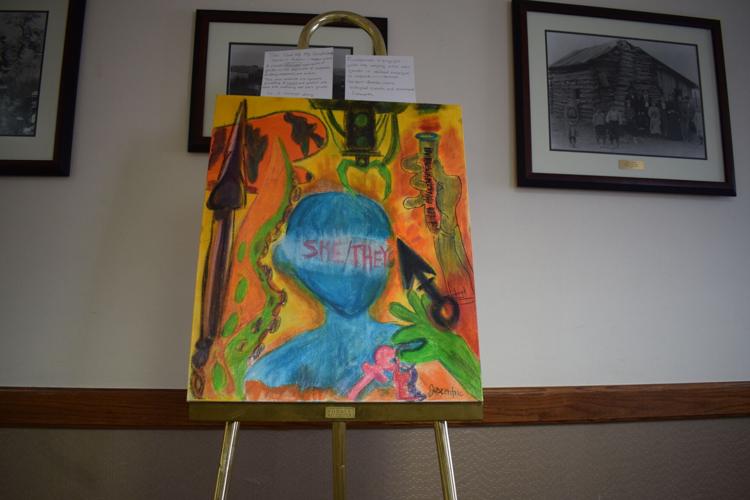
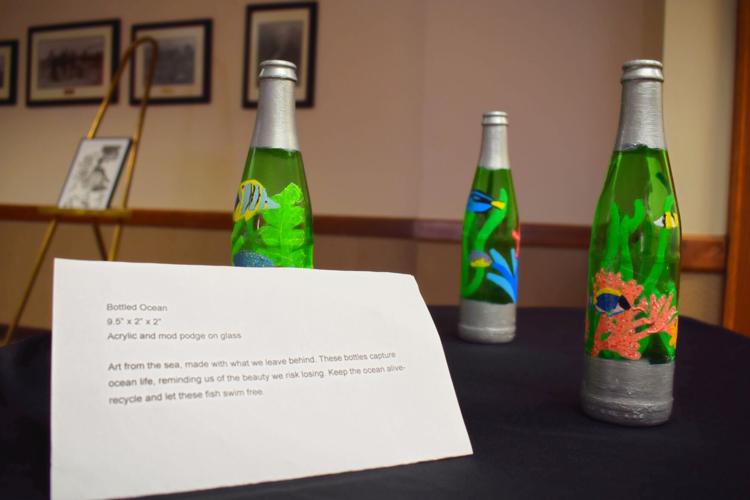
Consisting of art mainly from OU staff and students, the exhibition featured paintings, photography, mixed media and digital art submitted through an artist call in October.

Artwork on display during the "Imagining Social Justice Art Exhibit" on Nov. 19.
Bates said “Mosaic: Social Justice Symposium,” was one of the last social justice presentations held on campus with an arts focus. The symposium was last held in 2017. The idea for the exhibition came to Bates while researching other university’s centers for social justice, prompting conversation with OU colleagues.
“We were just kind of asking, ‘How do we have people have conversations without it being so charged?’” Bates said. “So the idea of just letting people look at art and having their own conversations with themselves might be the way to go.”
Many of the exhibition’s pieces explore themes of stigmas associated with gender and sexuality, including photographs from a protest at the Cleveland County Courthouse in February honoring Nex Benedict, a 16-year-old nonbinary student who died by suicide the day after a violent altercation with fellow students in a high school bathroom.
The exhibition comes nearly a year after Gov. Kevin Stitt signed executive order 2023-31 to formally review diversity, equity and inclusion programs in higher education in December.
In March, OU renamed the DEI office to the Division of Access and Opportunity in compliance with the executive order.
Bates said, given the political climate following the presidential election, he thinks people are fearful of conversations about social justice. Despite this, he said the uncertainty around such conversations makes them all the more necessary.
“I think people are really scared to engage in DEI … but people still long to have these conversations,” Bates said. “We can appreciate art even if we don't have the same values, and the ability to have freedom of speech doesn't always just mean words, it also means people being able to express themselves in art.”
Beyond conversation, Bates said he hopes not to change minds or political affiliations, but to raise consciousness for exhibit-goers beginning by asking questions about the art.
“I want people to be able to have conversations, ask questions and then go do research themselves,” Bates said. “It's really about are we asking ourselves questions, or are we just taking things at face value? I think that art always leaves room for interpretation, for the individual to continue to seek more information.”
This story was edited by Shelby Emery. Ryan Little and Sophie Hemker copy edited this story.


