
Oklahoma Festival Ballet opens this weekend with a mixed repertoire production of five pieces ranging from neoclassical ballet to contemporary styles.
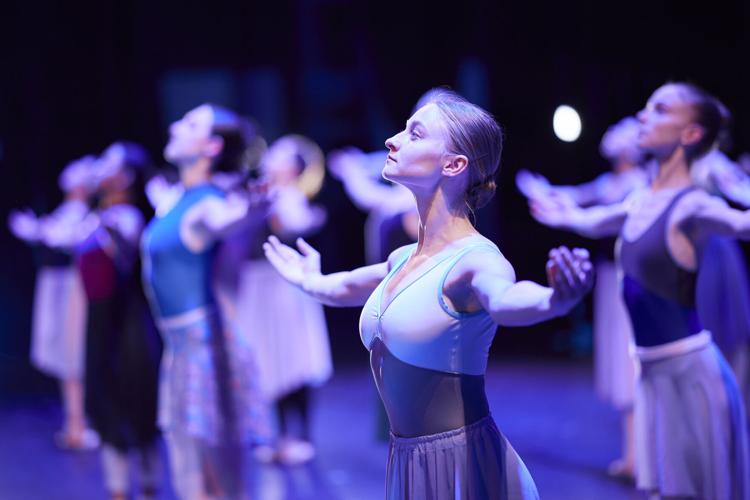
The show opens with an excerpt from a work that is a quintessential part of American ballet history, George Balanchine's “Serenade.” As co-founder of the New York City Ballet, Balanchine is often referred to as the "father of American ballet.” Balanchine’s works have been meticulously curated since his death in 1983.
“Serenade” was staged on the OU School of Dance by Jenifer Ringer, former New York City Ballet principal dancer and repetiteur of the Balanchine Trust.
The piece begins with very simple movement, done facing the audience and in unison by the 18 women. School of Dance Director Michael Bearden said that the simplicity of the initial movement is part of what makes the piece emotionally accessible to the audience.
“It's such a beautiful, almost a spiritual work,” Bearden said. “When the curtain goes up, you just feel like you feel like you're in dance church.”
School of Drama sophomore Kellen Sapp is the lighting designer for “Serenade,” “Antique Epigraphs,” and “Orphée.” Both “Serenade” and “Antique Epigraphs” had specific, but opposite requirements when it came to lighting design. Sapp said that the lighting for “Antique Epigraphs” needed to be distinctly different from the original, but that the “Serenade” lighting had to be representative of the original, which has been a new challenge.
“For designers it's sometimes challenging because, in the case of ‘Serenade,’ my name is going on this work, but I am beholden to tradition here in a way that I wouldn't be with a new piece,” Sapp said. “It's challenging to sort of like, let some of those like ideas about control go and focus on making it beautiful in the way that it was done the first time.”

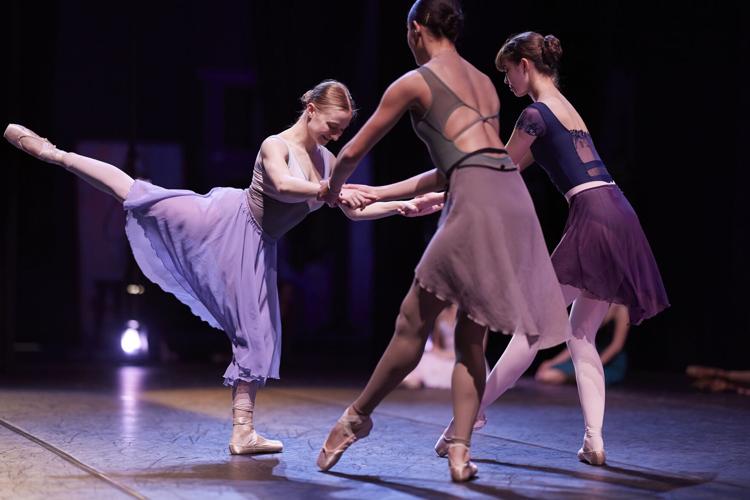
Delaney Gondo (right), Blaise Dagnen (center) and Darcey Lynn (left) in Jerome Robbins' "Antique Epigraphs."
As a designer, Sapp said that the most fulfilling part of creating the production has been seeing the design and movement come together.
“The exciting part here is that we are bringing lighting to the table and now we're finally seeing … dancers make that all come to life,” Sapp said. “Especially with ‘Antique Epigraphs,’ I had an idea in my mind, but I wasn't really sure how it would play out. That dance is just so beautiful, and all the work I do is about supporting that. But the exciting part is just seeing the dance.”
Created on the New York City Ballet in 1984, “Antique Epigraphs” is choreographed by Tony Award-winning choreographer Jerome Robbins. It features a cast of eight dancers and was staged by Ringer, who is also a repetiteur for the Jerome Robbins Trust. Bearden said that this is the first time the OU School of Dance has performed one of Robbins’ works.
“It's kind of another benchmark for our school to be able to do a work by such a well-known choreographer,” Bearden said. “And a choreographer who went outside of just concert dance, doing West Side Story, doing choreography for film, and choreography for Broadway.”
The statuesque and gestural movement and tunic-style costumes allude to Greek antiquity.
The piece is set to Claude Debussy’s “Six Épigraphes Antiques,” and is performed by School of Music faculty members. The live flautist and four-handed piano performance bring a contemplative and collaborative element to the work.
Ballet senior Eliza Harden performs in both “Serenade” and “Antique Epigraphs” and said she has enjoyed the collective energy of the two, all-female works.
“Almost all the women in the ballet department are in ‘Serenade,’ so that's really cool because it’s just girl power, it’s a group of strong women working together as a unit,” Harden said. “The same with ‘Antique,’ it's all women, and everyone's so strong and beautiful.”
Ballet is a very technically driven art form, and the training often lends itself to creating focus on uniformity and a desire for perfection that overshadows the emotional aspects of dance. Bearden said that “Antique Epigraphs” put a focus on individuality.
“‘Antique Epigraphs’ requires and develops the dancers to bring more of themselves to the work, their own thoughts and their own emotions,” Bearden said. “When Jenny staged the ballet, she said that Jerome Robbins, if he felt like a dancer was not being their authentic self, then he wasn't interested in working with them. In this piece, even though these women have this kind of unified feel, there's a lot of space in the choreography for each of them to bring themselves to the work.”
Harden also performs in “Train of Thought” by Yury Yanowsky. Originally created during the pandemic on Kansas City Ballet’s second company, “Train of Thought” is a dynamic work that incorporates lots of partnering and features brightly colored lighting and costumes. The piece was created for eight dancers, but Yanowsky expanded the cast so that he could work with more OU dancers.
“It was really cool working with Yury, because he didn't keep the choreography exactly the same as it was originally, he wanted to make it the OU version,” Harden said. “I thought that was cool how he was really flexible with kind of altering it for us.”

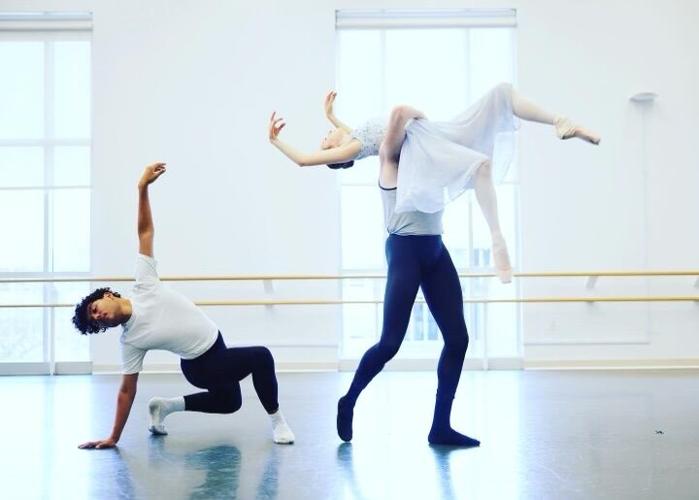
Susannah Major (elevated), Oscar Miller (right) and Christian Garcia (left) in Boyko Dossev's "Orpheé."
“Orphée,” by OFB Director Boyko Dossev is composed of four dancers, three male and one female, and incorporates lots of partnering work. The piece is performed as another collaboration with the school of music, and with three musicians and a vocalist.
The show concludes with a large group work by Penny Saunders called “Deux Amours,” French for “two loves.” The lighting and costumes comprise pink and purple hues as the atmosphere for the contemporary movement. Ballet performance freshman Joelle Kimbrough said that the style of “Deux Amours” is different from the others in the show.
“It’s a cool vibe to get into,” Kimbrough said. “I don't really know how to describe the vibe. It's more like, creative and like, kind of searching for something.”
The production displays a range of work from neoclassical ballet danced in pointe shoes to contemporary movement done barefoot. Harden said this year’s show in particular is accessible to the audience due to the spectrum of movement styles.
“It’s a really great show to come to if you've never seen a show before because it starts off with a very like, classical piece, the beautiful tutus and the pointe shoes, it's pretty much what people think of when they think of ballet,” Harden said. “As the show progresses, it kind of shows everything that dance and ballet can be. It’s really cool because it's like this really broad spectrum.”
Oklahoma Festival Ballet is at 8 p.m. on March 31, April 1, 6, 7 and at 3 p.m. on April 2, 8 in the Fine Arts Center’s Elsie C. Brackett Theatre. Tickets are available online and at the Fine Arts Box Office.
This story was edited by Silas Bales. Nikkie Aisha copy edited this story.


