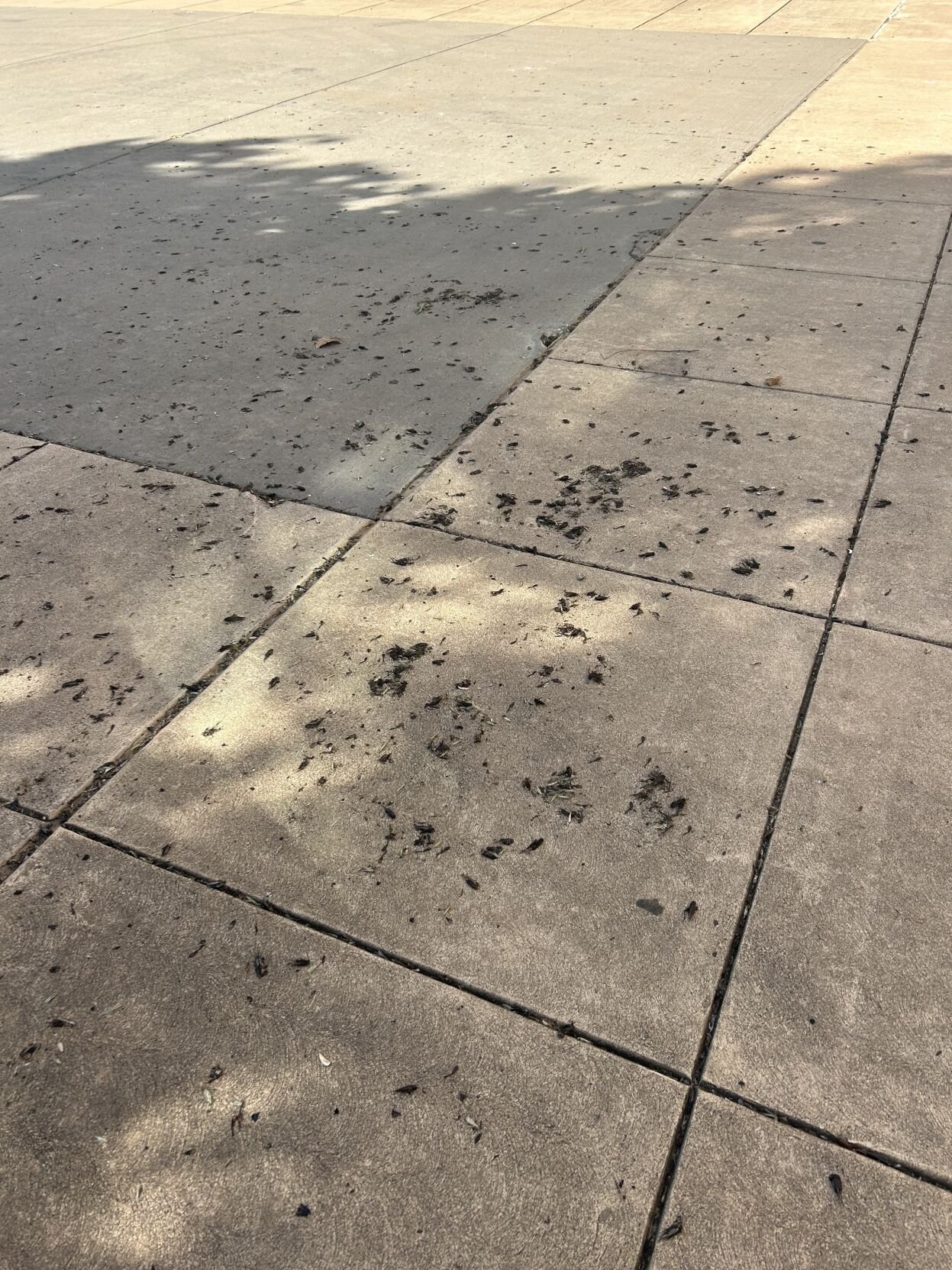


Every fall for the past decade, OU campus buildings have faced an annual cricket invasion.
Large numbers of jet-black field crickets can be found specifically in Gaylord College of Journalism and Mass Communication’s auditorium and hallways and the Asp Avenue Parking Garage during the early months of the school year.
These noisy critters are native insects to Oklahoma and normally seen in abundance in August and September.
Field crickets are attracted to light sources, making OU’s brightly-lit buildings appealing spots to gather, but are unable to survive once inside.
Kevin Hahn, Gaylord’s equipment and property manager, said the building’s structure and design attract overwhelming numbers of crickets.
“Gaylord has a lot more glass hallways and glass windows on the first floor than some of the buildings,” Hahn said. “Going down the hallway from the cage to the main lobby is a giant wall of glass. With all the lights on the building at night, it attracts all the crickets.”
Hahn said the structure of Asp Avenue Parking Garage contributes to its cricket levels in a similar way, with wide open spaces and ample lighting.
“They just get in there and follow the lights. It’s the only lit up building they can just walk in, hop in, fly in,” Hahn said. “I got buzz bombed two nights ago on a shoot. It flew across the room and hit me right in the face.”
The elevators in the parking garage often have a strong odor during heavy cricket seasons, a smell Hahn attributes to heaps of dead crickets.
“Sometimes, I feel like it's a shorter cricket season, but way heavier. And when it's those kinds of years, those are the years that you'll notice the parking garage elevator stink because the shafts are full of dead crickets,” Hahn said. “That smell is the bottom of the elevator shafts filled with crickets of parking garage.”
The cricket’s attraction to light that causes them to be drawn to the parking garage and Gaylord is due to their eye anatomy, which makes it easier for them to see in well-lit areas.
Brendan Morales, vice president of the OU Entomology Club — a group formed on the shared love of anthropods — explained that this phenomenon is due to the cricket’s compound eyes.
“They have very specialized sensors in their eyes that work differently than codes and rods in the human eye because they have compound eyes,” Morales said. “So they're focusing on what they can see, which are like different light levels, as opposed to color like we see. So higher light levels mean they can see better.”
Morales, newly appointed vice president this year, said he ran for the position due to his love for bugs, which extends to these campus crickets.
“I'm a huge proponent of, ‘If they're not hurting you, pick them up.’ I'll say that about any bug or spider,” Morales said. “As for my opinions on cricket species, there are some that are particularly worrying, but I have not seen any of them on campus.”
Entomology Club Communications Liaison Xander Margheim agreed that the campus crickets aren’t harmful.
“They're just little guys, and the only annoyance is just waste management, having to pick them up off all the sidewalks and all the buildings,” Margheim said. “But ultimately, they don't harm us, and it's really not that big a deal. They'll go away in the winter, they'll come back the next year.”
While Gaylord specifically seems to be a hub for crickets, these insects are all over campus in large quantities.
Hahn said other property managers on campus have noticed the bugs in their respective buildings when he asked during a meeting.
“All the building managers do a property management zoom call once a quarter. While we were on there, I kind of made a little sidebar conversation on the chat, off topic, is anybody else really struggling with it,” Hahn said. “Evans Hall, Wagner, a couple others chimed in and said, ‘Yep.’ So some buildings are definitely gonna get it worse than others, but it's a campuswide problem. We got crickets.”
While there are no current measures put in place to prevent the crickets, Hahn said the cleaning crews regularly sweep and keep the cricket numbers contained, just out of sight of students.
“Our pest control has traps put in certain places in the building,” Hahn said. “We don't really have traps out where the main students are, like the poison boxes and stuff like that.”
Despite the cleaning, Hahn said many cricket bodies can be found in areas that aren’t regularly cleaned out.
“There have been times where we've done a big clean of one of the big garage or storage spaces, and we have several years (worth) of crickets,” Hahn said. “Because nobody's done a full clean.”
This season has been a lighter but longer cricket season than normal according to Hahn, which matches this summer’s weather patterns.
The temperature in summer directly affects the number of crickets, as a hot season can accelerate their breeding cycles and growth.
The field crickets then emerge from their burrows in the early fall, when the cooler and wetter climate suits them best.
Morales explained this summer’s temperature can explain why fewer crickets are appearing this year, as it was less hot and moist than years past.
“With it being sort of a milder summer, we had relatively few days over 100 degrees, lots of days in sort of the upper 80s, lower 90s and just generally not a lot of rainfall,” Morales said. “It's been a bit harder for crickets this year. So probably a relatively low year, I would say.”
Hahn mentioned that despite the lower numbers, this season of crickets seemed longer than normal, which checks with the hotter temperatures continuing into October, as Margheim explained the crickets dislike extreme cold.
“The only thing that really stops them from coming out is winter. It's too cold,” Margheim said.
Once winter comes, the crickets will slowly disappear, but they will return when it warms up and every cricket season after for years to come.
This story was edited by Madisson Cameron. Kylie Caldwell, Hannah Lambert and Avery Avery copy edited this story.


