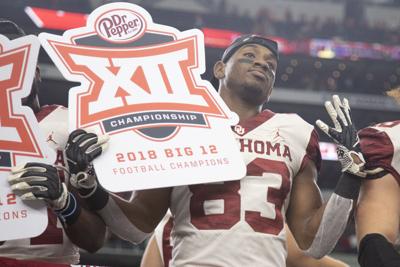

As Nick Basquine watched the racist video that involved one OU student videoing another student painting her face black and saying a racial slur, he shook his head in anger. But while the fifth-year Oklahoma wide receiver was frustrated, he wasn’t surprised.
“I guess I wasn’t naive or oblivious to the reality that that’s still on our campus,” Basquine told The Daily Saturday after agreeing to speak on the matter. “I’m just disgusted that stuff like that is still socially accepted on our campus … I know it’s not sitting too well with the team right now. They’re disgusted, too.”
Rewind three years, nine months and 24 days.
On March 8, 2015, a video surfaced of two Sigma Alpha Epsilon members leading a chant with the words, “There will never be a n----- in SAE.” In the aftermath of the SAE video, the Oklahoma football team was one of the leading voices in change, with then-senior linebacker Eric Striker leading the charge. Basquine, a freshman at the time, remembers the leadership many of the football players displayed and hopes to follow in their footsteps.
Basquine agreed to speak to The Daily despite the football team’s usual policy of having to go through the athletic department for media inquires. He felt it was important for him to represent not only his teammates, but also the student body. He understands the weight athletes — specifically football players — hold on a campus such as OU’s.
And he’s not going to stay quiet.
“It’s very important,” said Basquine, a Norman native. “We’re one of the few people on campus that have that platform. It’s not exclusive to us, student athletes, it’s for everybody on campus. But we have one of the biggest voices so we need to use it appropriately.”
'I encourage them to not be afraid to speak their mind.'
Just 53 days after Lincoln Riley was named Oklahoma’s offensive coordinator, Riley, like Basquine, was staring racism in the eye as the football team became one of the most listened-to voices on campus. And much like they often do on the football field, they came together for a greater purpose.
He joined his new team arm-in-arm and dressed in black as they canceled spring practice the day after the SAE video went viral, marching from Owen Field to the Everest Center. It’s a day Riley will never forget and a day he will forever use as an example of how a group of people came together for the better.
“The changes on our campus since the SAE event three years ago, I don’t know if they would have happened as fast or aggressively had that not happened,” Riley said Sunday. “There were so many positives that stemmed from that, that I was just proud of the way Bob (Stoops), our players, not just football but the athletic community, the entire campus responded to that and handled that. It really felt like in a lot of ways to me, and I was the new guy in town at that point, you could feel it bring everybody together and raised awareness. It became a positive.”
Riley reached out to numerous players on the team after Friday’s video surfaced. He said he was disgusted by the video, saying “it’s sickening. You hate it. On every level.”
Many of the players voiced their frustration with the situation on social media, specifically about how the university handled the situation. Kenneth Murray, Neville Gallimore and Marquise Overton all shared similar tweets, sharing their anger with how the situation was handled.
But it was senior cheerleader Tatum Texada who maybe had the most striking and heartfelt post.
“Today I will compete not for my university, but for me,” Texada wrote in a tweet. “I’m often approached with the question: Why do you cheer at OU? For that one little black girl in crowd who looks down and sees someone who looks like me. Racism is wrong. Actions speak louder than words.”
Today I will compete not for my university, but for me. I’m often approached with the question: Why do you cheer at OU? For that one little black girl in crowd who looks down and sees someone who looks like me. Racism is wrong. Actions speak louder than words. #BetterTogether pic.twitter.com/8G0656lIKu
— tates (@TatumTexada) January 19, 2019
Riley has no problem with his players speaking their minds — he encourages it. He understands the importance of his team responding to an incident of this magnitude.
“I’m proud of them. That’s part of coming to college, is learning to speak for yourself and learning to weigh in on values. That’s a part of being an American citizen,” Riley said. “I think our guys have done a great job. I encourage them to not be afraid to speak their mind.”
At his press conference Sunday, Riley was expecting to be asked about his new grad-transfer quarterback Jalen Hurts and his new defensive coordinator Alex Grinch. But the racist video had to be addressed.
“You always want to see it get better, and I think we’ve got some guys on our team that are absolutely going to make this place better,” Riley said. “The one thing I know, and I don’t know if I would have enough appreciation for this had I not been here two or three years ago when we had a similar incident, I’ve seen this university, community, players on our team, staff members, athletic administration, I’ve seen people take a situation like this that is ugly and turn it into a beautiful thing.”
'What does the apology do?'
Basquine admits this situation is different than SAE, but the root of the problem is the same and that’s what saddens and angers him most. He will continue to speak his mind in hopes that other students, not just athletes, will do the same.
“We always talk about the student athlete and how (students are) cheering for us because we’ve got the jersey on, but after that, they look at us like this,” Basquine said. “But I think it’s more so for the people in class and the ones walking across campus. What about the girl that they’re partnered with in geology lab? How does she feel?
“This time, I think we need to look more at the regular student.”
OU is a predominantly white school, with less than 20 percent of full-time faculty being people of color. During the 2018 fall semester, 5.1 percent of the 26,165 OU students were African American. Of the 111 players on Oklahoma’s 2018 football roster, 73 were African American.
As a former walk-on pursuing a degree in adult and higher education, Basquine is familiar with overcoming obstacles. He views this video no different and hopes he, his peers and the university will handle it appropriately.
“Even though it’s an emotional deal for a lot of us that are a minority, you can’t let that get in the way of getting the point across of why it’s not OK,” Basquine said. “We want to see change. There needs to be zero tolerance for racism.”
Since the video has surfaced, OU President James Gallogly has condemned the two students — Francie Ford and Olivia Urban — and said they have offered to apologize, while the Tri Delta organization has removed Ford for filming the video. Gallogly is also holding a press conference Monday afternoon addressing the video publicly.
“I’m very confident that everybody involved is going to work to make this happen the same way, where change continues to happen and we all continue to work together,” Riley said. “I know it puts the university in a tough situation, but President Gallogly and everybody else will be behind all of our students and there to support them, and we certainly want to support them as well.”
As for Basquine, he hopes to see more action taken, because right now, an apology doesn’t cut it.
“I know their hands are kind of tied right now,” Basquine said, “but at the same time, just saying they offered to apologize — what does that mean? We’ve already seen this happen on our campus and now it happens again…
“What does the apology do?”


