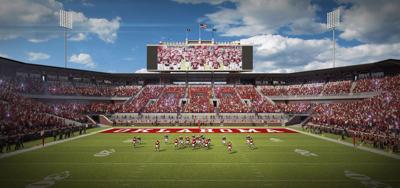
When plans to renovate Gaylord Family-Oklahoma Memorial Stadium were released last summer, the improvements to the structure were to cost $360 million.
The original plan included renovations to the west-side deck and press box as well as improvements to stadium infrastructure. Oklahoma also planned to add a continuous concourse that wrapped around the entire stadium.
However, after the Oklahoma oil crisis, the school scaled back plans. As it stands, Oklahoma is set to go through with $160 million-worth of the proposed renovations, or just 44 percent.
Oklahoma President David Boren cited falling oil prices as the reason behind the scaled-back stadium plans.
“In one week, half of the net worth of our major donors was wiped out by the falling oil prices,” Boren said. “You’re sitting there, somebody’s worth however-many millions dollars … three days later, they’re worth half that. That’s exactly what happened.”
The renovation will now take place in phases, Oklahoma athletic director Joe Castiglione announced at a Board of Regents meeting on March 10. The first facet of the project will focus on bowling the south end zone as well as adding new suites and club seating.
The first phase is scheduled to be completed by the beginning of the 2016 football season. Boren described the new plans as “focused and frugal.”
“Not one penny of state money,” Boren said. “Not one penny of tuition dollars or student fees. It's all coming from private gifts and athletic department-generated revenue.”
Bond funds will further contribute to financing the plans, according to Castiglione. The bonds will be funded through ticket revenue, which will provide a conservatively-estimated $5 million per year. Higher ticket prices from suites and club seats will generate an additional $12 million.
"People are still having a very difficult time with the budget for all state agencies this year because of the energy price situation and others,” Boren said. “We’re going to have tough times with the university budget, tough times with a lot of our fans.”
The stadium capacity, currently at 82,112 seats, will increase to more than 84,000 seats after phase one. The new south end zone structure will feature 22 suites, 60 open-air loge boxes and 1,976 club seats.
However, future building projects and adjustments to seat width and handrails could bring the new number back down to present-day levels, according to Boren.
The new south end zone facility will feature a new locker room, weight room with conditioning field, training room, nutrition center and meeting rooms, as well.
The second phase will replace the press box and west side deck. However, Boren said because of the present volatile nature of Oklahoma’s economy, he did not know when it will be green-lit.
“This is a 30-year bond, too,” Boren said. “And in the course of 30 years, oil prices are going to be up and down. I think the important thing is you need to be able to stress-test the project. In other words, that’s why you want the cushion on the annual revenue.”
Boren said his chief concern with the stadium renovations is making sure the university can pay off what it spends.
“I really don’t want my reputation to be — and I don’t want the university’s reputation to be — joined with anything about financial instability and [not] doing the right thing financially,” he said.


